
Qwello’s Up to €55m Equity Follows Up to €65m Debt
Qwello’s up to €55m equity follows up to €65m of debt as its latest public accounts show a €4.44m loss, framing a capital-intensive roll-up.
On this page
Conduct your own private market research
Add dossaro to Claude or ChatGPT and run source-backed register research from your own workspace.
 Add to Claude
 Add to ChatGPT
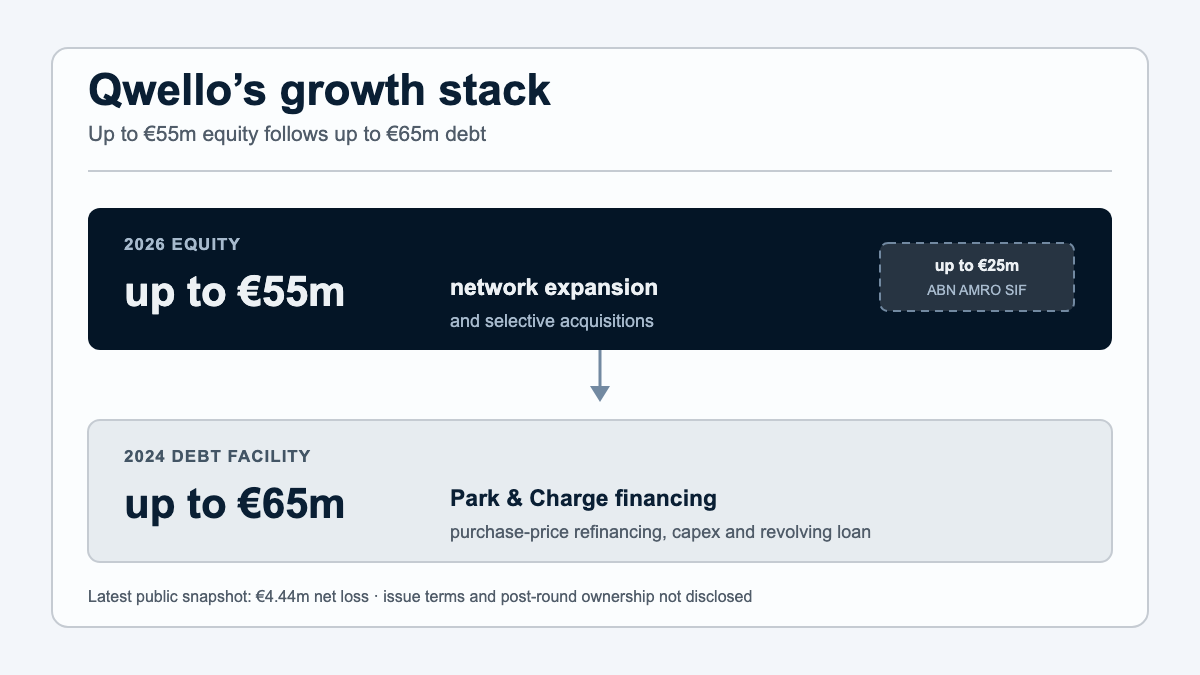
Qwello’s up to €55m growth-equity investment is arriving on top of a financing stack that already included up to €65m of acquisition, capex and revolving debt. The latest public company snapshot still shows a €4.44m net loss. The result is not a simple venture repricing. It is a balance-sheet financing story for a capital-intensive infrastructure roll-up.
Qwello said on 26 October 2026 that ABN AMRO Sustainable Impact Fund could invest up to €25m alongside a similar amount from Tiger Infrastructure Partners and other existing shareholders. The money is earmarked for organic expansion of the public charging network and selective acquisitions. In September 2024, ABN AMRO and Investec had already arranged up to €65m after Qwello acquired Dutch charge-point operator Park & Charge. That earlier facility included refinancing part of the purchase price, a capex facility and a revolving loan.
The public record supports a precise conclusion: Qwello is layering equity on debt to finance network growth and acquisitions while its last available accounts still show a loss. It does not disclose the new issue price, share count, class, investor allocation or post-money ownership. Those missing terms prevent a safe conclusion about dilution, valuation or control.
The new equity is tied to an infrastructure expansion plan
Qwello’s announcement describes an equity investment of up to €55m, not a single paid-in amount. ABN AMRO Sustainable Impact Fund can provide up to €25m. The remainder is described as a similar amount from Tiger Infrastructure and other shareholders, with the announcement naming Tiger as a long-standing financial partner. Qwello says the funding will support the continued expansion of its charging network across European cities and selective acquisitions that fit its operating model.
The operating footprint is already substantial. Qwello says it operates more than 19,500 charge points across more than 800 municipalities in Denmark, France, Germany, the Netherlands, Poland, Sweden, Spain and the United Kingdom. It also says the network runs on renewable energy and that it avoided more than 28,000 tonnes of carbon dioxide in the previous year. Those are company statements about current operations, not a filed valuation or an audited forecast.
What matters financially is the combination of recurring infrastructure investment and M&A. A charge-point operator must fund equipment, installation, grid connection and working capital before the full operating return is visible. Acquisitions can add sites and operating capability faster, but they also bring purchase-price funding and integration risk. Equity gives Qwello capacity to absorb that buildout. It does not, by itself, show that the business has reached a self-funding scale.
The 2024 debt facility changed the starting point
The €65m debt announcement came after Qwello’s acquisition of Park & Charge, which closed in May 2024. The facility from ABN AMRO and Investec included refinancing of part of the acquisition purchase price. The refinanced amount could be redeployed into European expansion, while a capex facility and a revolving loan provided further funding for Park & Charge’s growth.
That structure is more than a historical footnote. It means the 2026 equity is not funding a company with an empty balance sheet. It follows a financing package designed to combine an acquisition with future network investment. The debt can accelerate rollout when charge-point utilisation and municipal concessions are growing, but the company must still service it while sites mature. The equity can support expansion and acquisitions without placing every new investment on the revolving facility.
| Date | Financing event | Commercial role | What the public record does not show |
|---|---|---|---|
| November 2021 | Tiger Infrastructure announced a €50m investment in Qwello | Early growth capital for the charging-infrastructure platform | Share class, price and resulting ownership |
| May to September 2024 | Park & Charge acquisition followed by up to €65m debt from ABN AMRO and Investec | Refinanced part of the purchase price and added capex and revolving capacity | Drawn amount, maturity, covenants and security package |
| 26 October 2026 | Up to €55m growth equity from ABN AMRO Sustainable Impact Fund and existing shareholders | Funds organic network growth and selective acquisitions | Paid-in amount, issue terms, allocation and post-money ownership |
The sequence describes a financing model: an infrastructure platform uses equity for strategic capacity and debt for asset and acquisition funding. It is not evidence that one instrument is replacing the other. Nor does it establish that the new equity repaid the 2024 facility.
The latest accounts still show a loss-making public snapshot
The latest public company snapshot available for Qwello GmbH gives a different view from the upbeat expansion language in the announcement. It reports €114.31m of assets, €88.21m of equity and €25.64m of liabilities. It also reports a €4.44m net loss and 42 employees. The figures are a historical snapshot, so they cannot be treated as a 2026 run-rate or as proof that the new round was defensive.
They do, however, put the financing in an economically useful frame. Qwello’s assets and equity base are large relative to its employee count because the business owns, finances or operates physical infrastructure through municipal arrangements. The loss shows that growth capital is still being deployed while the business is scaling. Equity investors may be underwriting future utilisation, concession density and operating leverage rather than current profitability.
| Latest public snapshot | Amount or count | How to read it |
|---|---|---|
| Assets | €114.31m | A balance sheet carrying a physical infrastructure footprint |
| Equity | €88.21m | The reported equity base before the 2026 investment |
| Liabilities | €25.64m | Reported obligations before any new equity terms are known |
| Net result | €4.44m loss | The latest snapshot is not a proof of current profitability |
| Employees | 42 | A small reported headcount beside a capital-intensive operating model |
The numbers do not reconcile the €55m headline to a valuation. They also do not show how much of the 2024 debt was drawn, whether Park & Charge was fully consolidated, or how the 2026 investment will be recorded. Their value is narrower: they show why Qwello’s expansion requires a capital stack that can support assets before the full return appears in earnings.
The ownership record is informative but not a post-round cap table
The latest public ownership snapshot names TIP Charging Holdco Ltd with 58.9%, Green Railway Technologies with 36.0%, Alpha Future Funds with 2.5% and six other shareholders. It predates the 26 October announcement. The snapshot does not establish that TIP Charging Holdco is Tiger Infrastructure Partners, and the public material does not identify the ultimate beneficial owners behind every holder.
That distinction matters because existing shareholders are participating in the new round. Their participation could preserve positions, increase them, or sit alongside a new class of growth equity. The announcement gives no share count, issue price, rights or allocation. Without those terms, the named percentages should not be rolled forward as though they were the post-money cap table.
The 2021 Tiger announcement adds useful history. Tiger said it was investing €50m in Qwello and described the firm as a builder, owner and operator of public charging infrastructure. The 2026 release says Tiger has supported Qwello since 2021. Together, the announcements establish a continuing relationship, but not the legal identity of every current shareholder or the control rights attached to the new investment.
This is the same analytical separation visible in Smile2Impress’s EIB debt stack, where a debt headline needed to be read against the lender’s priority and use-of-proceeds structure. Hansetherm’s seed ownership reset shows the equity-side version: the amount raised does not answer who owns or controls the company after the issuance. Qwello’s public record leaves both questions open.
Growth equity can be the bridge between rollout and consolidation
There is a straightforward benign reading of the financing. Qwello may have built a repeatable charging model, used debt for identifiable assets and purchase-price refinancing, and now raised equity to expand its network without overloading the asset facilities. Existing shareholders may be supporting a growth plan whose commercial logic they already know. The €4.44m loss may reflect a company still investing ahead of utilisation rather than a financing emergency.
The more demanding reading is that the business needs fresh equity because a debt-backed roll-up is expensive to scale. Acquisitions add sites and customers, but they also add integration costs and financing obligations. If utilisation, concession wins or operating margins lag, the equity round may be carrying more of the growth risk than the announcement’s expansion language suggests. The public record cannot choose between these readings because it does not provide current revenue, cash flow, drawn debt, maturity dates or the terms of the new shares.
For investors, lenders and acquisition counterparties, the commercial question is therefore not whether Qwello raised €55m. It is how much capital is actually committed, where it sits in the priority stack and whether the company can turn a larger installed base into cash generation. A signed commitment of up to €55m is valuable capacity, but it is not the same thing as €55m of paid-in equity.
The next filings should settle the financing question
The next decision-changing records are the 2026 shareholder resolutions, the updated articles or capital filings, and Qwello’s next accounts. They should show whether a new share class was issued, the nominal capital change, the paid-in amount and any disclosed premium. Debt documents or subsequent accounts would help establish the drawn amount, security and maturity of the 2024 facilities. An updated ownership record would show whether the existing percentages survived the equity investment.
Until those documents appear, the defensible thesis is clear but bounded. Qwello is financing a European charging-infrastructure roll-up with two layers of capital: up to €65m of acquisition and growth debt arranged in 2024, followed by up to €55m of growth equity in 2026. Its latest public accounts still show a €4.44m loss. The evidence supports a story about capital intensity and risk allocation, not a claim about valuation, dilution or who controls the company after the round.
Sources
Continue reading
Related Research
Impress’s €40m EIB Loan Adds a New Layer to Existing Venture Debt
Impress’s €40m EIB loan sits beside outstanding Trinity charges, while older lender security was satisfied in January, making the debt stack visible.
Hansetherm’s €10m Seed Put Two Near-25% Blocks at the Center of Its Cap Table
Hansetherm’s €10m seed created 65,429 new shares, putting two less-visible blocks near 25% each while G-FUND holds 2.11% before scale-up plans.
Rabot Energy's $50m Series B Reweighted Its Investor Coalition
Rabot Energy's public €50m Series B maps to 26,816 new shares in RABOT Charge, diluting Rabe Venture from 21.90% to 16.34% on issued shares.
CarbonFarm's €7m Series A Left a Two-Tranche Equity Trail
CarbonFarm's €7m Series A left two 2026 equity tranches and €3,904.96 of capital, but public acts do not map named investors to legal positions.