
Hansetherm’s €10m Seed Put Two Near-25% Blocks at the Center of Its Cap Table
Hansetherm’s €10m seed created 65,429 new shares, putting two less-visible blocks near 25% each while G-FUND holds 2.11% before scale-up plans.
On this page
Conduct your own private market research
Add dossaro to Claude or ChatGPT and run source-backed register research from your own workspace.
 Add to Claude
 Add to ChatGPT
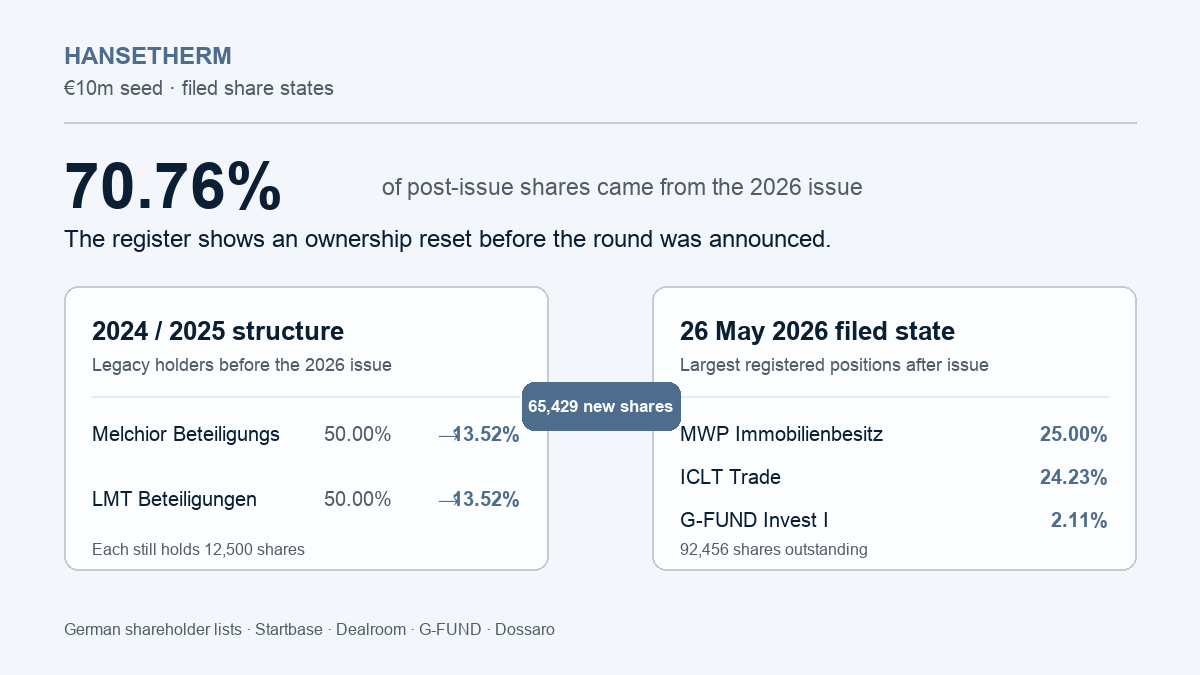
Hansetherm’s €10 million seed did more than give a heat-pump installer room to expand. A filed German shareholder list shows that the April 2026 capital increase created 65,429 of the 92,456 shares now outstanding. Two vehicles, MWP Immobilienbesitz GmbH and ICLT Trade GmbH, hold 25.00% and 24.23% respectively. G-FUND Invest I GmbH & Co. KG, the investor named in public coverage, holds 2.11% in the same list.
The result is an ownership reset, not simply a larger version of the 2024 structure. The two companies that each held half of hansetherm in 2024 now hold 13.52% each by issued share count. The new issue represents 70.76% of the post-increase shares and contains a broad group of funds, holding companies, real-estate vehicles and individual subscribers.
Public reporting says the round was signed in April, closed in May and announced on 22 October. It names G-FUND, companies from the real-estate sector and founders Leon Thomsen and Konstantin Lennertz as investors, but it does not disclose the allocation or valuation. The filing supplies the missing ownership shape. It does not disclose the cash premium paid for the shares or the governance rights attached to each block.
The filing turns a €10m seed into an ownership event
Startbase reports that hansetherm completed a €10 million seed round, with the transaction signed in April 2026 and closed in May. Dealroom’s independent account gives the same timing and says the company did not publish a valuation or investor-by-investor breakdown. The company plans to add staff, expand its installation capacity and develop proprietary software while extending its offer beyond heat pumps.
The German Handelsregister adds a different kind of precision. Hansetherm GmbH, Hamburg HRB 174065, had €27,027 of share capital after a 2025 issue. The shareholder list dated 26 May 2026 records €92,456 of capital and 92,456 shares. The difference is 65,429 shares, all created in the 14 April 2026 capital increase.
| Filed state | Total shares | What changed |
|---|---|---|
| August 2024 | 25,000 | Melchior Beteiligungs and LMT Beteiligungen held 12,500 shares each |
| April 2025 | 27,027 | HEIM & HAUS subscribed for 2,027 new shares |
| April to May 2026 | 92,456 | 65,429 new shares created for the latest syndicate |
That is a 242.15% increase on the 27,027-share pre-round base. The new shares account for 70.76% of the post-issue total. These are nominal share-capital figures, not a €65,429 cash description of a €10 million round. A German limited company’s filing can show the nominal value while the subscription premium and wider financing terms sit in the underlying agreements.
For investors, the distinction is important. The public headline identifies the amount of financing. The register identifies the legal positions that were created. The two numbers belong to the same event in the chronology, but they answer different underwriting questions.
Two less-visible blocks now carry the legal weight
The 30 April 2026 subscriber list names the recipients of all 65,429 new shares. MWP Immobilienbesitz GmbH received 23,114 shares, exactly 25.00% of the post-issue total. ICLT Trade GmbH received 22,403 shares, or 24.23%. Together, the two blocks represent 49.23% by issued share count.
The same list records 1,953 shares for G-FUND Invest I, equivalent to 2.11%. Other subscribers include Climate-Tech Fund I, a series of Voyagers Funds, HEIM & HAUS Holding, EBK Verwaltung, Lynxcon, Aquarius 024, Balde, Aturas, Nymphenburger Beteiligungs, MCH Management Capital Holding, CBS Ventures and several individuals. No single public source reviewed for the round assigns a valuation, subscription premium or voting agreement to those positions.
This changes the investor map in the public story. Startbase’s report highlights G-FUND, real-estate companies and the founders. G-FUND is present in the filed list, but its direct registered position is small compared with MWP and ICLT. The register does not connect MWP or ICLT to the named founders, and the names of the ultimate owners behind those companies are outside the evidence used here.
The practical implication is not that G-FUND is unimportant. A small direct share count can sit beside board rights, side agreements or a fund-level relationship that the public shareholder list does not describe. The hard fact is narrower: the largest filed blocks are not the investor names most visible in the public announcement.
The old structure was diluted, not simply topped up
In August 2024, Melchior Beteiligungs GmbH and LMT Beteiligungen GmbH each held 12,500 shares, or 50% of hansetherm. The April 2025 issue added 2,027 shares for HEIM & HAUS Holding GmbH. Melchior and LMT still held 12,500 shares each, but their individual positions fell to about 46.3%.
The 2026 issue changed the scale of that dilution. The two earlier holders still have 12,500 shares each, yet each now represents 13.52% of the enlarged total. Combined, they hold 27.04% by share count. HEIM & HAUS, which had 2,027 shares after the 2025 issue, now holds 5,045 shares, or 5.46%.
The filings do not establish who ultimately owns Melchior or LMT, nor do they turn issued-share percentages into a complete voting or fully diluted ownership map. They do establish that the former two-company structure no longer dominates the registered share count. Operational continuity sits elsewhere: the current extract names Leon Thomsen and Konstantin Lennertz as the two managing directors.
The distinction between management and ownership is useful for a business that sells a hands-on service. Hansetherm says it has installed more than 1,000 heat pumps and employs 90 people. Its model combines planning software with its own teams and a network of qualified tradespeople. The company’s managers remain visible, while the capital base has widened into a syndicate whose largest legal blocks are held through corporate vehicles.
The timing creates a financing question, not a motive claim
The round was reportedly signed in April, closed in May and announced in October. That five-month gap is unusual enough to matter for diligence, but it does not explain itself. A company may align a financing announcement with a product launch, an operating milestone or a broader communications plan. The chronology alone cannot establish a reason.
What the dates do show is that the ownership reset was legally in place before the public announcement. The subscriber list and the shareholder list are dated 14 April and 26 May 2026. The public story arrived later, after the company had already moved from a 27,027-share capital base to a 92,456-share base.
That sequence puts a specific question in front of investors and future counterparties: why was a round that created most of the current share count announced only after the closing, and which terms were agreed in the April documents? The answer could be routine communications timing. It could also clarify whether the €10 million amount was delivered through subscription premiums, related instruments or a combination of investor commitments. The public sources do not settle that capital bridge.
What the reset changes for future investors
Hansetherm is positioning heat-pump installation as the entry point to a wider residential-energy service. Its own site describes a package that combines consulting, planning, financing support, installation and maintenance, with future expansion into photovoltaics, air conditioning and battery storage. G-FUND’s portfolio page lists hansetherm under its energy and clean-tech investments while describing a broader consumer and operational thesis.
That model needs more than software scale. It needs installation capacity, working capital, supplier coordination and a repeatable customer-acquisition engine. The share issue matters because it appears to have financed a platform with many capital providers rather than a simple two-holder company. For a later investor, the relevant diligence is therefore not only how much was raised. It is who can block decisions, which investors have follow-on rights and whether the two 25% blocks act independently or together.
The public information leaves those rights open. The share register answers the question of who received the new nominal positions. It does not answer how the €10 million was priced, what premiums were paid, or whether any subscriber has contractual rights beyond the registered shares. The next confirmation statement, articles filing or shareholder agreement disclosure would be the decision-changing evidence.
The comparison with other European climate-tech rounds is instructive. 1KOMMA5°’s financing record shows why a funding headline cannot be treated as proof of fresh primary capital at the principal company. Reflex Aerospace’s filed ownership state likewise separates a planned strategic investment from a completed cap-table change. Hansetherm’s case sits between those patterns: the issue is already visible, but its economic price and rights are not.
The public seed headline says scale. The filing says ownership was rewritten before the announcement, with two corporate blocks at the center of the registered company and the previously dominant holders reduced to a minority position by share count. For investors, the next document to watch is the one that connects those blocks to their subscription economics and governance rights. That is where the €10 million headline becomes an underwritable capital story rather than only a growth signal.
Continue reading
Related Research
1KOMMA5°'s €70m Round Arrived With a Founder-to-G2VP Share Transfer
1KOMMA5° announced €70m at a $1.35bn valuation, but its latest Hamburg shareholder list still shows €74,911 capital and a 300-share founder transfer.
Reflex Aerospace's Planned NVIDIA Investment Has Not Yet Reset Its Filed Cap Table
Reflex Aerospace announced a planned NVIDIA minority investment, yet its latest filed list still shows Alpine at 47.43% and Ballheimer at 30.75%.
Salience Labs’ $125m Series B Was Split Across 23 Allotment Lines
Salience Labs’ $125m Series B spans 23 UK allotment lines worth about £125m, while Oxford Science Enterprises left the PSC record before the issue.
Hynamics’ Hy24 Sale Follows a €79m Capital Reset
Before EDF agreed to sell Hynamics to Hy24, the hydrogen subsidiary reset €79.5m of capital, took €21m more and simplified its group structure.