
Hynamics’ Hy24 Sale Follows a €79m Capital Reset
Before EDF agreed to sell Hynamics to Hy24, the hydrogen subsidiary reset €79.5m of capital, took €21m more and simplified its group structure.
On this page
Conduct your own private market research
Add dossaro to Claude or ChatGPT and run source-backed register research from your own workspace.
 Add to Claude
 Add to ChatGPT
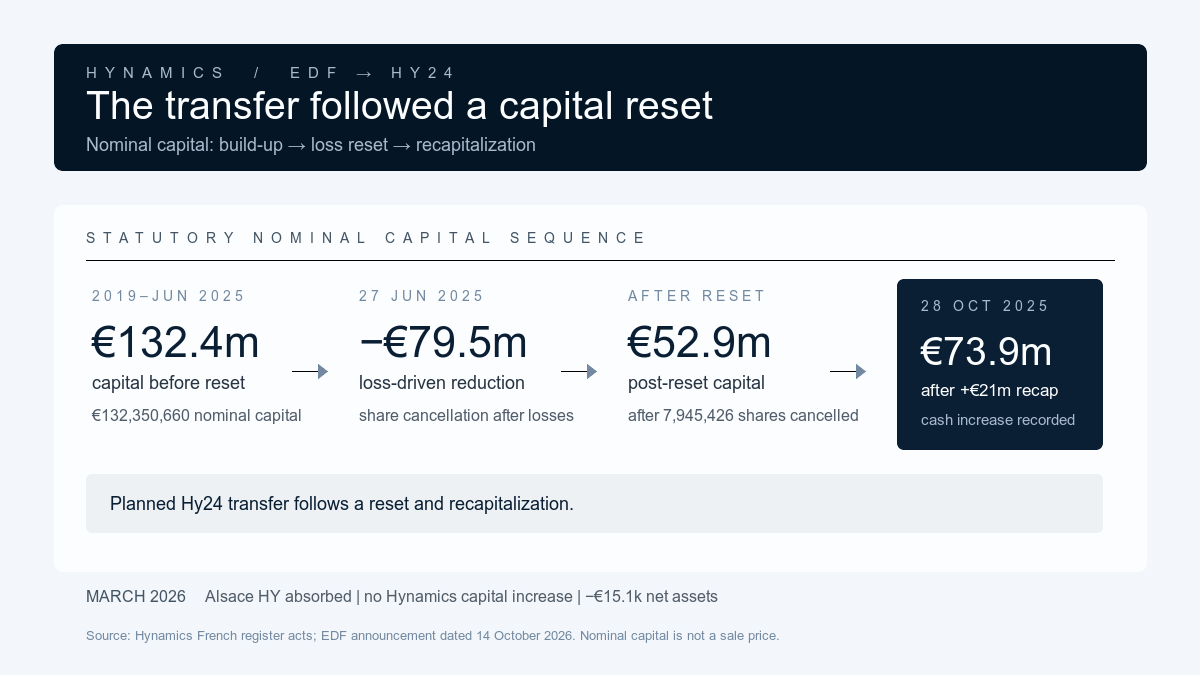
EDF’s proposed sale of Hynamics to Hy24 is arriving after a statutory reset, not from a clean balance sheet.
The EDF press release says Hy24’s Clean Hydrogen Infrastructure fund has agreed to acquire the low-carbon hydrogen subsidiary from EDF Pulse Ventures, with a possible closing in the first quarter of 2027 subject to customary conditions and regulatory approvals. Hynamics produces and markets low-carbon hydrogen for heavy mobility and industrial projects in France and the United Kingdom. EDF describes the deal as a new development phase, and Natixis Partners describes the same transfer as a growth opportunity.
The filed sequence adds the financial history that the announcement does not. Hynamics’ nominal capital reached €132.35066 million, then fell by €79.45426 million after the company recorded a €35.619298 million 2024 loss and carried forward €79.454268 million of losses. Four months later, the company received a further €21 million capital increase. A March 2026 merger project then absorbed a wholly owned subsidiary with a negative net-asset contribution.
That does not establish a sale price, EDF’s cash recovery or what Hy24 is paying. Nominal capital is not a cumulative cash-flow statement. It does show that the proposed ownership change follows a recapitalized and simplified platform. The important commercial question is therefore not only what Hy24 is buying, but what risk EDF had already absorbed before the transfer.
The sale announcement hides the capital sequence
EDF founded Hynamics in 2019 as a vehicle for low-carbon hydrogen development. The French register record for HYNAMICS, SIREN 844254979, shows a series of nominal capital increases before the proposed transfer. The sequence is visible in the 27 June 2025 updated statutes and sole-shareholder minutes.
| Date or step | Nominal capital movement | Capital after the step | What the record supports |
|---|---|---|---|
| Formation and 2019 | €37,000, then +€5m and +€5m | €10.037m | Initial EDF-backed build-up |
| May 2022 | +€32.31366m | €42.35066m | Larger project-platform capitalization |
| October 2022 | +€20m | €62.35066m | Further support before scale-up |
| July 2023 | +€35m | €97.35066m | Capital reached a higher operating base |
| October 2024 | +€15m | €112.35066m | Further nominal support |
| June 2025 | +€20m | €132.35066m | Pre-reset nominal capital |
| 27 June 2025 | −€79.45426m | €52.8964m | Loss-driven capital cancellation |
| 28 October 2025 | +€21m | €73.8964m | Post-reset cash recapitalization |
The numbers are not an alternative valuation of Hynamics. They are the legal capital sequence that sits underneath EDF’s later description of a company entering a new phase. L’Informé had already reported in March 2026 that EDF was looking for a new majority shareholder for a repeatedly recapitalized hydrogen business. The statutory record supplies more precision on the reset itself.
The €79m reset was a legal clean-up, not a sale price
The 27 June 2025 sole-shareholder minutes record a €35,619,298 loss for 2024 and carried-forward negative losses of €79,454,268. The sole shareholder then reduced Hynamics’ capital by €79,454,260 through cancellation of 7,945,426 shares. Capital fell from €132,350,660 to €52,896,400.
That distinction matters. The reduction is close to the carried-forward loss balance, but it is a statutory capital action, not proof that EDF transferred €79.45426 million to a buyer or that the same amount disappeared from a bank account. Capital reduction can clean the legal equity structure after losses without answering how much cash was spent on projects, how projects were valued or what liabilities remained.
The reset is nevertheless economically important. It makes the later transfer easier to read because the company did not move directly from a €132.35 million nominal-capital base into a new ownership phase. EDF first recognized the accumulated-loss problem in the legal capital structure. The register also shows that Hynamics remained a supported platform rather than a company abandoned after the reduction.
This is the same analytical boundary that matters in other recapitalization stories. In Foundever’s lender-to-equity reset, the capital action changes who sits behind the business without, by itself, proving the full value transferred. Hynamics requires the same discipline: the reset is evidence of financial repair and risk allocation, not a disclosed transaction valuation.
EDF added €21m before simplifying the group
On 28 October 2025, an HSBC certificate and updated statutes recorded a further €21 million cash increase. Hynamics’ nominal capital rose from €52,896,400 to €73,896,400. The sequence therefore runs from loss recognition and cancellation to a fresh injection, rather than from cancellation straight to a sale.
The source record does not say that the €21 million financed the Hy24 transaction. It may have supported Hynamics’ project portfolio, operating needs or general capitalization. The safe finding is narrower: EDF’s side of the group put additional nominal capital into the business after the reset and before the proposed transfer.
The March 2026 Alsace HY merger project adds a second form of preparation. Hynamics’ wholly owned Alsace HY subsidiary, SIREN 978263655, was to be absorbed without a Hynamics capital increase. The project records a negative €15,100 net-asset contribution. Absorbing a negative-net-asset subsidiary does not prove distress or a buyer demand, but it does simplify the legal perimeter and remove a small negative position from the group chart before the ownership change.
Together, the injection and merger make “recapitalized hand-off” a fair description of the sequence. It remains an interpretation of documented steps, not a claim that EDF’s motive was to make Hynamics saleable or that Hy24 negotiated a specific price because of them.
What Hy24 is buying, and what remains open
Hy24 is not presented as buying a shell. EDF says Hynamics has flagship projects in France and the United Kingdom, while Natixis says the new owner can accelerate the project portfolio with financial expertise. Those statements are compatible with a company whose nominal capital needed repair as projects matured. Hydrogen platforms often require repeated funding before project economics become visible, and statutory capital can move differently from project value.
The open questions are therefore deal questions, not questions that the current filings can answer:
- What consideration, if any, will EDF receive at closing?
- What ownership percentage will Hy24’s fund hold after the transaction?
- Which project liabilities, guarantees and development commitments move with Hynamics?
- Will Hynamics receive new project capital after the transfer, and from which vehicle?
- Does a closing filing disclose an equity value, a deferred payment or a separate support agreement?
The planned close remains subject to approvals. Until a closing announcement or post-closing filing answers those questions, it would be wrong to call the transaction a distressed sale, a bargain purchase or a full recovery event for EDF.
The stronger conclusion is more useful: EDF’s proposed transfer of Hynamics follows a €79.45426 million statutory capital reset, a €21 million recapitalization and a group simplification. The buyer is being offered a hydrogen platform after the old shareholder absorbed a documented loss and rebuilt the capital base. That is a different economic story from a clean growth sale, even though the public announcement quite properly emphasizes the next phase under new shareholders.
Continue reading
Related Research
Foundever's Debt Rescue Gave Participating Lenders 40% of Equity
Foundever cut nearly $900m of debt, while S&P says participating lenders received 40% of equity and existing owners invested $225m as maturities moved to 2030 and 2031.
Chargepoly's €23m Round Followed Capital Loss At Its Stations Unit
Chargepoly raised €23 million after its wholly owned stations vehicle fell below half its capital, shifting existing deployment risk to new investors.
Duralex's Rescue Also Ends Its Employee-Controlled SCOP
Duralex's €16m rescue keeps 155 jobs but replaces a worker-controlled SCOP, shifting control to Tomé and public-backed private capital in a court-selected rescue.
Hansetherm’s €10m Seed Put Two Near-25% Blocks at the Center of Its Cap Table
Hansetherm’s €10m seed created 65,429 new shares, putting two less-visible blocks near 25% each while G-FUND holds 2.11% before scale-up plans.