
Duralex's Rescue Also Ends Its Employee-Controlled SCOP
Duralex's €16m rescue keeps 155 jobs but replaces a worker-controlled SCOP, shifting control to Tomé and public-backed private capital in a court-selected rescue.
On this page
Conduct your own private market research
Add dossaro to Claude or ChatGPT and run source-backed register research from your own workspace.
 Add to Claude
 Add to ChatGPT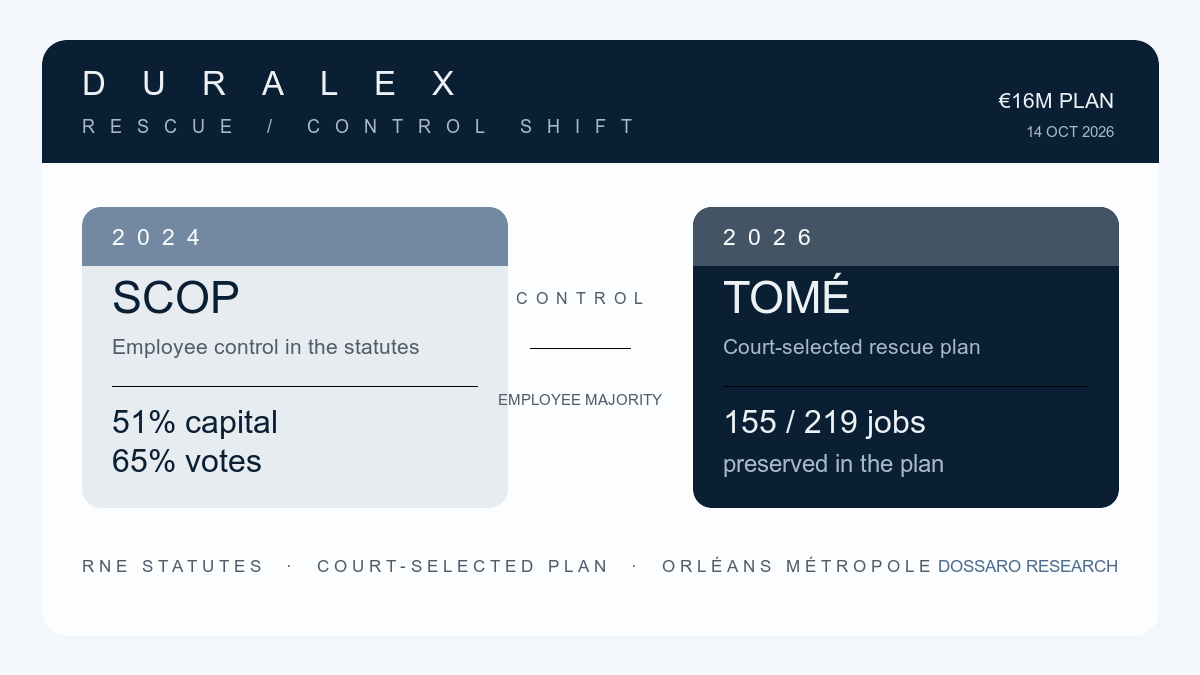
Duralex's rescue is being reported as a factory saved. The legal record shows a second event: a worker-controlled company is giving way to Tomé's private-public financing. The court-selected plan preserves 155 of 219 jobs and commits €16 million, but it also closes the chapter in which employees were required to hold the controlling share of the glassmaker.
The Orléans Métropole announcement says the tribunal selected the Tomé holding led by Cédric Meston after Duralex entered receivership on 1 June 2026. The plan combines €10 million of private money with a €4 million state loan and €1 million each from the Métropole and the Centre-Val de Loire region. A Le Monde account describes the same €16 million package and says the Duralex SCOP will end under the takeover.
That is the commercial point of the transaction. This is not only a continuation of production under a new brand steward. It is a control handover priced against the cost of keeping a factory and 155 jobs in operation.
The distinction is similar to the control question in KmB's Mutares rescue: a business can remain recognizable to customers while the legal balance of power changes underneath it.
The rescue changes the control model
Duralex SCOP SA was incorporated in 2024 as a cooperative public limited company. The initial capital certificate in the French national business register records €20,300 deposited on 10 July 2024, divided into 406 €50 shares. The constitutive statutes set the cooperative bargain in unusually clear terms: employee associates had to hold at least 51% of the capital and 65% of voting rights, while outside associates were capped at 35% of the votes under the stated cooperative rules.
Those provisions made the SCOP more than a financing wrapper. They put the workforce at the centre of formal control. The Duralex company page explains the operating principle in plain language: each employee-owner has one vote at general meetings. The court-selected rescue changes who supplies the money and, with it, who sets the governance terms.
| State | Capital and control | Funding meaning |
|---|---|---|
| 2024 constitution | €20,300 initial capital; employee associates required to hold at least 51% of capital and 65% of votes | Employees were the formal controlling constituency of the new SCOP |
| September 2025 cooperative update | Capital shown at €157,750; employee-majority rules remained in the statutes | The cooperative raised its capital base before the later court process, without abandoning its control model |
| October 2026 rescue plan | €16 million package; 155 of 219 jobs preserved; Tomé selected as buyer | Operations survive, but the SCOP control structure ends under private-public rescue capital |
The table separates three moments that are often collapsed into the phrase “Duralex was saved.” The plant's continuity and the cooperative's continuity are not the same thing.
The cooperative was capitalized before it was rescued
The updated statutes dated 23 September 2025, filed in May 2026, show capital of €157,750. Their employee-capital and employee-voting provisions still appear in the document. That means the rescue did not replace an empty shell. It followed an attempt to build a larger cooperative balance sheet while retaining employee control.
The 23 September 2025 general-meeting minutes also record an opening to external financing through a participatory title or simple bond with LITA. The decision sits alongside the admission of employee associates, the validation of capital and the adoption of updated statutes. In other words, the SCOP had begun to seek outside money before the court-appointed process forced a more decisive financing choice.
This sequence matters for the economics of the handover. A cooperative can preserve employee voting power while welcoming outside capital, but it still needs investors willing to accept the structure and the risk of a manufacturing turnaround. The documents establish that Duralex was trying to widen its financing channel. They do not establish the pricing, maturity, security or repayment terms of the LITA instrument.
The later rescue therefore should not be framed as a simple rejection of employee ownership. It is better understood as a point at which the existing cooperative capital base and funding route could not carry the plant through receivership. The €16 million plan buys operational continuity by changing the governing constituency.
Public money keeps the plant open, not the old governance
The funding mix makes the trade-off visible. Orléans Métropole and the Centre-Val de Loire region each contribute €1 million, while the state contributes a €4 million loan. The remaining €10 million is private, including €4 million from Tomé according to Le Monde. The Métropole also plans a progressive real-estate lease-back, giving the new operation access to a property solution alongside the cash package.
The immediate human result is concrete: 155 jobs are retained out of 219. The public contribution is therefore doing two jobs at once. It is helping prevent a liquidation outcome for a local industrial site, and it is underwriting a private-led attempt to modernize it. It is not preserving the old 51% employee-capital and 65% employee-vote bargain.
That distinction is important for diligence. Public support can reduce the funding gap without determining who controls the company after the rescue. A buyer can receive public loans, local equity-like support or property assistance and still hold the authority to appoint the board, set the turnaround priorities and decide whether to reinvest. The available announcement does not disclose the full allocation of shares, debt, leases or governance rights under the Tomé plan.
The plan also carries an industrial promise. Orléans Métropole says Duralex is expected to modernize and decarbonize, while Le Monde reports a Tomé ambition for an electric furnace by 2029. Those projects may lower energy exposure, but they also require capital after the rescue closes. Energy costs were nearly 20% of revenue in the account cited by Le Monde. Keeping 155 people employed is the first threshold, not proof that the new capital structure can fund the next one.
The €7 million citizen funding sits behind the handover
The cooperative's fundraising history adds another layer of asymmetry. LITA securities raised €7 million from the public, with an average contribution of about €300 and a €1,000 cap, according to Le Monde. The newspaper reported that LITA managing director Julien Benayoun warned investors that they would rank with creditors and could lose their investment if the rescue did not preserve value.
That warning is a useful boundary around the public story. Citizen funding helped keep the cooperative visible and financed, but it did not create a claim to keep employee control in place after the court-selected sale. Nor does the public reporting establish what each investor will recover. The rank of a security in a distressed capital structure is not the same as a confirmed loss, and the exact waterfall remains outside the documents reviewed here.
The transaction thus has two different constituencies to protect. Employees are measured through the 155 retained jobs and the continuity of the site. LITA investors are measured through the treatment of their securities in the rescue and any later restructuring. Tomé and the public lenders are underwriting a turnaround whose returns depend on the plant's future cash generation, not only on the value of the Duralex name.
What Tomé is buying, and what it must underwrite
Tomé's plan appears to buy the right to keep the factory, brand and operating base together while adding a new capital and governance framework. The Orléans release describes a progressive lease-back and an industrial modernization programme. Le Monde reports the choice of Tomé over another bid from Carlesimo and identifies the private and public contributors. Those sources support a control handover and a financing map. They do not disclose a purchase-price allocation between assets, liabilities, leases, inventory, intellectual property or future capital expenditure.
The unresolved economics are therefore operational. Can the €16 million package support working capital while the furnace and decarbonization programme are developed? How will the new owner treat the LITA securities and other creditor claims? Which decisions will remain with employees, if any, once the SCOP is gone? And does the public support cover only the initial rescue or also the next round of industrial investment?
Duralex's story is consequently larger than a familiar rescue headline. The 2024 records show a deliberate employee-control experiment, with a €20,300 starting capital base and a statutory 51% capital and 65% voting threshold. The 2025 records show that the cooperative expanded capital to €157,750 and opened a route to external financing. The 2026 plan preserves 155 jobs by replacing that control model with Tomé's private-public package.
The next diligence question is not simply whether Duralex survived. It is whether the new owner can finance the energy transition and honour the claims created under the cooperative while replacing the employees' former governance role. The court plan and transfer documents, Tomé's financing terms and Duralex's first post-rescue filings should show where that risk now sits.
Continue reading
Related Research
KmB's Mutares Control Chain Was Still Intact When Insolvency Hit
KmB moved from EMAG and Scherer to Mutares' wholly owned FERRAL vehicle before its October 2026 provisional insolvency, clarifying who sat above the risk.
Foundever's Debt Rescue Gave Participating Lenders 40% of Equity
Foundever cut nearly $900m of debt, while S&P says participating lenders received 40% of equity and existing owners invested $225m as maturities moved to 2030 and 2031.
Matter Machine's £4m Round Changed Founder Control At Launch
Matter Machine's £4m pre-Series A took a one-share founder company to 808,300 shares, cut the founder's PSC band and installed institutional governance.
CarbonFarm's €7m Series A Left a Two-Tranche Equity Trail
CarbonFarm's €7m Series A left two 2026 equity tranches and €3,904.96 of capital, but public acts do not map named investors to legal positions.