
Matter Machine's £4m Round Changed Founder Control At Launch
Matter Machine's £4m pre-Series A took a one-share founder company to 808,300 shares, cut the founder's PSC band and installed institutional governance.
On this page
Conduct your own private market research
Add dossaro to Claude or ChatGPT and run source-backed register research from your own workspace.
 Add to Claude
 Add to ChatGPT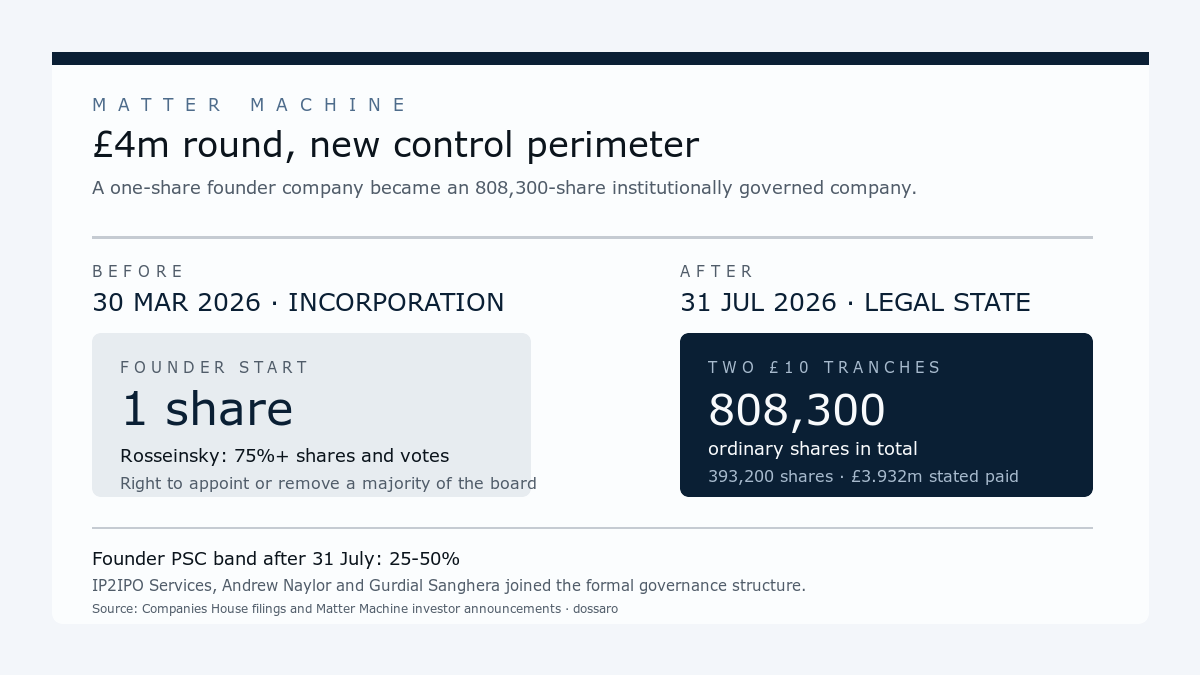
Matter Machine did not simply raise £4 million. In four months, the University of Liverpool spinout moved from a one-share founder company to 808,300 ordinary shares, while its founder's registered control band fell from at least 75% to more than 25% but no more than 50%.
The legal sequence puts the financing in a sharper business frame. Two 31 July allotments alone added 393,200 ordinary shares at £10 each, representing 48.65% of the final share count and £3.932 million of stated paid consideration. The same effective date brought a corporate director, two new individual directors and a Companies House change to Matthew Rosseinsky's person-with-significant-control record.
IP Group described the transaction as an oversubscribed £4 million pre-Series A led by IP Group. Northern Gritstone separately disclosed a £1.1 million investment. The public releases explain who backed the company. The filings show what the round changed: founder economics were diluted and institutional governance arrived at the company's launch.
The financing and the legal sequence
The public announcement and the filings describe the same event at different levels. IP Group and Northern Gritstone focus on the materials-discovery business, its University of Liverpool origin and the investor syndicate. Companies House records the legal state that investors and counterparties will rely on.
| Date | Public or filed event | Economic change |
|---|---|---|
| 30 March 2026 | Matter Machine incorporated | Matthew Rosseinsky subscribed for one ordinary share and was recorded with 75% or more of shares and votes, plus the right to appoint or remove a majority of the board |
| June 2026 | Early ordinary-share allotments filed | The company moved from its one-share starting point through several nominal or near-nominal cash allotments |
| 31 July 2026 | Two £10 ordinary-share allotments filed | 193,200 and 200,000 shares were issued for cash, taking the reported total to 808,300 |
| 3 August 2026 | PSC and director notices filed | Rosseinsky moved into the 25% to 50% band; IP2IPO Services, Andrew Naylor and Gurdial Sanghera were appointed |
| 18 August 2026 | New articles and capital-rights filings filed | Investor transfer, pre-emption, tag-along, drag-along and director provisions entered the public record |
The sequence is a useful Companies House research workflow in miniature. A funding release answers the question “who announced the round?” The filing history answers “which legal rights and obligations changed, and when?”
Two tranches carried almost half the final shares
The decisive filings are the two SH01 statements for allotments made on 31 July. One reports 193,200 ordinary shares at £10 each. The other reports 200,000 ordinary shares at £10 each. Together they represent 393,200 shares, or 48.65% of the final 808,300 ordinary shares.
| 31 July allotment | Shares issued | Stated paid amount | Share of final 808,300 |
|---|---|---|---|
| First £10 tranche | 193,200 | £1,932,000 | 23.90% |
| Second £10 tranche | 200,000 | £2,000,000 | 24.74% |
| Combined | 393,200 | £3,932,000 | 48.65% |
Earlier June allotments built the company toward the final capital state at nominal or near-nominal prices. The 31 July statements say the shares were allotted for cash, carry voting, dividend and capital rights, and have no redemption rights. Those terms make the two tranches ordinary voting equity, not a debt-like bridge or a purely symbolic capital entry.
The £3.932 million stated in these two forms is close to the £4 million public round. It is not a disclosed investor allocation. Companies House does not name the allottee for either tranche, so the filings cannot support a claim that IP Group, Northern Gritstone or another named participant received a specific percentage. The difference between the public round size and the two stated paid amounts may reflect other parts of the financing sequence or transaction accounting. The evidence does not justify a more precise reconciliation.
This is the same discipline required when reading other private financings. Ground A's pre-seed connects new shares to visible legal holders because its shareholder list names the recipients. Matter Machine's SH01 forms show the cash-bearing issuance and the final denominator, but not the investor-by-investor split.
Founder control moved into a shared governance structure
Rosseinsky's starting position was unusually clear. The incorporation document records one ordinary share subscribed by him and a control statement covering at least 75% of shares and voting rights, plus the right to appoint or remove a majority of the board.
The PSC04 filed on 3 August records the effective date of the change as 31 July. Rosseinsky then held more than 25% but no more than 50% of the shares and voting rights. He remained a significant controller, but the public control record no longer described a company controlled by the founder in the original sense.
The board changed at the same time. IP2IPO Services Limited, company 05325867, became a corporate director. Andrew James Naylor joined from an address at No. 1 Circle Square in Manchester, the address also associated with Northern Gritstone. Gurdial Singh Sanghera, who IP Group described as Matter Machine's new leader and a former Oxford Nanopore chief executive, was appointed as a director as well.
The address overlap is a governance clue, not proof that Northern Gritstone holds a particular share position. The filing establishes Naylor's appointment and address. It does not establish his mandate, an investor nominee agreement or an ownership percentage for any fund.
The new articles adopted by special resolution on 24 July and filed on 18 August make the governance change more durable. Their contents include pre-emption rights, transfer procedures, tag-along and drag-along provisions, leaver terms and rules for investor-director appointments. Those provisions are standard tools for an institutionally financed company, but they also change the practical setting in which a founder's remaining 25% to 50% position can be exercised.
The public round explains the cash, not the full cap table
IP Group's announcement says it led an oversubscribed £4 million pre-Series A into an AI-driven materials-discovery company spun out of the University of Liverpool. Northern Gritstone's announcement confirms its £1.1 million investment and names the University of Liverpool Enterprise Fund, Norrsken Evolve, LYVA Labs and Parkwalk's Northern Universities Venture Fund in the wider syndicate.
Those releases establish the financing's commercial purpose and the named institutions. They do not disclose the subscription price paid by each investor, whether every named institution subscribed directly to the ordinary shares, or whether any amount sat in a different security or vehicle. The legal record therefore supports a financing-and-control conclusion, not a new cap table with investor percentages.
That distinction matters to diligence. A founder can remain above 25% while losing the board appointment right that once made the company founder-controlled. An investor can have a large economic position without being the legal allottee named in an SH01. A corporate director can add institutional process without proving unilateral control. Each fact has to stay at its own legal layer.
CuspAI's pre-Series B ownership position shows the same analytical problem from another direction: a visible founder block before a public round is a reference state, not a promise about the post-round economics. For Matter Machine, the new evidence is stronger on the control change because the PSC band and director appointments share the 31 July effective date.
A more institutional launch changes the next question
The business consequence is not simply that Rosseinsky was diluted. Matter Machine launched with a governance perimeter designed for several institutions, a corporate director and an investor-rights framework, while the founder retained a material but smaller control band.
That structure can make sense for a university spinout. IP Group brings commercialisation experience, Northern Gritstone supplies a substantial cheque, and the new leadership adds operating experience from Oxford Nanopore. The public sources support that growth logic. They do not erase the legal consequence of the financing: practical decision-making is now shared across founder, board and institutional rights.
The next diligence question is therefore specific. Which institution, if any, received the 193,200 and 200,000 ordinary shares, and what rights sit beside those holdings? The answer may appear in a later confirmation statement, shareholder information filing, allotment resolution or a transaction document that names the subscribers.
Until that document arrives, the supported finding is already material. Matter Machine moved from one founder share and a 75% plus control record to 808,300 ordinary shares, nearly half of them issued in two £10 cash tranches, with the founder's control band reduced and institutional governance installed at the same time.
Continue reading
Related Research
Ground A's €9.1m pre-seed leaves each founder at 22.75%
Ground A's €9.1m pre-seed created 31.75% of new shares, leaving each founder vehicle at 22.75% and Vsquared Ventures III at 14.17% in the latest register.
CuspAI's Founders Held 32.61% Before The $450m Series B
CuspAI's founders held 32.61% before its $450m Series B, while UK sovereign capital entered a company whose post-round ownership is not yet public.
Volta's $300m Raise Had A 30.5x Nominal Share-Price Ladder
Volta's $300m raise hid a 30.5x nominal price ladder from $58 Seed shares to $1,769.91 Series A stock, plus preferred rights and $2m of debt set-off.
Ubitium’s $14m Seed Rebalanced the Syndicate Around a 51.69% Legacy Block
Ubitium’s $14m seed left its unchanged 25,000-share block at 51.69%, while Ibex became the largest new legal holder in the August 2026 register.