
Rabot Energy's $50m Series B Reweighted Its Investor Coalition
Rabot Energy's public €50m Series B maps to 26,816 new shares in RABOT Charge, diluting Rabe Venture from 21.90% to 16.34% on issued shares.
On this page
Conduct your own private market research
Add dossaro to Claude or ChatGPT and run source-backed register research from your own workspace.
 Add to Claude
 Add to ChatGPT
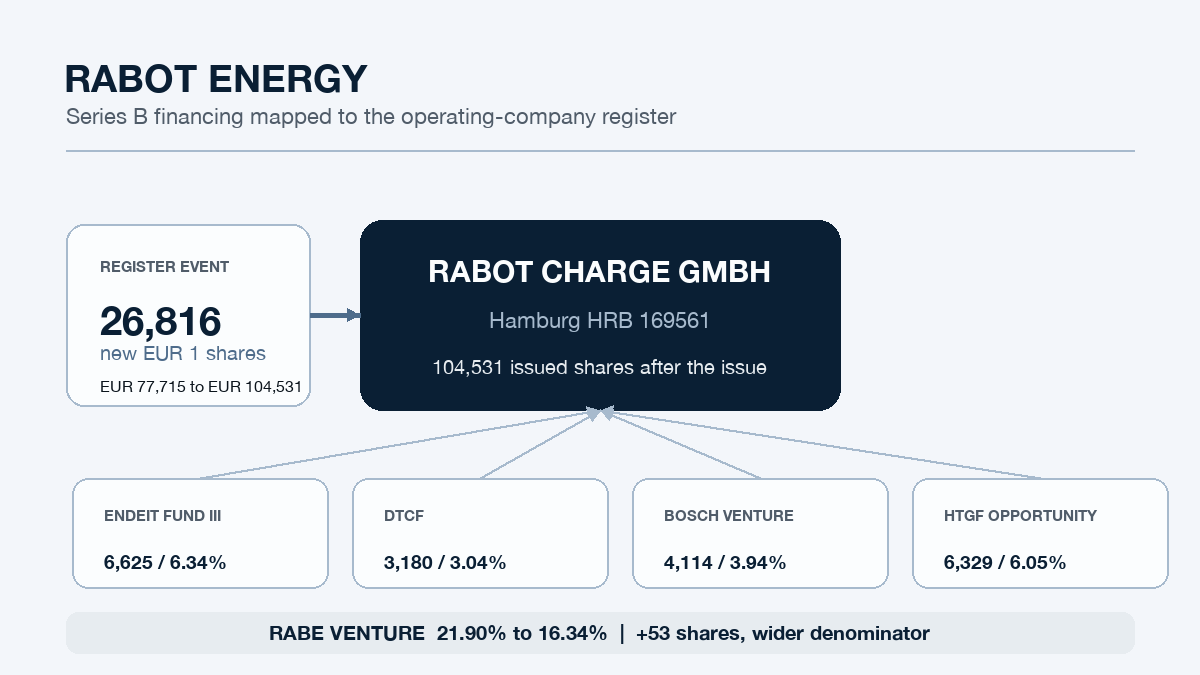
Rabot Energy's public financing story is a €50m/$50m Series B. The German register shows the more specific event behind that headline: RABOT Charge GmbH, the Hamburg operating-company node in Rabot's group, issued 26,816 new one-euro shares. Nominal capital rose from €77,715 to €104,531.
That issue did not make the €50m headline disappear. It made the financing legible. The shareholder documents name the new investor vehicles and show how existing positions moved when the issued-share base expanded. Rabe Venture GmbH, the founder-linked vehicle, added 53 shares but fell from 21.90% to 16.34% of issued shares. Endeit Fund III, DeepTech & Climate Fonds, Robert Bosch Venture Capital and HTGF Opportunity vehicles entered the visible operating-company register.
The evidence does not disclose the cash premium paid above nominal value, a valuation, liquidation preferences, voting agreements or a final control position. The defensible finding is narrower and more useful: the round reweighted the investor coalition at the operating subsidiary, not simply the list of names in a press release.
The public round and the legal entity are different layers
Rabot Energy's announcement dated the round 14 October 2026 and described a Series B of 50 million. It named Endeit as the new lead investor alongside DeepTech & Climate Fonds, with existing participation from HV Capital, High-Tech Gründerfonds, Bosch Ventures, CNI, Acurio Ventures and vent.io. The company said the capital would support a one-million-customer ambition, platform development and the connection of household batteries into a virtual power plant.
Endeit's account, published on 15 October, called the financing a $50M Series B and repeated the investor list. pv magazine's report independently described a €50m round and the plan to expand Rabot's customer base and battery-networking technology. GreenGate Partners separately described a USD 50m financing and its investor group.
Those sources establish the public financing event and its commercial purpose. They do not identify the share register used for the financing. The relevant legal record is for RABOT Charge GmbH, Hamburg HRB 169561. Rabot's own company description says the brand is operated by RABOT Energy DE GmbH, while the sourcing run resolved RABOT Charge as the operating-company node whose shareholder lists expose the issued-share movement. A group chart is not a cap table, so the article keeps the register claim at this entity boundary.
What 26,816 new shares reveal
The 3 April 2025 shareholder list recorded €77,715 of nominal capital divided into 77,715 one-euro shares. It put Rabe Venture at 17,023 shares, or 21.90%, and showed a broad existing syndicate that included MCB, HV Capital, yabeo Impact, vent.io, Acurio, CNI and HTGF IV.
The 19 August 2026 subscriber list in the register document set records 26,816 new shares. It names 6,625 subscriptions for Endeit Fund III, 3,180 for DeepTech & Climate Fonds, 4,114 for Robert Bosch Venture Capital, 6,088 for HTGF Opportunity and 241 for HTGF Opportunity Private. Existing investors also subscribed: HV Capital took 2,570 shares, while vent.io, Acurio, CNI and Rabe Venture took smaller allocations. The listed amounts total exactly 26,816 shares.
The 23 September and 22 October shareholder lists then place those shares in the post-round map. The October list records €104,531 of nominal capital and an implied issued-share base of 104,531. That base is the denominator for the percentages below. It is not a valuation denominator and it does not describe any unissued option pool or preference rights.
| Holder or vehicle | Before issue | After issue | Change in shares | Reading |
|---|---|---|---|---|
| Rabe Venture | 17,023 / 21.90% | 17,076 / 16.34% | +53 | Founder-linked vehicle diluted as the base expanded |
| MCB Beteiligungs- und Beratungsgesellschaft | 9,000 / 11.58% | 9,000 / 8.61% | 0 | Same nominal holding, lower issued-share percentage |
| HV Capital Fund IX | 11,060 / 14.23% | 13,630 / 13.03% | +2,570 | Follow-on participation, still below its old percentage |
| Nineteen Sixty one | 5,921 / 7.62% | 6,098 / 5.83% | +177 | Follow-on participation, diluted percentage |
| HTGF IV | 3,863 / 4.97% | 5,214 / 4.99% | +1,351 | Old fund plus a new HTGF opportunity complex |
| vent.io | 3,346 / 4.31% | 3,982 / 3.81% | +636 | Follow-on participation, diluted percentage |
| Acurio Ventures Fund III | 4,943 / 6.36% | 5,425 / 5.19% | +482 | Follow-on participation, diluted percentage |
| CNI Opportunity | 2,329 / 3.00% | 2,806 / 2.68% | +477 | Follow-on participation, diluted percentage |
The table is a calculation from the filed share counts and published percentages. It does not turn a nominal share into a cash amount. The most important signal is the asymmetry between the founder vehicle and the new coalition: Rabe Venture's holding grew by 53 shares, while the denominator grew by 26,816.
The new coalition is wider than the lead-investor headline
Endeit's public role is clear. It led the round. The register adds the more granular operating-company picture: Endeit Fund III holds 6,625 shares, or 6.34% of the post-round issued base. DTCF holds 3,180 shares, or 3.04%. Robert Bosch Venture Capital holds 4,114, or 3.94%. HTGF Opportunity and HTGF Opportunity Private together hold 6,329 shares, or about 6.05%.
That mix matters because a financing coalition is not only a ranking of lead and participants. It is also a distribution of future follow-on capacity and relationship weight. The register shows a new block of climate, growth and venture vehicles alongside the older group. HV Capital remains the largest named follow-on holder at 13.03%, and Rabe Venture remains the largest founder-linked vehicle at 16.34%, but neither number should be read as a voting or control conclusion.
This is where the round has commercial meaning beyond the funding announcement. Rabot says it wants to grow from more than 200,000 customers toward one million and connect batteries, wallboxes and heat pumps into a virtual power plant. That strategy needs product capital, but it also needs a syndicate able to fund hardware, software and energy-market execution over time. The filings show that the new capital widened the set of named vehicles attached to the operating company. They do not show how those investors share governance or future financing rights.
Why €26,816 is not €50m
The nominal increase is the amount by which the registered share capital rose. It is not the round proceeds. German GmbH shares can be issued above their nominal value, and the reviewed public documents do not disclose the subscription premium, the price per share or the valuation. The €50m/€50m public figure may therefore sit largely in a premium or other financing consideration that is not visible in the nominal capital line.
The same discipline applies to dilution. Rabe Venture's change from 21.90% to 16.34% is an issued-share calculation based on two shareholder lists. It does not quantify economic dilution after preferences, option rights or conversion mechanics, and it does not prove that any founder lost board control. Hansetherm's seed ownership reset shows why a new share base can change the apparent balance before a financing's full rights are public. XRlabs' founder-control map illustrates the opposite boundary: a register can clarify founder exposure without proving every governance right.
The group structure also limits what can be inferred. RABOT Charge's shareholder list is not a disclosure of RABOT Energy's ultimate beneficial owners, and the documents do not establish whether the operating subsidiary is the only entity receiving round proceeds. The article therefore treats the register as evidence of the issued-share event, not as a complete group cap table.
The next document that would change the analysis
The strongest current conclusion is that Rabot's Series B reweighted its operating-company investor coalition. The register documents prove the number of new shares, the named subscribers and the resulting issued-share percentages. The public announcement explains the commercial ambition: more customers, a wider energy platform and a virtual power plant built from distributed household devices.
What remains open is equally important. A filing or verified company disclosure showing subscription premiums, valuation, preference rights, voting arrangements or the post-round board would move the analysis from nominal dilution to financing economics and control. Until that document appears, the €50m/€50m headline should be read as disclosed financing capacity, while the 26,816-share issue is the precise legal footprint visible in the RABOT Charge register.
Continue reading
Related Research
Hansetherm’s €10m Seed Put Two Near-25% Blocks at the Center of Its Cap Table
Hansetherm’s €10m seed created 65,429 new shares, putting two less-visible blocks near 25% each while G-FUND holds 2.11% before scale-up plans.
XRlabs Added Seed-2 Preference Rights While Its Founder Kept Statutory Control
XRlabs raised an $8.4m Playground-led seed while filings show 621,130 Seed-2 shares and a founder still above 50% with majority board rights.
Cognitive Credit’s $40m Growth Investment Sits Beside a New HSBC Security Layer
Cognitive Credit announced a $40m Summit-led investment, while filings show 876 new shares and an outstanding HSBC security over its IP and business.
Qwello’s Up to €55m Equity Follows Up to €65m Debt
Qwello’s up to €55m equity follows up to €65m of debt as its latest public accounts show a €4.44m loss, framing a capital-intensive roll-up.