
Impress’s €40m EIB Loan Adds a New Layer to Existing Venture Debt
Impress’s €40m EIB loan sits beside outstanding Trinity charges, while older lender security was satisfied in January, making the debt stack visible.
On this page
Conduct your own private market research
Add dossaro to Claude or ChatGPT and run source-backed register research from your own workspace.
 Add to Claude
 Add to ChatGPT
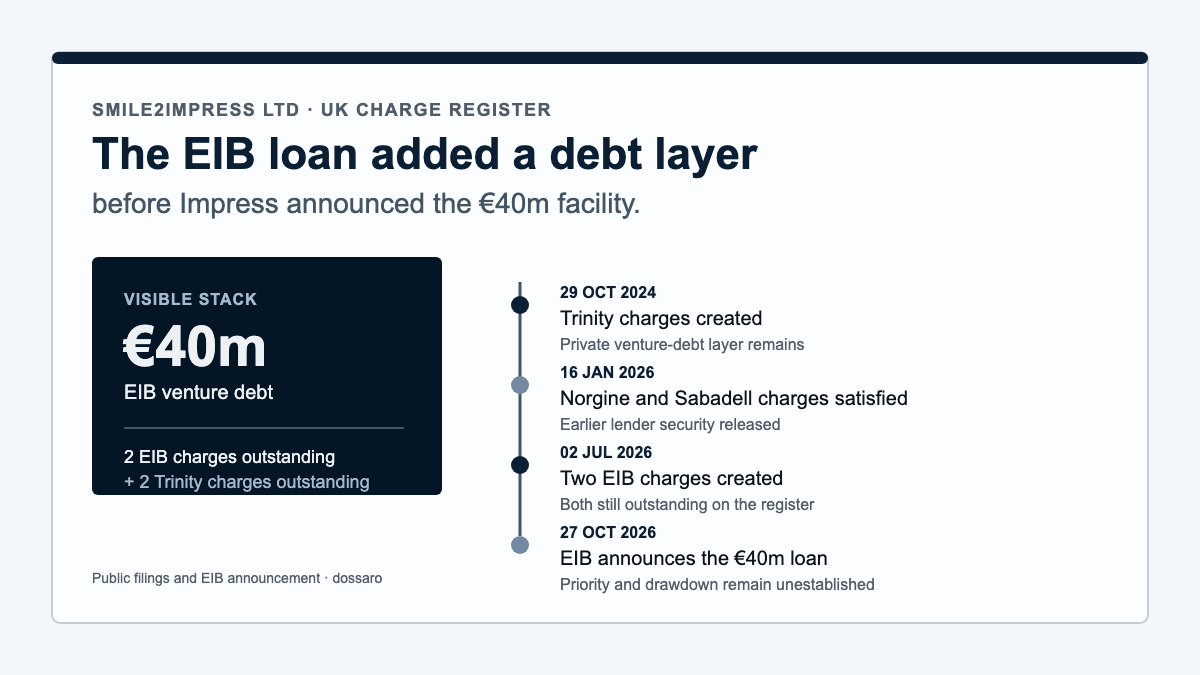
Impress’s €40m European Investment Bank loan was secured on the company’s UK subsidiary months before the lender announced it. Two EIB charges were created on 2 July 2026, delivered to Companies House the next day, and remain outstanding alongside two Trinity Capital charges from 2024.
That chronology changes the financing story. Impress is not simply adding a public-backed growth loan to an equity-funded healthtech expansion. Its visible UK security trail shows a new EIB layer sitting beside private venture debt, after older Norgine and Sabadell charges were satisfied in January. The register does not establish drawdown, lender priority or the full collateral package, but it does make the debt stack economically relevant.
The loan was public in October, security was visible in July
The EIB announcement dated 27 October describes a €40m venture-debt loan to Impress. The loan is guaranteed by InvestEU and is intended to develop Impress’s clinical artificial-intelligence platform and support expansion in Germany, the Netherlands and the United Kingdom. The EIB says the business has more than 110 clinics and has treated more than 500,000 patients.
The public announcement arrived nearly four months after the security filings. On the Companies House charges register, charge 129578950005 and charge 129578950006 were both created on 2 July and delivered on 3 July. The person entitled on each is the European Investment Bank, and both are marked outstanding.
The timing is not proof that the full loan was drawn in July. It is evidence that the EIB’s legal security was already visible on the UK register before the growth plan became public. That distinction matters when a financing headline presents the loan as a new source of runway rather than as a secured layer in an existing capital structure.
The UK subsidiary carries the visible debt trail
The charge records belong to SMILE2IMPRESS LTD, company number 12957895, the UK subsidiary in the Impress group. The operating story is broader: the principal Spanish entity is SMILE2IMPRESS S.L. (Sociedad Unipersonal), established in Barcelona in 2019. The public filings do not, by themselves, describe the group’s full guarantee chain or show which entity ultimately receives every euro of the EIB facility.
The UK record nevertheless gives a precise sequence of lender exposure:
| Date | Public record | What it establishes |
|---|---|---|
| 16 January 2026 | Charges 129578950001 and 129578950002 satisfied in full | Earlier Sabadell and Norgine security was released on the UK subsidiary |
| 2 July 2026 | Charges 129578950005 and 129578950006 created | The EIB became the named person entitled on two new charges |
| 3 July 2026 | The two EIB charge registrations delivered | The July security entered the public Companies House record |
| 27 October 2026 | EIB announces a €40m venture-debt loan | The financing purpose and InvestEU guarantee become public |
The same register shows two charges created on 29 October 2024 for Trinity Capital Inc. Both remain outstanding. The older charges that named Sabadell Venture Capital and Norgine Ventures Fund I S.C.A. are the ones marked satisfied on 16 January 2026. The result is a visible change in lender mix: earlier security was released, Trinity remained, and EIB security was added before the announcement.
Two lender layers remain outstanding
The public charge summaries do not support a ranking conclusion. The summary for charge 129578950006 begins “All current and future real property and intellectual...” while the summary for 129578950005 has no applicable brief description. The filing history identifies the two underlying registration PDFs as 49 and 80 pages, but the public index does not supply the intercreditor terms, covenants, drawdown schedule or complete security definitions.
That leaves a narrow but important finding. The EIB and Trinity are both visible as current charge holders on the same UK subsidiary. It is not safe to call the EIB senior, first-ranking or fully secured ahead of Trinity without the instruments and any priority agreement. It is equally unsafe to treat the EIB facility as an unsecured corporate loan simply because the announcement focuses on artificial intelligence and international growth.
The distinction is familiar in private-market analysis. StrollMe’s hybrid fleet financing separates a growth plan from the secured and operating obligations that make the plan financeable. Cognitive Credit’s capital stack similarly shows why the headline amount is only one part of the economic structure. Impress’s filings add a lender chronology to an announcement that otherwise reads like a straightforward expansion story.
Equity funded the scale-up before debt extended it
Cinco Días reports that Impress had raised about €250m across five equity rounds before the EIB facility. Its independent report describes the company as preparing to expand in northern Europe and says the 2024 round was €110m. Public funding histories use different amounts for some earlier rounds, so the defensible description is “about €250m reported across five equity rounds,” not a reconstructed cap table or exact fully diluted total.
The sequence now visible is therefore:
| Confirmed fact | Commercial reading | Not established by the public record |
|---|---|---|
| About €250m of equity was publicly reported across five rounds | Impress had a substantial equity-funded growth base before the EIB announcement | Investor percentages, dilution, preferences or current shareholder control |
| Two Trinity charges from October 2024 remain outstanding | Earlier venture debt remains part of the UK subsidiary’s visible financing perimeter | Trinity’s principal balance, covenants or priority against EIB |
| Two EIB charges were created in July and remain outstanding | The EIB facility has a legally visible security layer ahead of the October announcement | Drawdown date, amount drawn, ranking or complete collateral |
| The EIB loan is guaranteed by InvestEU | A public guarantee changes the risk-sharing context around the lender | That InvestEU changes private lender priority or shareholder economics |
This is why the €40m should not be read as a simple substitute for equity. It extends a capital base that already includes private debt, and the register shows that the extension was documented through security over the UK subsidiary. The commercial consequence is not necessarily distress or refinancing pressure. It is that the expansion plan now sits inside a multi-lender structure whose terms will matter as Impress adds clinics, develops its AI platform and enters new markets.
InvestEU changes public exposure, not proven priority
The InvestEU guarantee is a material part of the EIB’s public framing. It helps explain why a European public bank is supporting a venture-debt facility for clinical AI and international expansion. It does not answer the private-law questions created by the charge register. A guarantee can alter who bears part of a credit loss without telling outside readers whether EIB or Trinity ranks first against a particular asset, claim or enforcement scenario.
That distinction protects against two opposite overstatements. The facility should not be described as ordinary unsecured runway when two EIB charges are outstanding. But it should not be described as first-priority public capital, fully drawn debt or a claim over every clinic and item of intellectual property when the public charge summaries do not establish those points.
The EIB release and Cinco Días both emphasise the platform, the clinic network and expansion in Germany, the Netherlands and the UK. Those are the operating uses of capital. The Companies House record adds the financing mechanism: two EIB registrations alongside Trinity, after two older lender charges were satisfied.
The next documents are the intercreditor terms and Spanish records
The public evidence supports a specific conclusion and a specific watchpoint. Impress’s €40m EIB loan was legally secured months before its announcement, adding two outstanding EIB charges to an existing Trinity debt layer. Older Norgine and Sabadell security had been satisfied in January. The chronology is high-confidence; the economics of priority, drawdown and collateral remain unresolved.
The next decision-changing records are the two EIB charge instruments, any intercreditor or priority agreement with Trinity, and the Spanish financing and shareholder documents for SMILE2IMPRESS S.L. Those materials would show whether the UK security is a group-wide package, how the lenders share collateral, and whether the facility was drawn in full or in stages. Until they are available, the defensible reading is not “Impress has €40m of clean growth runway.” It is “Impress has added a public-bank security layer to a continuing venture-debt stack while it scales a heavily equity-funded business.”
Sources
Continue reading
Related Research
StrollMe’s €22m Raise Finances a Fleet, Not Just a Valuation
StrollMe raised €22m in equity and debt. Its filings and customer terms put the key question on fleet, receivables and risk allocation, not valuation.
Cognitive Credit’s $40m Growth Investment Sits Beside a New HSBC Security Layer
Cognitive Credit announced a $40m Summit-led investment, while filings show 876 new shares and an outstanding HSBC security over its IP and business.
Guidewire’s $1.7bn Hyperexponential Deal Runs Through an Existing Capital Stack
Guidewire agreed to buy Hyperexponential for $1.7bn plus up to $400m. UK filings show an existing preferred stack, not a new pre-sale financing.
Roadsurfer's Kennedy Lewis Majority Follows a Nearly €500m Fleet-Debt Build-Out
Roadsurfer's Kennedy Lewis majority follows nearly €500m of fleet debt, founder rollover and a 2027 profitability target, public sources report.