
Christian Lindner Added 60 Shares to QuoIntelligence's Post-Series A Capital Base
QuoIntelligence's latest shareholder list records Christian Lindner's 60-share transfer from Mercurius, leaving €54,894 capital unchanged after the Series A.
On this page
Conduct your own private market research
Add dossaro to Claude or ChatGPT and run source-backed register research from your own workspace.
 Add to Claude
 Add to ChatGPT
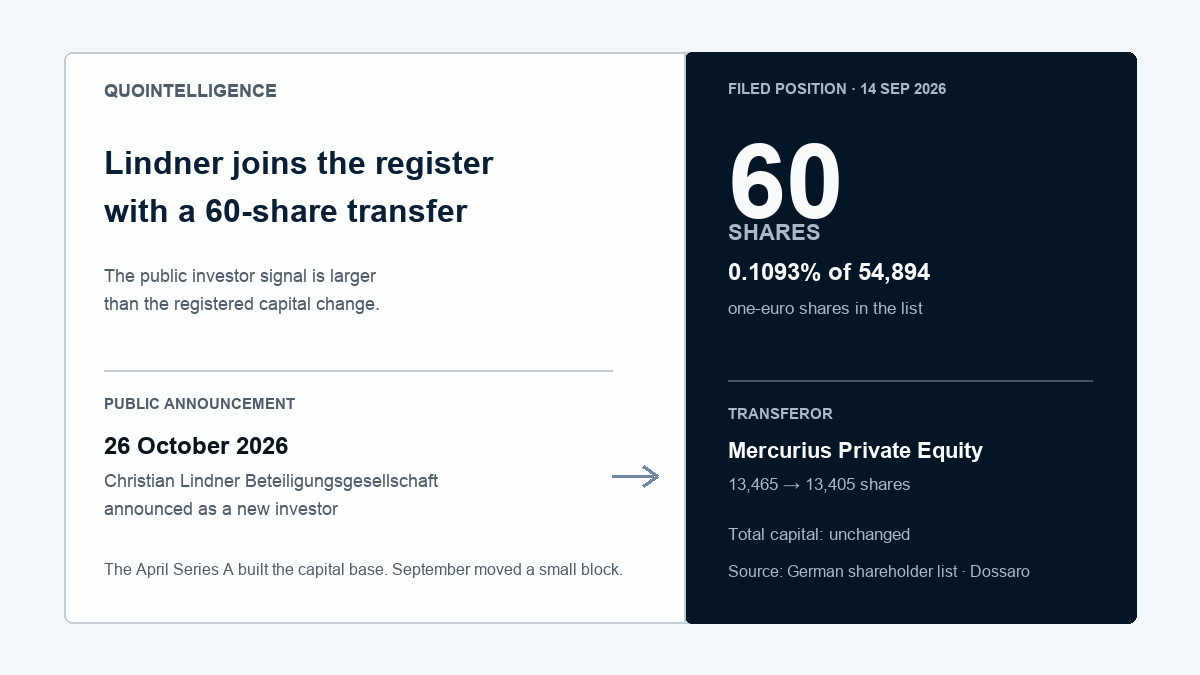
Christian Lindner's new QuoIntelligence stake is small on the register: 60 shares transferred from Mercurius Private Equity, equal to about 0.1093% of the company's unchanged €54,894 nominal capital.
That is not the same thing as saying the investment is unimportant. QuoIntelligence announced Lindner as a new backer on 26 October, and the former German finance minister brings a public profile and a potentially useful network to a European cybersecurity company. But the latest shareholder list changes the business reading of the announcement. The legal event visible after the April Series A is a secondary transfer, not a new capital increase or an obvious change of control.
The new investor is a 60-share transfer
QuoIntelligence's announcement says Lindner invested through Christian Lindner Beteiligungsgesellschaft after the company completed a €7.3 million Series A in April. It does not disclose the price or financial terms. Independent coverage by EUVC and Vestbee reports the same undisclosed investment and the same April financing context.
The German shareholder list recorded on 14 September gives the first hard view of the new position. Christian Lindner Beteiligungsgesellschaft mbH is listed with 60 one-euro shares and a total participation of 0.1093%. The change column labels the entry “Abtretung”, the German term for a transfer. The same list records total capital of 54,894 shares.
The preceding list, recorded on 21 May after the April capital increase, also showed 54,894 shares. It contained no Lindner vehicle. Mercurius Private Equity held 13,465 shares, or 24.53%, in that earlier state. In September, Mercurius held 13,405 shares, or 24.42%. The 60-share reduction matches the new Lindner position exactly.
| Filed state | Total nominal capital | Lindner vehicle | Mercurius Private Equity | What changed |
|---|---|---|---|---|
| 21 May 2026 | 54,894 shares / €54,894 | Not listed | 13,465 shares / 24.53% | Post-Series A baseline |
| 14 September 2026 | 54,894 shares / €54,894 | 60 shares / 0.1093% | 13,405 shares / 24.42% | 60 shares transferred; no new issue |
The arithmetic is simple but commercially useful. 60 / 54,894 is approximately 0.1093%. Total capital changed by zero. On the filed share count, Lindner entered the company without adding a new nominal share to the capital base.
The April financing built the investor base
The small September transfer makes more sense against the financing that came first. QuoIntelligence's April announcement says Elevator Ventures, the venture arm of Raiffeisen Bank International, led the €7.3 million Series A with BMH Beteiligungs-Managementgesellschaft Hessen. eCAPITAL Entrepreneurial Partners and Mercurius Private Equity also participated, according to the company's release.
The 21 May shareholder list is the register baseline after that transaction. It shows eCapital V Technologies Fonds at 24.89%, Mercurius at 24.53%, founder Marco Riccardi at 11.39%, Cyber Custodes Holding at 11.38% and EV II EuVECA at 9.76%. The April financing therefore created the institutional shareholder base into which Lindner entered later.
The distinction matters for investors reading the public sequence. The April round is the documented capital-formation event. The September update moves a small block between existing and new holders. It does not show a further issue, a fresh nominal capital amount or a share-count-based control shift. Nor does the list establish the full economics of the transfer: the price, any premium, and any rights attached to the transaction are not public in the sources used here.
This is a familiar separation in private-company finance. A primary financing sends new money to the company and expands the issued share base. A secondary transfer moves existing equity between holders. Both can be described as an investment, but they answer different questions for a buyer, investor or employee considering the cap table.
The difference also appears in other private-market funding structures. Risk Ledger's Series B shows how named cash allotments can change the ranking of an investor and a founder. CloudNC's Series B filing shows the other side of the problem: a financing headline can sit beside a new share class whose subscriber map and economics are not fully visible. In QuoIntelligence's case, the visible fact is narrower: a new name joined the register through a 60-share transfer.
A small stake can carry a large signal
The register cannot price Lindner's public profile or the access he may bring. QuoIntelligence describes him as backing its European cybersecurity growth, and Lindner's quoted statement frames the company as a European technology business in a strategically important market. That positioning is consistent with QuoIntelligence's commercial pitch around European digital sovereignty, threat intelligence and regulatory demand from NIS2 and DORA.
The company also has an operating record that gives the signal a business context. QuoIntelligence says the European Union Agency for Cybersecurity awarded it a four-year, €1.4 million contract in 2025. The April release reported zero client churn in 2025 and nearly sixfold growth in customer lifetime value since 2023. Those are company-reported metrics, not independent financial statements, but they explain why a recognizable investor can matter even without a large registered position.
That strategic value should not be confused with new financing capacity. A 0.1093% holding does not establish control, a board seat or a veto. It does not reveal whether the transfer was paid at the April round price, at a discount, at a premium or under a separate arrangement. The list makes ownership visible; it does not measure the network effect.
The straightforward commercial explanation is that Lindner's vehicle wanted a small direct position while Mercurius recycled part of its holding. That can give the company a prominent supporter without asking the company to issue another share class or reopen the April financing. It can also let an existing investor realise a small part of its position while remaining a 24.42% holder.
The public announcement therefore carries two different forms of information. It tells the market that QuoIntelligence has added a politically prominent backer. The shareholder list says the registered economic step was modest and secondary. For venture and growth investors, the distinction affects how the event should enter a financing model: as a signal about investor coalition and access, not as evidence of new cash, valuation or control.
The price and rights remain private
The filings establish the transfer but not its consideration. The company did not disclose financial terms, and neither independent summary reports a price or fresh use-of-funds commitment. The register also does not show whether the 60 shares carry side-letter rights, information rights, advisory status or any other arrangement outside the shareholder list.
Those gaps are not a reason to dismiss the transaction. They define what the public record can support. It is safe to say that Lindner's vehicle holds 60 shares and that Mercurius transferred the same number. It is not safe to assign a euro amount, say that QuoIntelligence received no value, or describe Lindner as a controlling or strategic shareholder on the basis of the share count alone.
The next filing will decide whether the public signal becomes a larger economic position. A later shareholder list could show another allotment, a further transfer or a different holder balance. A deed or public agreement could disclose the price or rights. Until then, the strongest source-backed reading is precise: Christian Lindner joined QuoIntelligence's post-Series A shareholder group through a 60-share secondary transfer, while the registered capital base stayed at €54,894.
For investors, that changes the question they should ask next. The issue is not whether Lindner is on the cap table. He is. It is what the company and the investor paid for the position, what rights came with it, and whether the public signal eventually turns into a larger financing or governance event.
Continue reading
Related Research
Risk Ledger's £24m Round Put Axiom Ahead Of Its Founder
UK filings show Axiom became Risk Ledger's largest individual shareholder as £18.5m of cash allotments trailed the announced £24m Series B headline.
CloudNC’s $20m announcement sits beside a voting preferred-share filing
CloudNC announced $20m, while its latest SH01 records 44.9m voting Series B shares with priority economics, no named allottees and no direct currency match.
Cognitive Credit’s $40m Growth Investment Sits Beside a New HSBC Security Layer
Cognitive Credit announced a $40m Summit-led investment, while filings show 876 new shares and an outstanding HSBC security over its IP and business.
Epoch's $4.25m Seed Came With 670,087 Preferred Shares
Epoch's $4.25m seed sits beside 670,087 preferred shares, $6.26m of filed paid-in amounts, a Burnt Island board appointment and a June issue window.