
Universal Quantum's $100m Round Entered a Negotiated Preference Stack
Universal Quantum's $100m Series A met existing preference, anti-dilution and participation rights, while post-round ownership remains undisclosed.
On this page
Conduct your own private market research
Add dossaro to Claude or ChatGPT and run source-backed register research from your own workspace.
 Add to Claude
 Add to ChatGPT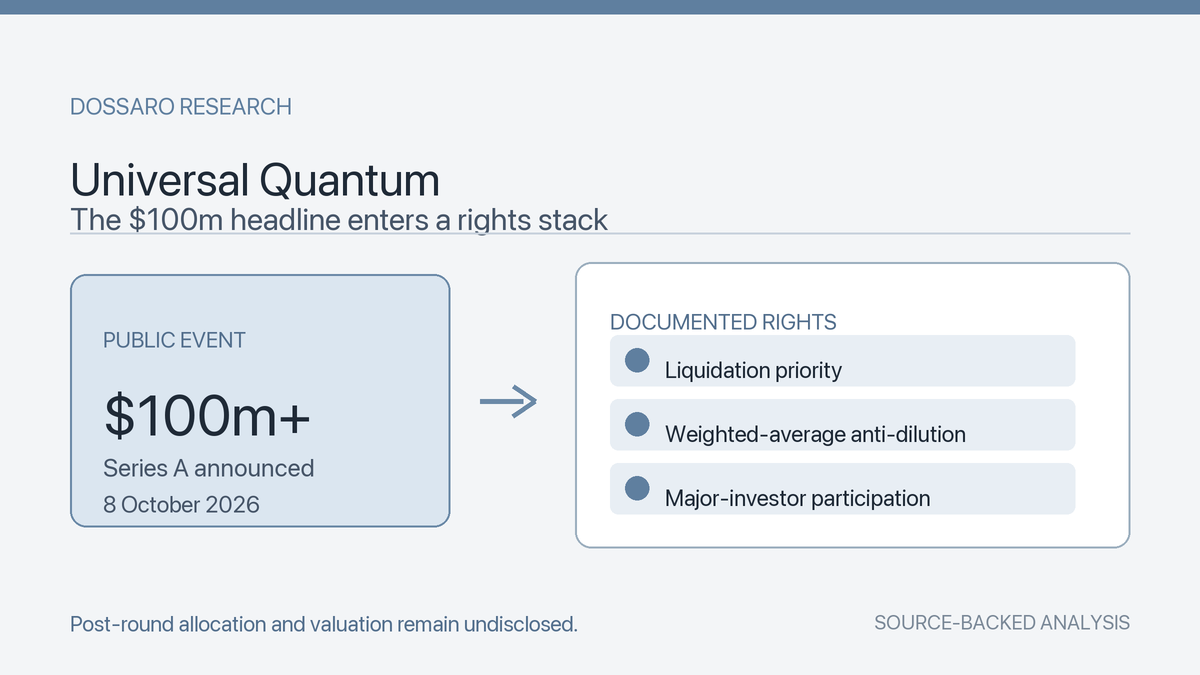
Universal Quantum's record Series A was announced as a quantum-computing milestone. The more consequential finding is in the company's existing legal architecture: Series A investors already have a priority claim in a liquidation or exit, broad-based weighted-average protection against a cheaper issue, and a route to participate in future allotments. The round's headline is public. Its precise post-round ownership and dilution are not.
Nauta Capital said on 8 October 2026 that Universal Quantum had secured more than $100 million in Series A funding, the largest Series A raised by a UK-headquartered quantum company. The announcement named DCVC and Firgun Ventures as co-leads and listed EDBI, Artal, Integral GlobalTech, Main Sequence, Hostplus, NGS Super, IAG Capital, EdenBase, Eigenstate Holdings, SiteGround Capital, Nauta, The Venture Collective and Roblox founder Dave Baszucki among the participants. The Cap Table reported the amount as $100 million, total funding above $125 million and no disclosed valuation. Nauta's announcement and Quantum Computing Report's independent coverage confirm the date, round and syndicate.
That is enough to establish the financing event. It is not enough to calculate the ownership outcome. The 23 June 2026 articles filed at Companies House, adopted by a member resolution dated 31 May, show why: the round entered a negotiated preference and control stack rather than a blank ordinary-share register.
The legal rights were in place before the cheque was announced
The filed articles give Series A holders the greater of their preference amount or their as-converted share of proceeds before ordinary shareholders in a liquidation or exit. The wording does not disclose the preference amount or the number of Series A shares held by each investor, so it cannot produce a payout model. It does establish the order of the economic waterfall.
The same document gives Series A holders a conversion route. The class can convert into ordinary shares at the applicable conversion ratio, and automatic conversion is tied to specified events such as a qualifying IPO or SPAC transaction. That makes the instrument economically two-way: a preference claim in a downside or negotiated exit, with the option to take ordinary economics when those are more valuable.
The articles also contain broad-based weighted-average anti-dilution protection. If the company issues new securities below the relevant starting price, the formula can create additional Series A shares for the affected investors, subject to the article's conditions and any investor-majority waiver. This is not a promise that a future down round will be prevented. It is a mechanism for shifting part of the dilution risk back toward the company and the other holders.
The practical stack can be read as follows:
| Documented term | Who benefits | Commercial effect | What remains unknown |
|---|---|---|---|
| Liquidation preference | Series A holders | Priority claim before ordinary holders, with an as-converted alternative | Preference amounts, seniority between investors and final payout |
| Broad-based weighted-average anti-dilution | Series A holders | Additional shares may be issued after a qualifying lower-price issue | Starting prices, investor holdings and any waiver |
| Major Investor participation and pre-emption | Qualifying major investors | Pro-rata access to new securities and a path to maintain exposure | Which named funds qualify and how much each will take |
| Class and investor-majority consent | Relevant classes and investor majority | Some rights changes and issuances require a defined consent route | The voting threshold applied to this financing |
The table describes the rights architecture, not a reconstructed cap table. The Companies House articles artifact is the primary source for the clauses.
A large allotment authority is not evidence of shares issued
The written resolutions filed alongside the articles authorised directors for five years to allot shares or grant rights to subscribe for or convert securities up to an aggregate nominal amount of £115.10684. At the articles' £0.00001 nominal value per ordinary share, that nominal ceiling would correspond to as many as 11,510,684 shares if every pound of authority were used for shares at that nominal value. That is a capacity calculation, not evidence that those shares were issued, nor evidence of the price paid for them.
The same resolutions disapplied statutory and contractual pre-emption for allotments made under that authority and adopted the new articles. The resolution artifact therefore explains how the company could execute a financing within the new framework. It does not identify the investors in the October round or tell us whether the authority was used.
The filing history shows why that distinction matters. A 5 June 2024 SH01 recorded 15,480,250 ordinary shares. A 11 December 2024 SH01 recorded 16,099,289 ordinary shares after allotments dated 28 November. A 31 October 2025 SH01 recorded 16,395,701 ordinary shares after allotments dated 1 October. Those filings show a long-running ordinary-share history, but they do not expose the Series A allocation or the price of the new financing announced in October 2026.
The 2025 filing, for example, lists multiple ordinary allotments with different amounts paid per share and one non-cash allotment. It would be unsafe to add those lines together and label the result a venture round. The filings establish issued capital at their own dates. They do not convert an announced dollar amount into an investor-by-investor denominator.
Founder control remains a separate question
Companies House currently records Dr Sebastian Weidt and Prof Dr Winfried Karl Hensinger as active persons with significant control, each in the more-than-25%-and-up-to-50% bands for shares and voting rights. The PSC records for Weidt and Hensinger are source-native control disclosures. They are not a post-round cap table, a beneficial-ownership opinion or proof that either founder owns a specific percentage after the Series A.
The current officer list also shows the two founders as directors alongside Zeynep Koruturk, appointed in July 2026. That governance surface is useful context for the rights in the articles, but it does not answer who funded the round, who holds the Series A class or how the new money changed voting power.
This separation is not a technicality. ZuriQ's preferred-share filing shows how a public funding headline can sit beside class-specific rights that are visible only in the articles. Reactive Technologies' debt and preference stack shows a related risk-transfer problem where a financing instrument and ordinary equity should not be treated as the same economic layer. Universal Quantum's PSC records provide a control signal; they do not replace the missing financing documents.
The counterposition: standard terms can still be material
These provisions may be standard venture terms and may have been negotiated before the 8 October announcement. The filed articles do not say that each clause was created for this particular close, and the public release does not identify the subscription agreement, issue price, share count or investor allocation. The rights could also be amended, waived or superseded by financing documents that have not yet appeared in the register.
That uncertainty should narrow the claim, not erase the signal. A round above $100 million entering a company with a Series A preference, down-round protection and major-investor participation mechanics has a different risk profile from the same cheque issued as unqualified ordinary shares. The legal stack determines who gets first access to value, who can defend exposure in a cheaper financing and who has a route to stay in the next issue.
What the next filing should answer
The next decisive evidence would be a share allotment, confirmation statement, subscription agreement or other financing instrument that identifies the issuing entity, the number and class of securities, the issue price and the investors' allocation. A later filing could show whether the £115.10684 authority was used, whether Series A shares were issued directly or through rights that convert later, and how the new capital sits alongside the ordinary register.
Until that evidence appears, the strongest source-backed description is precise: Universal Quantum announced a UK-record Series A of more than $100 million, while its June articles already gave Series A investors priority, broad-based weighted-average anti-dilution and participation rights. The founders remain visible in source-native PSC records, but the post-round ownership percentages and the economic price of those protections are not public.
For researchers who need to keep shareholder, PSC and filing-date surfaces separate, the UK Companies House source guide sets out a repeatable evidence workflow. That discipline is what keeps a financing headline from becoming an invented cap table.
Continue reading
Related Research
ZuriQ's $25.5m Seed Created A 28.6% Preferred Block
ZuriQ's $25.5m seed closed legally in May, creating a 28.6% preferred block and adding a Quantonation-linked director before its July reveal.
Reactive Technologies’ €19m EIB Debt Meets a £25m Preference Stack
Reactive Technologies’ €19m EIB debt is non-dilutive, but filings show £25m of Series D preference rights and an HSBC charge over IP and assets.
Foundational's £8.2m Pre-Seed Put Preferred Shares Ahead of Founders
Foundational's £8.2m pre-seed left 480,827 preferred shares ahead of founder ordinary stock, revealing the priority stack behind its satellite-laser launch.
Adaptyv's $40m Series A Sits Above a Parent-Owned Swiss Lab
Adaptyv announced a $40m Series A, while its Swiss Sàrl record shows a US-parent-owned launch and no public post-round investor split or dilution map.