
Reactive Technologies’ €19m EIB Debt Meets a £25m Preference Stack
Reactive Technologies’ €19m EIB debt is non-dilutive, but filings show £25m of Series D preference rights and an HSBC charge over IP and assets.
On this page
Conduct your own private market research
Add dossaro to Claude or ChatGPT and run source-backed register research from your own workspace.
 Add to Claude
 Add to ChatGPT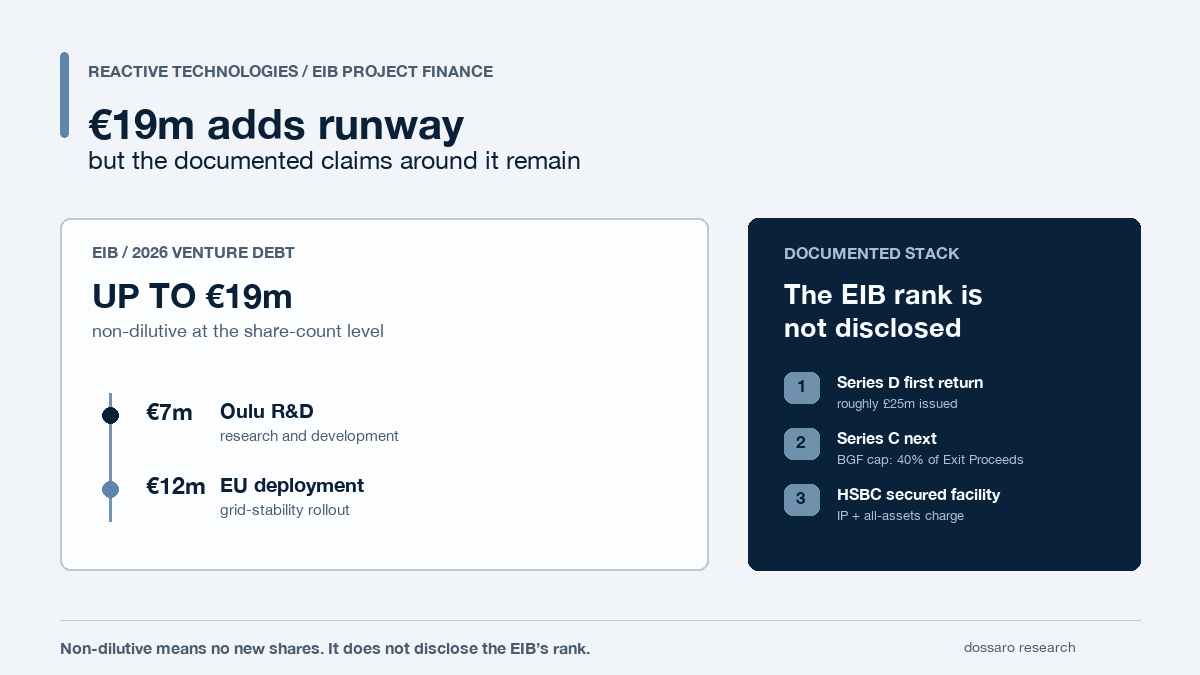
The European Investment Bank has announced up to €19 million of venture debt for Reactive Technologies, a grid-stability company expanding its measurement platform. The financing is described as non-dilutive. Companies House filings show why that adjective is only one part of the story: the company already has a roughly £25 million Series D preference layer, a later filing that preserves a return-of-capital order, and an HSBC facility secured over intellectual property and the wider asset base.
The public documents do not disclose where the EIB loan ranks against HSBC or whether EIB has security. They do show that new debt arrives beside, not instead of, a documented set of shareholder and lender claims. The commercial question is therefore not simply whether Reactive avoids issuing more shares. It is how much operating and exit value must eventually serve the claims already on the stack.
The EIB money funds a grid expansion, but its rank is not public
The EIB announcement describes a €19 million venture-debt package for Reactive Technologies. It allocates up to €7 million to research and development in Oulu and €12 million to deployment across the European Union, with InvestEU and TechEU support. The EIB project register records three signatures on 6 August 2026, while the public announcement was dated 23 September 2026. Those are different milestones for the same project, not two separate financings.
The EIB project record and an independent Undiluted account put the project cost at roughly €40 million. Undiluted reports the three signed facilities as €12 million, €4.42 million and €2.58 million. The public material does not state an interest rate, maturity, draw schedule, covenant package, security or intercreditor position. No EIB charge appears in the Companies House records reviewed for this article.
That absence is a boundary, not a conclusion that the loan is unsecured. The EIB package can be growth finance, and the sources give no basis to call it a rescue or a refinancing of HSBC. It is safer to say that the company has new debt-funded capacity while the EIB’s place in the priority order remains undisclosed.
The 2024 Series D created a first-return layer
Reactive’s 8 March 2024 SH01 return of allotment records 4,516,575 ordinary shares issued at £5.535168837 per share including the premium. Multiplying the filed quantity and displayed price produces approximately £25,000,005, so the defensible description is a roughly £25 million Series D issuance rather than an exact price claim. The filing increased the ordinary class to 16,048,755 shares before later updates.
The Series D allotment is only the issuance record. A subsequent 20 February 2025 confirmation statement contains the economic terms that matter for a future return of capital. It says Series D is returned first, subject to the conditions in the articles and statement, followed by Series C. Ordinary and growth shares come after those classes. The same filing says the BGF investors’ aggregate proceeds are capped at 40% of Exit Proceeds unless they elect to disapply that cap.
The wording does not reveal the preference amount, a conversion decision or the price at which an exit would occur. It does establish a contractual order. If the company eventually produces a return of capital, the Series D and Series C layers are not economically equivalent to ordinary shares simply because all of them appear in one issued-share total.
| Layer | Publicly documented fact | What it does not show |
|---|---|---|
| EIB, 2026 | Up to €19m venture debt, split between R&D and EU deployment | Rank, security, pricing, maturity or covenants |
| Series D, 2024 | 4,516,575 ordinary shares at a displayed £5.535168837 per share, roughly £25m | Final proceeds, conversion choice or the full preference amount |
| Series C and BGF, 2025 | Series C follows Series D; BGF proceeds are capped at 40% of Exit Proceeds unless disapplied | Which investors exercise which rights at an exit |
| HSBC, 2025 | £7m facility with fixed IP and floating all-assets security in the filed charge | Current drawn balance, recoveries or intercreditor terms |
The StandardX preferred-share record shows the same analytical distinction: an investment headline and a filed priority right answer different questions. For Reactive, the Series D headline is the capital raised. The confirmation statement is the evidence for who is first in the shareholder return order.
The latest register shows a concentrated institutional base
Reactive’s 2026 confirmation statement records 16,088,755 ordinary shares, 741,367 deferred shares and 47,710 growth shares, for 16,877,832 shares across the listed classes. The schedule names M&G Catalyst Capital Fund with 4,155,248 ordinary shares, BGF Nominees with 2,145,121, Breakthrough Energy Ventures II with 1,611,469 and Equinor Ventures AS with 1,313,007. RES UK & Ireland appears with 972,816; Eaton Intelligent Power with 464,684; Accenture with 189,672; and Toshiba Corporation with 104,646.
These are filed positions in a confirmation-statement schedule, not a current beneficial-ownership analysis. Nominee entries can stand between the register and the ultimate investor, and the statement does not turn each line into a control conclusion. The useful point is narrower: the capital base remains institutionally concentrated while the preference terms documented in the previous filing continue to frame the shareholder side of the stack.
HSBC already has a claim over the operating asset base
The 17 December 2025 MR01 charge records a security package in favour of HSBC UK Bank PLC. It identifies a fixed charge over the GRID-SONAR trademark and patents EP2577832 and GB2480705, a floating charge over the company’s property and undertaking, and a negative pledge. In plain terms, the filing gives HSBC a documented claim over specified intellectual property and the wider asset base. It does not disclose how much of the facility is drawn or what an enforcement outcome would recover.
Reactive’s FY2025 group accounts add operating context. The accounts report £2.806 million of revenue, a £10.696 million loss and 67 employees for the year ended 30 March 2025. They also describe a contracted pipeline above £68 million and more than 240 patents. The accounts say the £7 million HSBC facility was extended on 16 December 2025: £2 million is due in December 2026, £0.5 million in April 2028, £0.5 million in September 2028 and £4 million in December 2028. The going-concern note says the extension provides funding for operations, debt service and investment.
Those numbers should not be read as evidence that EIB money is a rescue. They explain why a long-dated, asset-secured facility matters commercially: growth projects can create value, but cash generated by those projects is not available to every claimant on equal terms. The HSBC charge is a filed fact; its practical recovery value is not.
“Non-dilutive” describes shares, not every risk
For ordinary shareholders, the EIB financing avoids a new allotment and therefore avoids immediate dilution in the share count. It does not remove the Series D and Series C return-of-capital order, the BGF proceeds cap, or the HSBC security package. Those claims can affect what remains for ordinary and growth holders even if the company never issues another share.
For the company, debt can preserve ownership while funding the Oulu R&D programme and EU deployment. It also creates repayment obligations whose terms are not public in the announcement. For the EIB, the public record confirms a development objective and a total commitment, but not the downside protection or rank that would be needed to model its economics. For HSBC, the charge establishes priority over specified collateral, subject to the underlying documents and any intercreditor arrangements.
This is why “non-dilutive” should be treated as a description of the financing instrument, not a conclusion about risk. The share count can stay stable while the claims on future cash flow become more layered.
The next document that matters is the EIB debt layer
The current evidence supports a precise thesis: Reactive Technologies has paired a large public project-finance commitment with an existing preference stack and an asset-secured bank facility. Its growth plan may be constructive, but the public record does not yet tell investors whether the EIB debt is senior, subordinated, unsecured, secured by a different pool, or governed by a separate intercreditor agreement.
The decision-changing watchpoint is therefore not another rounded funding headline. It is an EIB term sheet, charge, accounts note or later filing that identifies security, maturity, covenants, repayment and ranking. A future confirmation statement can also update the shareholder positions, but it is unlikely to answer the debt question on its own.
Until that document appears, the responsible reading is neither “EIB rescued the company” nor “EIB debt is harmless.” It is that Reactive has non-dilutive capital for grid expansion, while the filed Series D preference rights and HSBC security already define important parts of the economic order around that capital.
Continue reading
Related Research
StandardX's £10m Seed Round Put Two Preferred Classes Ahead of Ordinary Shares
StandardX announced a £10m isotope seed. Companies House filings show £9.81m of priced allotments, senior preferred rights and a pre-round funding gap.
Basecamp’s $140m Series C Put a Preference Waterfall Behind the Headline
Basecamp’s $140m Series C was filed in staged C1 and C2 allotments with a 1x preference priority, a pre-emption waiver and no public allocation by investor.
Qureight's $20m Round Sat Above Preferred Equity and HSBC Security
Qureight's $20m Series B followed a £2m senior C1 issue and four HSBC security filings, placing lenders and preferred capital ahead of older equity.
Ethris's €30m EIB Debt Followed a 2.7% Gates Equity Step
Ethris secured €30m of EIB venture debt after a 2,723-share Gates Foundation capital increase diluted existing holders by about 2.7% in the latest July list.