
StandardX's £10m Seed Round Put Two Preferred Classes Ahead of Ordinary Shares
StandardX announced a £10m isotope seed. Companies House filings show £9.81m of priced allotments, senior preferred rights and a pre-round funding gap.
On this page
Conduct your own private market research
Add dossaro to Claude or ChatGPT and run source-backed register research from your own workspace.
 Add to Claude
 Add to ChatGPT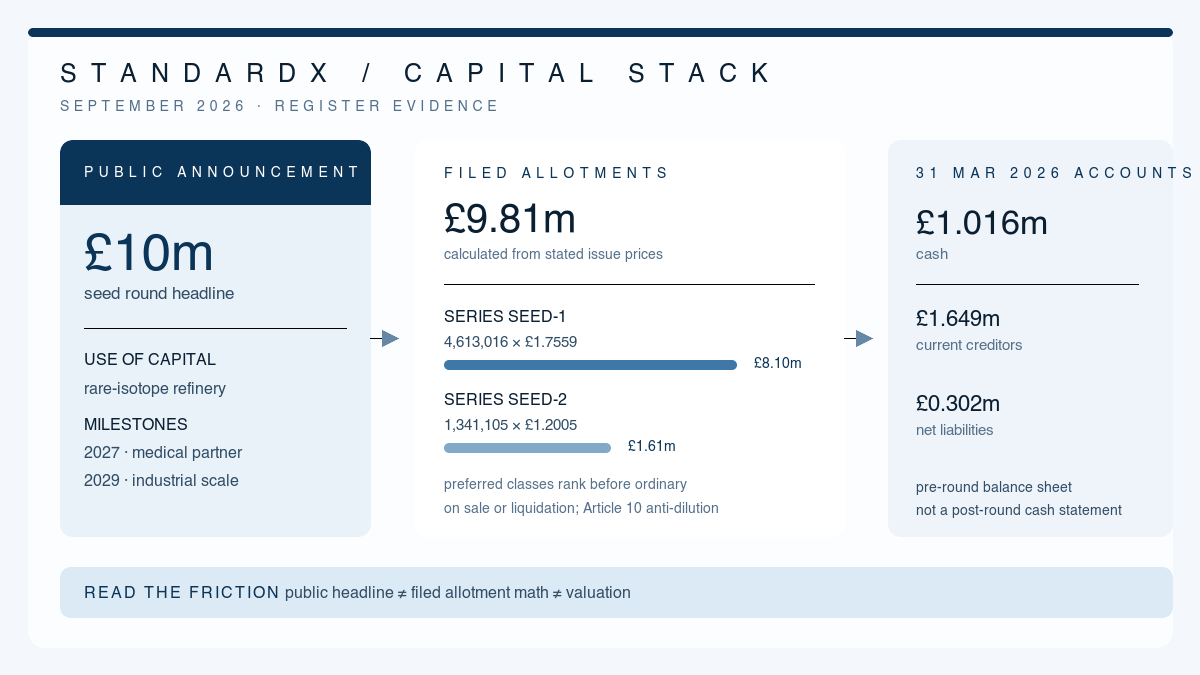
StandardX's public £10m seed round left a detailed legal trail. Companies House filings show two preferred share classes priced across several August allotments, with about £9.81m of filed allotments calculated from the stated issue prices. Those classes rank ahead of ordinary shares on a sale or liquidation and carry anti-dilution rights.
The latest accounts add a second layer of context. At 31 March 2026, StandardX reported £1.016m of cash against £1.649m of current creditors and net liabilities of £0.302m. The accounts pre-date the September announcement, so they are not a post-round cash statement. They do show why a long production plan for rare isotopes makes the structure commercially important: the company was financing a business with a near-term balance-sheet hole before it announced the round.
The filings do not establish a valuation, a fully diluted cap table or an individual investor's control. They do establish the legal sequence and the order in which different classes sit in the capital stack.
The £10m headline and the £9.81m filed footprint
StandardX's 23 September announcement says the company raised a £10m seed led by Vsquared and East X, with firstminute, UKI2S, Brevan Howard Macro Venture and Geometry. It says the money will support the isotope-refinery programme, with first isotope production for a medical partner targeted for 2027 and industrial production targeted for 2029. Startup.eu's independent deal report reports the same sterling headline and investor group.
The UK filing trail is more granular. Three returns of allotment state the number of shares issued and the amount paid on each share. The final confirmation statement, filed after the allotments, reports the resulting issued share classes. Applying the stated prices to the filed quantities gives the following picture:
| Filed component | Shares | Stated price per share | Calculated amount | Capital-stack meaning |
|---|---|---|---|---|
| Series Seed-1 | 4,613,016 | £1.7559 | £8,099,994.79 | Preferred class with sale and liquidation priority; Article 10 anti-dilution rights |
| Series Seed-2 | 1,341,105 | £1.2005 | £1,609,996.55 | Preferred class with the same stated priority and anti-dilution language |
| Ordinary allotment | 56,950 | £1.7559 | £99,998.51 | Ordinary shares with full voting, dividend and capital-distribution rights |
| Total priced allotments | 6,011,071 | £9,809,989.85 | Rounded filed footprint of about £9.81m |
The table's share total is not a separate issued-share denominator because the returns cover different allotment events and the final confirmation statement is the authoritative total. The £9.81m figure is the sum of the three calculated amounts, not a claim that the company raised exactly £9.81m instead of £10m. Rounding, timing, instruments and transaction terms can explain why a public headline and filed allotment arithmetic do not match to the pound. The reviewed public record does not say which explanation applies.
Two preferred classes sit ahead of ordinary shares
The confirmation statement reports 16,164,401 issued shares: 75,000 deferred, 10,135,280 ordinary, 4,613,016 Series Seed-1 and 1,341,105 Series Seed-2. The class particulars are more informative than the nominal share count.
Series Seed-1 holders are entitled to notice of, attendance at, and votes at general meetings. They receive dividends pari passu with other equity holders, but on a liquidation they receive distributions after the deferred shares and before the ordinary shares. The same order applies to sale proceeds. The filing also says Seed-1 benefits from the anti-dilution rights in Article 10.
Seed-2 has the same published order: after deferred shares and before ordinary shares on a liquidation or share sale, with the same Article 10 anti-dilution reference. Ordinary shares have full voting, dividend and capital-distribution rights, but they sit behind both preferred classes in the stated waterfall.
This is the practical difference between a financing headline and a capital stack. A preferred class can be first in line for the value available at an exit without being a majority of the issued shares. The filings do not disclose the multiple, participation election, conversion mechanics or other protections that would determine how much value that priority represents.
The distinction is familiar in private-company diligence. Basecamp's Series C preference waterfall shows why a headline round amount cannot be read as a simple common-share price. StandardX's filing goes one step earlier in the story: it identifies the classes and their priority before a later document discloses the negotiated economics.
The shareholder schedule shows a concentrated preferred block
The 21 August 2026 confirmation statement names the principal preferred holders. Vsquared Ventures III GmbH & Co. KG held 2,448,886 Seed-1 shares, equal to 15.2% of all issued shares and 53.1% of the Seed-1 class. EXV Starmaker One LP held 1,139,017 Seed-1 shares and 832,986 Seed-2 shares, or 1,972,003 preferred shares in total and 12.2% of all issued shares.
The schedule also records 569,508 Seed-1 shares for Brevan Howard Macro Venture Fund I, 79,731 Seed-1 and 208,246 Seed-2 for Firstminute capital III, 222,108 Seed-1 for Geometry Fund I, and 208,246 Seed-2 for The UK Innovation & Science Seed Fund. These are legal shareholder positions at the confirmation date. They are not a valuation table, and they do not reveal side letters or board rights.
The founders retain a large ordinary position. Ross Antonie Micheal Allen and Richard John Pearson each held 4,875,000 ordinary shares. Together that is 9.75m shares, about 60.3% of the final issued count by nominal share number. Each person's PSC record is in the 25–50% band. That supports a description of shared founder ownership, not an assertion that either individual holds more than 50% or that the investors have taken control.
EXV Starmaker One LP is the named shareholder vehicle. The public announcement associates the round with East X, and the vehicle's general-partner chain can be followed through the register. It is more precise to describe an East X-related vehicle or control chain than to say that East X personally owns the shares.
The balance sheet explains the financing pressure
StandardX's accounts for the year ended 31 March 2026 report £244,935 of fixed assets and £1,102,386 of current assets, including £1,016,293 of cash. Creditors due within one year were £1,649,301. The result was net current liabilities of £546,915 and net liabilities of £301,980. The creditors note includes £1,610,000 of convertible loans, £6,979 of trade creditors, £23,111 of tax and social-security liabilities and £9,211 of other creditors. Average headcount was six.
Those numbers are not a warning that the seed failed. They are a timing marker. The accounts were approved on 27 August 2026, before the 23 September public announcement. They therefore describe the company that entered the financing process, not the cash position after the round. They also explain why the preferred terms matter to counterparties: a business moving from laboratory and refinery development to medical and industrial production needs capital that can bridge a long path to revenue, while the preferred investors have a documented priority in a sale or liquidation.
The public timetable makes that bridge concrete. StandardX says medical-partner production is targeted for 2027 and industrial production for 2029. Nothing in the reviewed filings proves that the stated £10m is sufficient for those milestones, or that the company will not need another round, debt, grants or customer financing. It does show that the seed was raised against a balance sheet with current creditors larger than cash.
What the filings establish, and what remains open
The strongest supported conclusion is narrow. StandardX announced a £10m seed for isotope-refinery development. Companies House filings then recorded priced allotments calculated at about £9.81m, split between Series Seed-1, Series Seed-2 and a small ordinary allotment. Both preferred classes rank ahead of ordinary shares on a sale or liquidation and carry a stated anti-dilution reference. The founders retain shared ordinary ownership, while the investor schedule shows a concentrated preferred block led by Vsquared and an East X-related vehicle.
The filings do not disclose the valuation, the subscription agreement, the liquidation multiple, board appointment rights, conversion choices or post-round cash. They also do not prove that the difference between £10m and £9.81m is a missing payment. A later confirmation statement, a post-round shareholder filing or accounts covering the period after September would connect the legal capital to the economic outcome.
For now, the next document to watch is not another funding headline. It is the record that shows how the two preferred classes were negotiated and how the filed shares changed the company's post-round economics.
Continue reading
Related Research
Basecamp’s $140m Series C Put a Preference Waterfall Behind the Headline
Basecamp’s $140m Series C was filed in staged C1 and C2 allotments with a 1x preference priority, a pre-emption waiver and no public allocation by investor.
Open Cosmos' Founder Held About 41% Before Its €300m Round
Open Cosmos' €300m round sits above a register where founder Rafael Jorda held about 41% of stated capital and preferred shares ranked ahead of ordinary.
ZuriQ's $25.5m Seed Created A 28.6% Preferred Block
ZuriQ's $25.5m seed closed legally in May, creating a 28.6% preferred block and adding a Quantonation-linked director before its July reveal.
Trigify’s HubSpot Exit Left 2,149 B Shares Unexplained
Trigify said its team was joining HubSpot. Companies House filings show fund:AI’s 5.68% A-share position and 2,149 non-voting B shares issued on 23 September.