
Trigify’s HubSpot Exit Left 2,149 B Shares Unexplained
Trigify said its team was joining HubSpot. Companies House filings show fund:AI’s 5.68% A-share position and 2,149 non-voting B shares issued on 23 September.
On this page
Conduct your own private market research
Add dossaro to Claude or ChatGPT and run source-backed register research from your own workspace.
 Add to Claude
 Add to ChatGPT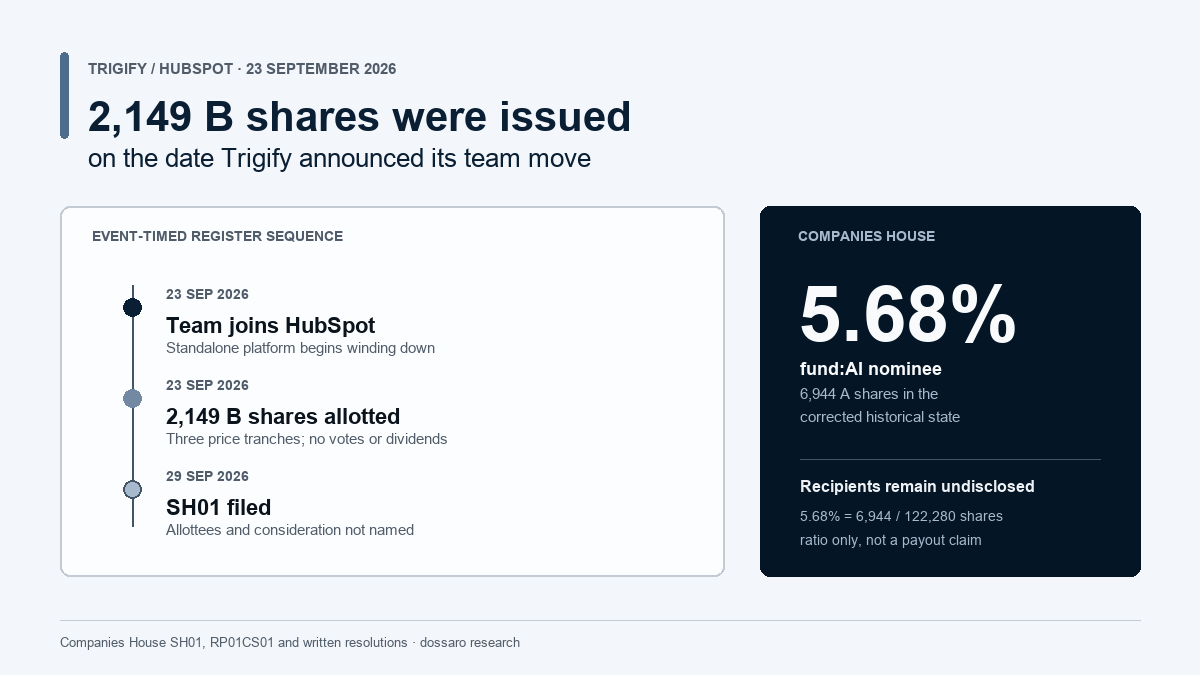
Trigify said on 23 September that its team was joining HubSpot and that the standalone platform would be wound down. The Companies House record filed six days later adds a material capital-stack fact: 2,149 B ordinary shares were allotted on the same 23 September date in three stated price tranches. The filing does not name the allottees or say that HubSpot received the shares.
The preceding corrected confirmation statement provides another piece of the map. In the latest historical state it records 6,944 A shares for MNL Nominees Limited as fund:AI nominee, equal to 5.68% of the 122,280 shares then on the register. Haatch says it exited its full Trigify position to HubSpot in an all-cash transaction that delivered up to 3.53x for investors. The public exit story and the register therefore point to the same event, but they do not disclose the final holder map or the consideration flowing to each holder.
The public exit story is clear; the consideration is not
Trigify’s announcement describes a team move rather than a conventional product sale. It says HubSpot was attracted to the experience the team developed in signals, data and context, and that the standalone service would be retired. Standard customer access is scheduled to end at 11:59pm BST on 22 October 2026, subject to individual contractual arrangements. The notice also says the Trigify product and customer accounts will not continue inside HubSpot.
Haatch’s exit announcement uses more direct transaction language. It says the full position was sold following Trigify’s acquisition by HubSpot and that the all-cash transaction delivered up to 3.53x for Haatch investors. Wealth Club’s account adds that Haatch’s SEIS fund invested in February 2024 and its EIS fund followed in July 2024, with the investment realised in September 2026.
Those sources establish the commercial outcome reported by the company and an investor. They do not provide a purchase price, a shareholder schedule at closing, or the legal instruments used to settle the position. The register helps with that missing layer, but only up to the facts that were filed.
A corrected historical state puts fund:AI at 5.68%
The key pre-event record is not the earlier uncorrected confirmation statement. Trigify filed a replacement statement for the 11 June 2025 confirmation date. It separates three nominee lines that had previously been collapsed into one MNL Nominees entry. The statement reports 108,610 ordinary shares and 13,670 A shares, or 122,280 shares in total.
| Holder or class in the replacement statement | Filed position | What the record supports |
|---|---|---|
| MNL Nominees Limited as fund:AI nominee | 6,944 A shares | 6,944 / 122,280 = 5.68% of the historical issued total |
| MNL (BBI Haatch) Nominees Limited | 1,680 A and 1,666 ordinary shares | A separate nominee line linked to the corrected schedule; no beneficial-owner allocation is filed here |
| MNL Nominees Ltd | 5,046 A and 6,944 ordinary shares | A separate nominee line; the statement does not convert it into a named investor return |
| Max Miles Mitcham | 82,500 ordinary shares | The named founder position in this historical schedule |
| All classes | 122,280 shares | The denominator for the 5.68% arithmetic, not a fully diluted or closing cap table |
The 5.68% figure is a share-count ratio, not a claim about fund:AI’s economic return. The nominee is the registered holder in the filing; the beneficial owners behind that line are not identified. The statement also does not show whether a later transfer, redemption or exit settlement changed that position before or during the HubSpot transaction.
The control record is similarly time-bound. Max Mitcham remains the active person with significant control in the profile, while Hugo Millington-Drake filed a cessation on 13 July 2026. Neither fact proves who owned Trigify at the point of the HubSpot transaction, and the public notice does not say that HubSpot took a shareholding in the company.
The 23 September allotment created a non-voting class
The event-timed filing is a 29 September SH01 return of allotment. It says the shares were allotted on 23 September, the same date as Trigify’s public announcement. The filing records three B ordinary tranches:
- 1,333 shares at £0.00001 paid per share;
- 350 shares at £16.25069 paid per share; and
- 466 shares at £16.25069 paid per share.
The three tranches total 2,149 B shares. After the allotment, the statement of capital shows 108,610 ordinary shares, 13,670 A shares and 2,149 B ordinary shares, or 124,429 shares in total. The B class carries no voting, dividend or redemption rights. On a winding up or return of capital, it has no A-share preference and is entitled to residual assets pro rata with all non-deferred shares.
The class was not created accidentally in the filing process. Written resolutions dated 31 August authorised directors to allot exactly 2,149 B ordinary shares and disapplied pre-emption rights for that authority. That establishes the legal capacity for the issue. It does not establish the commercial agreement under which the shares were allotted.
This is where a headline exit and a capital register diverge. A transaction can involve an employee, investor, rollover or other settlement instrument without the public filing naming the recipient. Conversely, the B shares may have an administrative purpose that is unrelated to HubSpot’s consideration. The filing supplies the date, class, quantity and stated price per share. It does not supply the allottees, a sale agreement or the reason for the three price points.
Why the timing matters, and why it does not prove a payout
The date sequence is unusually tight: the team move was announced on 23 September, the B shares were allotted on 23 September, and the SH01 was received by Companies House on 29 September. That sequence makes the allotment relevant to the transaction chronology. It does not turn a timing correlation into a payment claim.
The same caution applies to Haatch’s return. Haatch says its full position exited for up to 3.53x, and Wealth Club identifies the EIS and SEIS investment dates. Neither public source says that Haatch held the 6,944 A shares in the corrected Trigify statement, that a fund:AI nominee received a particular amount, or that any of the 2,149 B shares were issued to HubSpot. The register does not show a buyer, a seller, a purchase price or a distribution waterfall.
The StandardX preferred-share record illustrates the distinction. There, filed share classes expose the order of priority even though the public round headline is rounded. Trigify’s B shares expose a dated issuance and a restricted rights profile, but the filing does not expose the contract that connects that issuance to the exit.
The register shows exposure, not the final exit map
For investors, the corrected statement identifies a measurable historical fund:AI exposure and separates it from other nominee lines. For the founders, the register shows that a new non-voting class was authorised before the public transition. For customers, the public notice is more concrete than the register: the standalone service is being retired, access and integrations have a stated end date, and customer data will be retained or deleted under contractual and legal obligations.
None of those records supports a claim that HubSpot bought Trigify’s shares, that the founders received a particular payout, or that the B class diluted voting control. The B shares have no votes, while the existing ordinary and A classes retain their stated voting and dividend rights. Their residual claim may still affect value allocation, but the public filing does not provide the amount of capital available at closing or the agreements that rank each claimant.
The defensible finding is narrower and more useful: Trigify’s public team transition coincided with a new class of 2,149 non-voting B shares, while the last corrected historical statement placed fund:AI’s nominee at 5.68% of the issued share count. That is an event-timed capital fact, not a reconstructed purchase price.
The next filing should connect the shares to the exit
The next decision-changing evidence is a post-23 September confirmation statement or shareholder schedule that identifies the B allottees and any changes to the ordinary and A holders. A transaction agreement, completion statement or later accounts could show whether the B shares were part of a rollover, employee arrangement, investor settlement or another mechanism, and whether the all-cash consideration described by Haatch was paid to registered holders, beneficial owners or a separate vehicle.
Until those records appear, the public evidence supports three statements. Trigify’s team joined HubSpot while the standalone product was retired. Haatch reported an all-cash exit of up to 3.53x. Companies House recorded 2,149 non-voting B shares on the announcement date and a corrected historical 5.68% fund:AI nominee position. It does not yet show who received the new class or how the exit proceeds were allocated.
Continue reading
Related Research
StandardX's £10m Seed Round Put Two Preferred Classes Ahead of Ordinary Shares
StandardX announced a £10m isotope seed. Companies House filings show £9.81m of priced allotments, senior preferred rights and a pre-round funding gap.
Basecamp’s $140m Series C Put a Preference Waterfall Behind the Headline
Basecamp’s $140m Series C was filed in staged C1 and C2 allotments with a 1x preference priority, a pre-emption waiver and no public allocation by investor.
The Public Investors Behind White Star Capital Fund IV
White Star Capital's $250 million Fund IV spans France, Quebec and Guernsey, with Aéroports de Paris and La Caisse named as investors in public filings.
Mistral’s Pimento Deal Swaps 51.7% of the Startup Into Mistral Shares
Mistral’s Pimento acquisition includes a filed swap of 693,056 shares for 244,786 Mistral shares, while the cash leg and sellers remain unnamed.