
WhiteLab's $26m Series B Followed a Parent-Debt Share Conversion
WhiteLab's French SAS was still wholly controlled by its Delaware parent after a 28,669-share debt conversion when the $26m Series B was announced.
On this page
Conduct your own private market research
Add dossaro to Claude or ChatGPT and run source-backed register research from your own workspace.
 Add to Claude
 Add to ChatGPT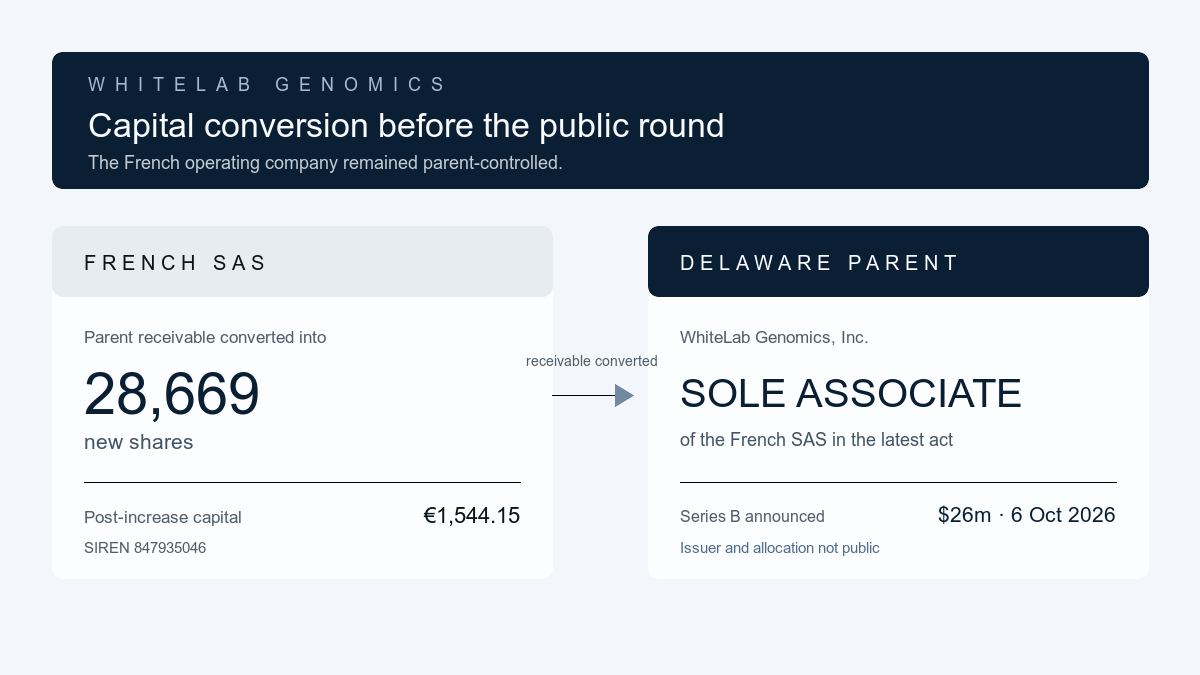
WhiteLab Genomics announced a $26 million Series B on 6 October 2026. The financing led by AVP and joined by Yaday Health and Blast Club is a substantial step for a company building AI-designed delivery systems for genomic medicines. But the latest public French company records show that the round cannot be read directly from the French operating company’s cap table.
Before the announcement, WhiteLab Genomics SAS was still held by one shareholder: WhiteLab Genomics, Inc., a Delaware company. The French entity’s latest visible capital increase added 28,669 shares for that parent and was paid by setting off a current-account receivable. The subscription premium was redacted in the available act. This is not evidence that the Series B investors were absent or that the parent financed the whole round. It is evidence that the legal entity most readers associate with WhiteLab had a parent-led capitalization immediately before the public financing, while the allocation of the new outside money remained above or outside the French register state.
The public round and the legal-entity question
WhiteLab’s official release says the company closed a $26 million Series B led by AVP, with Yaday Health and Blast Club joining existing investors Omnes Capital and Debiopharm Innovation Fund. It says the money will support in vivo validation across viral and non-viral delivery technologies and commercial expansion in North America, Europe and Asia. AVP managing partner François Robinet and Yaday Health managing partner Daniel Teper joined the board in connection with the transaction.
Those facts describe the commercial event. They do not identify the issuer, the share class, the instrument, the amount subscribed by each investor or the post-money ownership of the French SAS. WhiteLab’s own release refers to the company and its platform rather than publishing a cap table. That distinction matters because a French SAS and a Delaware parent can carry different shareholder, board and financing records.
The French entity is WHITELAB GENOMICS, SIREN 847935046, an active société par actions simplifiée registered in Evry-Courcouronnes. Public company data identifies David Delbourgo as president and Julien Cottineau as directeur général. The available French records describe the operating company, but the relevant capital acts place the shareholder relationship one level above it.
A parent receivable became 28,669 French shares
The French capital history starts at €1,000 divided into 100,000 shares. Earlier acts recorded several small increases. A decision dated 27 February 2026, formalized in a 6 March constatation, brought the capital to €1,544.15 and the issued share count to 154,415 by adding 28,669 shares.
The decisive detail is the subscriber. The act identifies WhiteLab Genomics, Inc., file number 6812140 in Delaware, as the sole associate represented by David Delbourgo. The related president’s act says the new shares were subscribed at €0.01 nominal value plus a premium and paid by compensation against the associate’s current-account receivable. The amount of that premium is redacted in the available document, so the French record does not reveal the cash-equivalent value of the conversion.
The updated statutes repeat the capital state and say the French president is subject to the board of WhiteLab Genomics, Inc. Taken together, the documents show a parent-controlled operating company and a capital increase that settled part of a parent claim in shares. They do not show an external shareholder entering the French SAS in February or March.
The arithmetic is straightforward but its meaning needs care:
| Evidence point | Registered fact | What it supports | What it does not support |
|---|---|---|---|
| Before the March 2026 act | €1,257.46 capital and 125,746 shares | The prior French operating-company baseline | A valuation or cash balance |
| 27 February decision and 6 March constatation | 28,669 shares added; capital reached €1,544.15 | A parent-led increase against a current-account claim | The premium amount or the Series B proceeds |
| March statutes | WhiteLab Genomics, Inc. remained sole associate; president subject to its board | Parent-level control of the French SAS | The identity or percentage of Series B investors |
The new shares represent 18.56% of the post-increase share count, calculated as 28,669 divided by 154,415. That is a share-count proportion inside the French SAS, not a valuation percentage and not a measure of the parent’s contribution. Because the premium is unavailable and the parent’s receivable balance is not quantified in the accessible text, the calculation should not be turned into a financing amount.
Why the $26m headline does not map onto the French cap table
The timing creates the article’s central tension. WhiteLab announced the Series B on 6 October, several months after the parent-led French capital increase. Yet the last visible French state still shows one associate and a board relationship running through the Delaware parent. There are at least three consistent explanations.
First, the Series B may have been raised at WhiteLab Genomics, Inc. The outside investors could therefore hold parent-level shares or instruments that do not appear in the French subsidiary’s shareholder record. Second, the investors may have subscribed to a convertible, preferred instrument or another claim whose legal effect had not produced a new French shareholder list by the evidence cutoff. Third, the parent conversion may have been ordinary balance-sheet preparation ahead of a financing that will only become visible in later filings.
None of these explanations can be selected from the public record available here. The source-backed finding is narrower: the French operating company’s latest visible capital movement was internal to its parent relationship, while the public Series B announcement did not publish the legal allocation of the new money.
This is the same entity-location problem that appears in other private-market financings. In Wordsmith AI’s Delaware-parent structure, the operating story and the investor-level issuer sit in different jurisdictions. Restate’s parent-opco cap table shows why a financing headline cannot be assigned to the visible operating company without a document that names the issuer. The WhiteLab records add a specific mechanism: a receivable was converted into French shares before the outside financing was publicly described.
The control signal is real, but it is not a payout claim
The French acts support a clear control statement. WhiteLab Genomics, Inc. was the sole associate of the SAS in the March records, and the president was subject to the parent board. That means the French operating entity did not show a dispersed shareholder base immediately before the Series B announcement.
The acts do not support stronger claims about economic ownership. A Delaware corporation can have its own shareholders, preferred rights and financing instruments that are invisible in a French subsidiary’s public share record. The French sole-associate entry therefore cannot be used to say that Delbourgo personally owned all of WhiteLab, that AVP or Yaday lacked an economic interest, or that any investor received a particular percentage.
The same caution applies to the board appointments. Robinet and Teper joined the board in connection with the transaction, according to WhiteLab’s release. Their appointments show governance participation, not a disclosed voting threshold, liquidation preference or control block. The French records do not identify the board’s reserved matters or the terms of the parent-level financing.
What the structure means for the next financing step
The arrangement can be commercially sensible. A parent can centralize fundraising and intellectual-property ownership while the French SAS employs staff, contracts with research partners and operates a local business. Converting a parent receivable into subsidiary shares can simplify the subsidiary’s balance sheet before a new financing or support a clean group structure for investors.
It also creates a diligence question for investors, partners and employees. The $26 million headline does not, by itself, prove that the French operating company received cash, that its liabilities were strengthened or that its registered share count will change by a predictable amount. Those outcomes depend on the issuer, instrument and downstream funding documents.
The next decision-changing documents are a post-6 October French shareholder list or capital act, WhiteLab Genomics, Inc.’s Delaware charter or financing filing, and any instrument terms that identify the Series B issuer and share class. A later French filing could show whether the parent remained the sole associate, whether new shares were issued to a nominee or whether the capital was left unchanged because the round sits entirely at parent level.
Until that evidence appears, the strongest reading is precise. WhiteLab raised $26 million at the group level according to its public announcement. Before that announcement, its French SAS was still parent-controlled and had just converted a parent current-account receivable into 28,669 shares. The public materials do not yet tell readers where the Series B investors’ legal and economic rights sit.
Continue reading
Related Research
Wordsmith's $114m Funding Sits Above A £1 UK Subsidiary
Wordsmith AI has announced $114 million of funding above a one-share UK subsidiary, while Ross McNairn's latest register state preserves founder control rights.
Restate’s $20m Series A Meets a 79.552% Delaware Parent Stake
Restate's $20m Series A follows a German register snapshot where Delaware parent Restate Software held 79.552%, leaving the round's operating-company cap table unproven.
Inbolt's €11m Round Put Voting Control on a Separate Track
Inbolt's €11m round came with only 1,700 net new shares, 65,495 non-voting shares and a BNP-specific 4.99% voting threshold in its statutes.
Namespace’s $42m Series B Puts the Swiss Subsidiary in Context
Namespace’s $42m Series B was announced for Namespace Labs Inc, while Swiss filings show a wholly owned subsidiary and a parent-level financing perimeter.