
Namespace’s $42m Series B Puts the Swiss Subsidiary in Context
Namespace’s $42m Series B was announced for Namespace Labs Inc, while Swiss filings show a wholly owned subsidiary and a parent-level financing perimeter.
On this page
Conduct your own private market research
Add dossaro to Claude or ChatGPT and run source-backed register research from your own workspace.
 Add to Claude
 Add to ChatGPT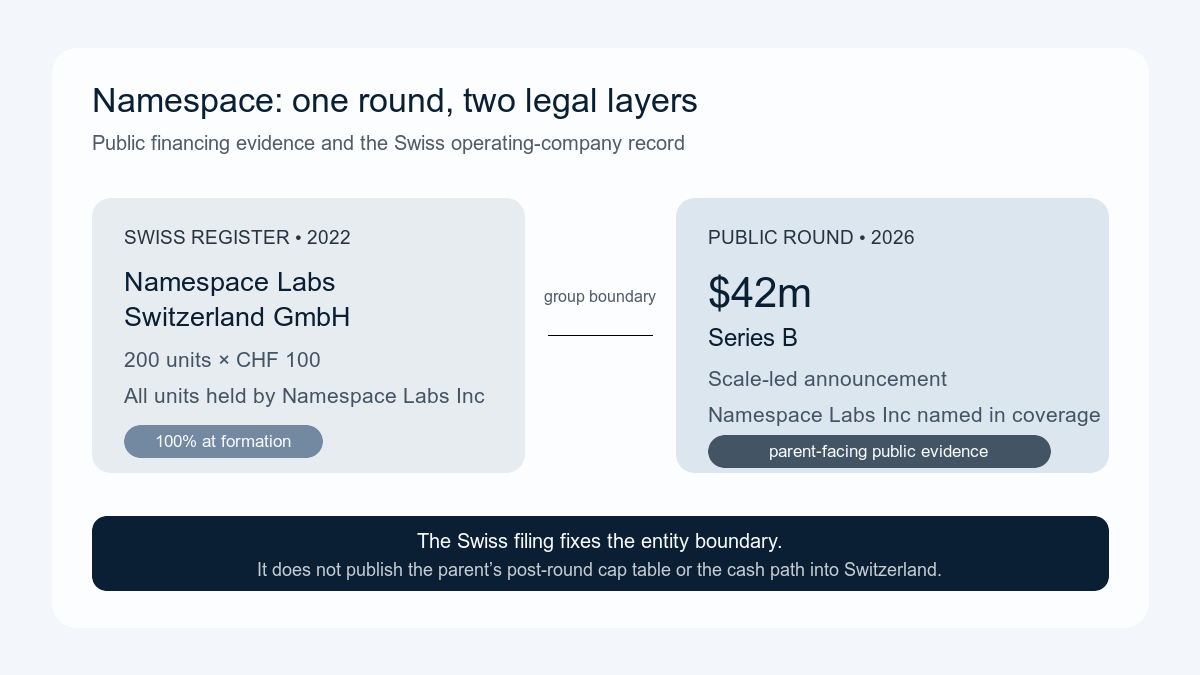
Scale led Namespace’s $42 million Series B, an affirmative financing signal for a developer infrastructure company building compute for agentic software engineering. The company’s Swiss filing supplies a second fact that changes how the round should be read: Namespace Labs Switzerland GmbH was incorporated with all 200 CHF 100 units held by Namespace Labs Inc, the Delaware parent named in the register record.
That does not prove where every dollar of the new round was subscribed or how cash will move through the group. It does establish the key perimeter. The public financing announcement points to Namespace Labs Inc and the business as a whole, while the Swiss register describes a separate operating company whose ownership was parent-held at incorporation. Investors, customers and employees should not treat the Swiss filing as a post-round cap table for the entire startup.
The round is visible, but its legal perimeter is not
Scale’s 6 October announcement says it led Namespace’s $42 million Series B. It describes Namespace as a development platform for agentic software engineering, with devboxes and infrastructure for software agents. The post points to customers including SpaceXAI and Ramp and says the company is extending its platform across data centres and Apple Silicon hardware.
SiliconANGLE’s independent report identifies the company as Namespace Labs Inc, says the round was led by Scale, and names NEA, 20VC, Essence, Burst and Susa among the participating investors. It reports total funding of $65 million after the Series B and describes a compute cloud built around ephemeral storage, high-speed networking and cache infrastructure.
Those sources answer the market question of who backed the round and what the capital is intended to fund. They do not publish an issue price, share classes, investor percentages or a legal subscription entity. The Swiss register answers a different question: which company was formed in Switzerland, and who held its units when it was formed?
| Public evidence | What it establishes | What remains open |
|---|---|---|
| Scale’s investment announcement | Scale led a $42m Series B for Namespace | Issuer, security type and investor percentages |
| SiliconANGLE’s report | Namespace Labs Inc is the named company; total funding reached $65m | Whether proceeds were subscribed at the parent or allocated to an operating company |
| Swiss SHAB incorporation record | Namespace Labs Inc held all 200 units of Namespace Labs Switzerland GmbH | Current ownership after the financing and any intercompany cash movement |
The distinction is not a technicality. A round can be economically important for a group while the company visible in a local register remains a wholly owned subsidiary. The financing headline therefore cannot be used to infer that the Swiss company issued the new securities or received the proceeds directly.
The Swiss company started as a wholly owned subsidiary
The exact Swiss entity is Namespace Labs Switzerland GmbH, registration number CHE-330.822.617. Its 6 January 2022 Swiss Official Gazette publication records a new limited-liability company in Adliswil with CHF 20,000 of capital divided into 200 units of CHF 100 each. Namespace Labs Inc, identified with Delaware file number 6238762, held all 200 units. Hugo Gomes dos Santos was registered as managing director with sole signature.
That is a precise legal relationship at a precise date. It is stronger than saying the two names are merely affiliated, but it is not a current group-wide cap table. The record establishes 100 percent parent ownership of the Swiss company’s units at incorporation. It does not state who owns Namespace Labs Inc, how the parent’s investors participate, or whether the Swiss subsidiary later issued units or transferred any interests.
The next Swiss publication, dated 7 October 2024, records statutes dated 26 September 2024 and a move from Adliswil to Maneggstrasse 33 in Zurich. The publication does not report a capital increase or shareholder change. Zefix’s current company profile identifies Namespace Labs Switzerland GmbH as active at that Zurich address.
| Register point | Filed fact | Analytical boundary |
|---|---|---|
| 6 January 2022 | CHF 20,000 capital; 200 units; all held by Namespace Labs Inc | Incorporation ownership snapshot, not a 2026 cap table |
| 7 October 2024 | Statutes changed and the registered office moved to Zurich | No shareholder or capital change is reported in this publication |
| Current Zefix profile | Active Swiss entity at Maneggstrasse 33 | Profile data does not disclose parent financing terms or investor stakes |
The register path is therefore useful because it fixes the entity boundary. It is not a substitute for the Delaware parent’s financing documents.
Why the parent and subsidiary boundary matters after a large round
Namespace says the new money will support infrastructure for software agents and developer workflows. The commercial activity may be spread across the group: engineering, employment, contracts, intellectual property and data-centre arrangements can sit in different legal entities. The Swiss company’s purpose includes software development, distribution and maintenance, as well as services connected to that work. Its formation record also allows financing to direct or indirect parent and sister companies.
Those clauses make a cross-border operating structure plausible, but they do not show that the Swiss company borrowed from the parent, received a capital contribution or paid for the new hardware. The public evidence supports a narrower conclusion. Namespace Labs Inc is the company named in the independent financing coverage, and Namespace Labs Switzerland GmbH was parent-owned when its Swiss units were issued. The visible financing perimeter is therefore parent-facing until a later document identifies the issuer or a transfer into Switzerland.
That matters to several readers:
- Investors and underwriters need to know which entity issued the securities, where the new money sits and which subsidiaries provide the operating assets or contracts. A Swiss subsidiary filing cannot answer those questions by itself.
- Customers and counterparties may contract with a local company while the financing and intellectual-property rights sit elsewhere. The legal counterparty and the venture-backed parent are not automatically interchangeable.
- Employees may work for a Swiss subsidiary while participating in a parent-level option or share plan. The public round announcement does not reveal the plan’s issuer, pool size or dilution treatment.
- Competitors and acquirers should distinguish a group funding headline from the assets and obligations held by the exact company they might buy or partner with.
The same entity-level discipline appears in Hadrian’s $40 million financing, where a Dutch parent-level round sits alongside a UK support company and a filed option schedule. Wiremind’s financing story shows the other side of the problem: founder and investor control can change at the funded company even when public headlines compress the structure into one brand.
What the public record supports, and what it does not
The evidence supports four connected findings. Scale led Namespace’s $42 million Series B. Independent coverage names Namespace Labs Inc and five additional participating investors, taking stated total funding to $65 million. The Swiss operating company was formed with all 200 units held by Namespace Labs Inc. The 2024 Swiss publication reports a relocation and statutes update, not a disclosed capital or shareholder change.
The evidence does not support a post-round ownership percentage for Namespace Labs Switzerland GmbH, a current cap table for Namespace Labs Inc, a valuation, a conclusion that the Swiss subsidiary received the $42 million, or a claim that any specific investor owns or controls the Swiss company. It also does not show whether the round was common equity, preferred equity, a convertible instrument or another security.
That boundary leaves a useful business conclusion rather than a gap disguised as certainty. The Swiss filing is evidence of the group’s legal architecture, not evidence of the round’s full capitalization. A reader who treats the local register as the startup’s cap table risks assigning parent-level investor economics, proceeds and control to an operating company whose own units were fully parent-held at formation.
The next document that could change the reading
The decision-changing watchpoint is a parent-level financing document or a later Swiss filing. A Delaware corporate filing, investor announcement with legal issuer details, updated Swiss unit register or intercompany agreement could show where the subscriptions were made, whether the Swiss company received a capital contribution or loan, and which entity owns the relevant intellectual property and contracts.
Until that evidence appears, the strongest reading is positive but bounded. Namespace has secured a $42 million Series B led by Scale to expand an agent-focused developer infrastructure platform. The Swiss register shows that its operating company began as a wholly owned subsidiary of Namespace Labs Inc and later moved to Zurich without a disclosed capital or shareholder change. The round is therefore best understood as a parent-level financing story whose consequences for the Swiss entity still require the next document.
Continue reading
Related Research
Hadrian's $40m Round Leaves a 399,057-Option Question at the Dutch Parent
Hadrian's $40m round sits at a Dutch parent while UK accounts show 399,057 outstanding employee options, exposing a future-value claim absent from the announcement.
Wiremind's €35m Round Meets a Filed Founder-Control Architecture
Wiremind's €35m first financing says founders keep control. June statutes show how voting seats and quorum rules make that claim legally meaningful.
Restate’s $20m Series A Meets a 79.552% Delaware Parent Stake
Restate's $20m Series A follows a German register snapshot where Delaware parent Restate Software held 79.552%, leaving the round's operating-company cap table unproven.
Breedr's $27m Series B Did Not Add Shares to Its UK Operating Company
Breedr announced a $27m Series B, but BREEDR LIMITED's latest UK filed accounts show unchanged capital, £32.6k cash and £2.5m net liabilities.