
Wiremind's €35m Round Meets a Filed Founder-Control Architecture
Wiremind's €35m first financing says founders keep control. June statutes show how voting seats and quorum rules make that claim legally meaningful.
On this page
Conduct your own private market research
Add dossaro to Claude or ChatGPT and run source-backed register research from your own workspace.
 Add to Claude
 Add to ChatGPT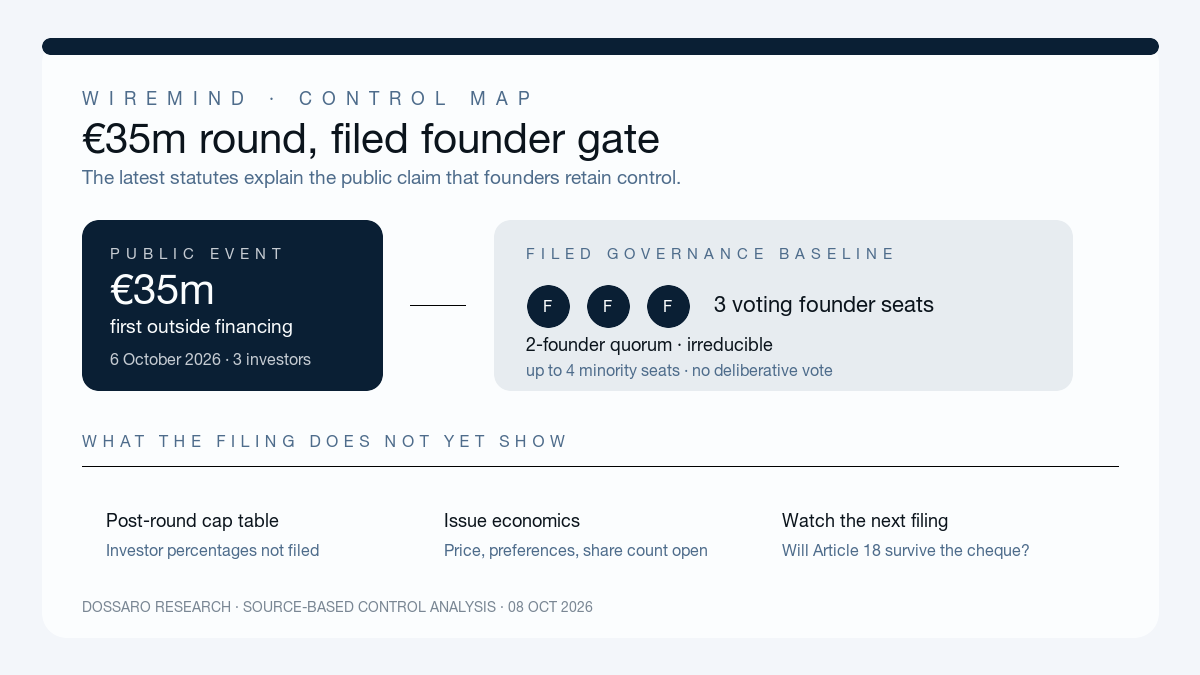
Wiremind's first outside financing comes with a public control claim and a legal structure that explains why it is credible. The Paris transport-software company announced a €35 million round on 6 October 2026 from IronWave, Bpifrance's Large Venture fund and Seaya Andromeda. Its co-founders, Colin Girault-Matz and Charles Pierre, said they remain majority shareholders and retain control.
The latest filed statutes, dated 12 June, show the mechanism behind that statement. They give founders the right to designate all three deliberative seats on Wiremind's strategic committee. Up to four minority-designated seats may join, but those seats have no deliberative vote. The committee cannot deliberate unless at least two founder representatives are present, a quorum the statutes call irreducible.
That is a stronger finding than a headline about founders staying invested. It is a voting architecture that protects the committee's ability to act even after new capital arrives. It is also not a post-round cap table. Wiremind has not yet filed the share issuance, investor allocations or any amended governance document for the October financing, so the June record shows the pre-round legal baseline rather than a guaranteed permanent outcome.
The public round and the filed baseline answer different questions
Wiremind's own announcement calls the €35 million financing its first strategic funding round. It names IronWave, formerly Wendel Growth, Bpifrance Investissement through Large Venture and Seaya Andromeda as the new investors. PR Newswire's independent distribution repeats the amount, date, investor group and the founders' majority-shareholder and control statement.
The announcement also describes a business that has funded itself since its 2014 founding and remained profitable. Wiremind reports 67% revenue growth in 2025, more than 80 clients and 23 new clients during that year. The stated use of the new capital is international expansion, including South America, the Middle East and Asia-Pacific, alongside more investment in machine learning and large language models.
The public release therefore establishes the financing event and management's description of the outcome. It does not disclose how much equity each investor bought, whether any shares were issued at closing, the issue price, liquidation preferences or the final shareholder percentages. Those questions belong to the register and transaction documents that have not yet appeared.
| Public statement | What the June 2026 statutes show | What remains open |
|---|---|---|
| €35m first outside financing from three investors | Capital of €10,390 divided into 1,039,000 ordinary shares at €0.01 nominal value | The October issue price, new share count and investor allocations |
| Founders remain majority shareholders and retain control | Three founder-designated seats have deliberative votes; a two-founder quorum is irreducible | Whether the governance terms are amended in the financing documents |
| Minority investors join the company | Up to four minority-designated committee seats are expressly non-voting | Any separate consent, veto or information rights under the shareholder pact |
The distinction matters because ownership and control are related, not interchangeable. A founder can hold less than a majority of the fully diluted equity and still control a board or strategic committee. Conversely, an investor can hold a large economic stake and receive protective rights without controlling day-to-day decisions. Wiremind's filed rules make that separation visible before the new cap table is available.
Three voting seats and an irreducible quorum
Article 18 of the June statutes filed for Wiremind SAS creates a strategic committee of up to seven members. Only three members have deliberative votes, and the founders designate all three. Four members designated by the minority holders can attend and participate in the committee's work, but the statutes state that they have no deliberative vote.
The quorum rule is the structural hinge. The committee can deliberate only when at least two founder representatives are present. That requirement cannot be waived by simply adding more minority seats. A founder representative may be represented only by another founder representative or a company employee, which further limits the ability to replace a founder vote with an investor proxy.
Once the quorum is met, decisions are taken by a simple majority of the members present with deliberative votes. The president has a casting vote in a tie. Because the voting pool is three founder-designated seats, the filed rules give the founder group a practical gate over whether the committee can decide anything at all and a decisive position on ordinary committee votes.
The rule is not just a boardroom detail. It protects the committee's operating capacity during a financing transition. New investors can obtain visibility through non-voting seats, while the founders keep the minimum presence required for reserved-matter approvals. This is the kind of governance term that can make a public control statement economically meaningful without revealing the founders' exact percentage ownership.
Reserved matters turn the committee into a capital gate
The committee's remit covers more than strategy discussions. The statutes require prior committee approval for a list of reserved decisions, including capital operations and significant new securities. They also cover debt, guarantees, major asset transactions, senior hiring and litigation above stated thresholds.
| Reserved area in the statutes | Threshold or effect | Why it matters after a financing |
|---|---|---|
| Capital operations and securities | Capital changes and issuances; instruments above 5% of capital are separately listed | A large new round or option programme cannot bypass the committee process |
| Borrowing and guarantees | More than €200,000 | Financing and security decisions remain inside the governance perimeter |
| Significant assets, including intellectual property | More than €200,000 | A sale or pledge of core assets needs committee approval |
| Senior compensation and hiring | More than €100,000 annual gross compensation | Investors cannot unilaterally reset senior staffing through a committee vote |
| Litigation and settlements | More than €100,000 financial impact | Material disputes and settlements require the same gate |
The statutes also say that the parties must use their shareholder votes to respect the rights and obligations in the shareholder pact and to adopt shareholder resolutions that the committee has already approved. The document does not disclose the full pact, so it would be wrong to convert this language into a complete investor-rights map. It does, however, show that the committee is designed as a precondition for a wide range of capital and operating choices.
Wiremind's earlier filings explain why the nominal share count is an imperfect proxy for the financing. In December 2025, the company divided the nominal value of 10,385 one-euro shares by 100, leaving the €10,385 capital unchanged but creating 1,038,500 shares at €0.01 each. In June 2026, an exercise of 500 Paxone BSPCE added five euros of nominal capital and 500 ordinary shares, bringing the filed total to 1,039,000 shares and €10,390 of capital. The BSPCE decision confirms that step.
Those entries are legal history, not an October subscription schedule. They establish the denominator and the governance text immediately before the financing, but they do not say how the €35 million was priced or allocated. The December 2025 nominal split decision is useful precisely because it prevents a reader from treating the €10,390 capital figure as a valuation or cash raised.
The control claim is strong, but it has a date boundary
Wiremind's founders said they retain control, and the June statutes show a coherent legal route to that result: all three deliberative seats are founder-designated, two founders must be present for a valid meeting and the minority seats do not vote. The combination is stronger evidence than a founder quote alone.
The date boundary remains essential. The statutes are the latest filed version located for this run, but they predate the 6 October announcement. A financing can amend a committee composition, change the shareholder pact or create consent rights that are not visible in the old text. The public announcement also says that the founders remain majority shareholders, but it does not publish the percentage or distinguish ordinary shares from options and other instruments.
That makes the most defensible reading narrower than “the founders cannot be diluted.” The evidence supports this statement: immediately before the public round, Wiremind's filed governance rules reserved deliberative committee control for founder representatives and required an irreducible founder quorum. It does not support a post-closing ownership percentage, a permanent veto or a claim that the investors have no governance protections.
The pattern echoes Nuclear Turbines' founder-control financing, where voting arrangements mattered more than a headline ownership number, and ZuriQ's preferred-share round, where a legal share class revealed economics that the funding announcement did not. Wiremind adds a different signal: control is visible in the committee rules before the new investor percentages are.
What the next filing should settle
The next decision-changing record is a post-round French register filing or amended statutes. It should show whether Wiremind issued new ordinary or preferred shares, whether the €35 million entered as equity or through another instrument, and whether the strategic committee provisions changed. A shareholder-pact disclosure, if it becomes public, would clarify investor consent and exit rights that the statutes reference but do not reproduce.
Until then, the round is best understood as a capital injection into a founder-led governance system, not as a completed transfer of control. The commercial question is whether Wiremind can use the new money to expand internationally and add generative AI while preserving the decision-making architecture that supported its self-financed growth. The filed rules show how that architecture worked at the last documented point. The next filing will show whether it survived the cheque.
Continue reading
Related Research
Nuclear Turbines Founders Held 57.6% Before £15m Reveal
Nuclear Turbines announced £15m, while its latest register shows founders at 57.6%, IQ Capital at 15.4% and about £6.2m of cash equity filed.
ZuriQ's $25.5m Seed Created A 28.6% Preferred Block
ZuriQ's $25.5m seed closed legally in May, creating a 28.6% preferred block and adding a Quantonation-linked director before its July reveal.
Joe AI's €2m Round Added a Protected 31,008-Share Block
Joe AI's €2m round reserved 31,008 ABSA shares and matching ratchet warrants for one unnamed subscriber, while Épopée gained a strategic seat in governance.
Octave's €10m Series A Followed Years of SPDG Governance
Octave's €10m Series A followed years of SPDG board representation and a new Quintin Tech director, so the round was not a blank governance slate.