
Octave's €10m Series A Followed Years of SPDG Governance
Octave's €10m Series A followed years of SPDG board representation and a new Quintin Tech director, so the round was not a blank governance slate.
On this page
Conduct your own private market research
Add dossaro to Claude or ChatGPT and run source-backed register research from your own workspace.
 Add to Claude
 Add to ChatGPT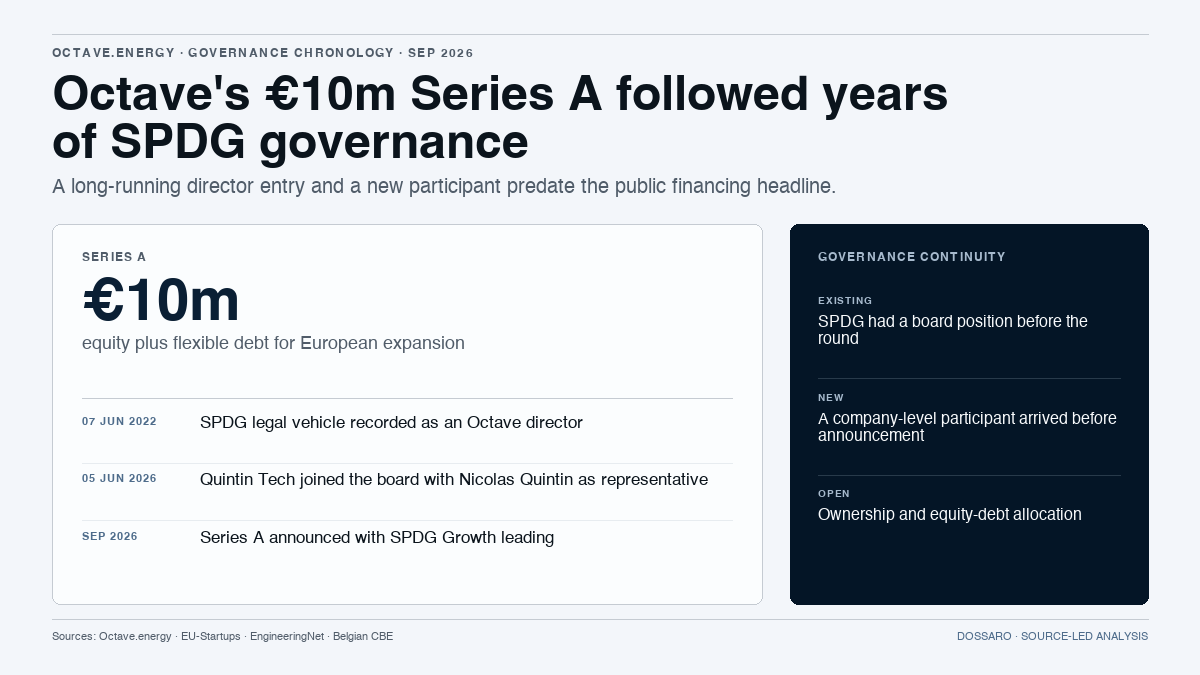
Octave.energy's €10 million Series A was announced as expansion capital, but the Belgian register shows that its lead investor was already part of the company's governance years before the round. SPDG's legal vehicle has been a director of Octave since June 2022, according to the public CBE profile. A separate entity called Quintin Tech joined the board on 5 June 2026, shortly before the financing announcement, with founder Nicolas Quintin recorded as its permanent representative.
That chronology does not prove who owns Octave or how the new money was allocated. It does change the financing story. The round was not negotiated on top of a blank governance slate: one named investor had a long-running board position, while a new company-level participant arrived before the Series A was public.
The company's announcement says the Series A combines equity and flexible debt. SPDG Growth led, with imec.istart, BNP Paribas Fortis and KBC participating. Octave said the capital would fund teams in the Netherlands, France and Germany and continued development of its battery-energy-storage and energy-management platforms. Independent coverage from EU-Startups confirms the amount, mixed financing, investor group and expansion plan.
For investors, founders and lenders, the useful question is therefore not simply how much Octave raised. It is which governance rights and financing obligations were already in place before the round, and which of those rights changed when the capital was raised.
The funding headline and the register answer different questions
Octave's public announcement is clear about the commercial event. The Mechelen company said it raised €10 million in Series A funding, led by SPDG Growth, with imec.istart, BNP Paribas Fortis and KBC. The company described the financing as a mix of equity and flexible debt and said the money would support sales and operations in the Netherlands, France and Germany. EngineeringNet's 3 September report independently describes the same Series A, investor group and market expansion.
The register adds a different layer. Octave is an active Belgian private limited company under CBE 0745969194. Its public profile records an address in Mechelen from 17 October 2025 and lists director entities with their effective dates. Those entries are legal governance facts. They are not a cap table, a shareholder list or a debt schedule.
| Publicly visible position | Date or status | What it supports | What it does not prove |
|---|---|---|---|
| Octave, CBE 0745969194 | Active Belgian private limited company; Mechelen address from 17 October 2025 | Exact legal identity of the financing subject | Current shareholders, valuation, or allocation of the €10m |
| SPDG, CBE 0420201921 | Director entity since 7 June 2022; SPDG Growth says it has invested since seed | A pre-existing governance and investor relationship | SPDG control, ownership percentage, or board veto rights |
| Quintin Tech, CBE 0799645729 | Director entity since 5 June 2026; Nicolas Quintin is the permanent representative | A new company-level governance participant before the announcement | That Quintin Tech is founder-owned or received Series A shares |
| Series A announcement | September 2026; €10m equity plus flexible debt | Public amount, investor names and expansion purpose | Equity versus debt split, pricing, dilution, security, or lender priority |
The four rows should not be collapsed into one ownership conclusion. A director entity can represent an investor or founder-linked company without disclosing the economics. The CBE profile proves formal board presence, not who subscribed for shares or lent money.
SPDG was already in the governance chain
SPDG's position is the clearest continuity signal. The CBE profile lists Société Anonyme de Participation et de Gestion, CBE 0420201921, as a director of Octave since 7 June 2022. The same profile identifies Jean-Nicolas Lunden de Biolley as its permanent representative from June 2023. Octave's 2026 announcement separately describes SPDG Growth as an investor since the seed round.
Taken together, those facts support a narrow conclusion: the lead investor had both an economic relationship and a formal company-level governance presence before the Series A. They do not support the stronger claim that SPDG controlled Octave. The profile provides no voting percentage, reserved-matters schedule, board-vote split or shareholder agreement.
That distinction matters in a financing that combines equity with flexible debt. An incumbent investor can lead a later round while retaining information and governance rights from an earlier relationship. The new round can therefore fund expansion without representing a clean handover from one investor group to another. The public announcement names the participants; the register shows that at least one of them was already part of the legal governance structure.
For founders, the relevant diligence question is whether the Series A changed the rights attached to that existing position. Did SPDG keep the same board appointment route? Did the debt component include consent rights or security? Did new equity enter through a capital increase, a conversion, or a parent-level instrument? None of those answers is visible in the public announcement.
Quintin Tech entered before the round was public
The second dated event is more subtle. Quintin Tech, CBE 0799645729, was incorporated in March 2023 and appears in Octave's public director profile from 5 June 2026. Nicolas Quintin is named as its permanent representative. Public coverage identifies Quintin as an Octave co-founder and Head of EMS, while the CBE record identifies only the legal company and its formal role.
The timing creates a useful governance fact without proving a beneficial-ownership fact. Quintin Tech entered the board about three months before the Series A announcement. That may be a founder-management vehicle, an administrative appointment, or a vehicle connected to a financing or reorganisation. The register does not state which interpretation is correct.
It would therefore be unsafe to say that Quintin Tech received shares, that Nicolas Quintin retained a particular percentage, or that the new appointment gave founders control. The defensible statement is that a separate legal entity represented by a named co-founder joined Octave's formal governance before the financing was publicly disclosed.
The sequence is commercially relevant because financing and governance can move on different calendars. A board appointment can precede a press release, while the share issuance, debt agreement or investor rights remain private. A counterparty reading only the announcement could miss that the company had already added a new legal participant to its board.
€10m does not reveal the equity and debt split
The Series A headline is a total amount, not a valuation. Octave says the financing combines equity and flexible debt, but it does not say how much of the €10 million is new share capital, shareholder or bank debt, a convertible instrument, or another form of financing. The announcement names BNP Paribas Fortis and KBC as participants, but it does not assign each institution a cheque, security package or repayment priority.
That matters for a battery-storage business. Octave says it has delivered systems representing more than 200 MWh, served over 400 businesses, remained profitable for three consecutive years and generated €16 million in 2025 revenue. Hardware and project deployment create financing needs different from pure software. Debt can avoid the same dilution as equity, but the public materials do not show which assets or cash flows support the facility.
The commercial consequence is asymmetrical. Existing shareholders may face dilution from the equity component, while lenders may receive priority claims or information rights. Customers and installation partners may care about continuity and performance obligations rather than the cap table. The same €10 million headline can therefore distribute risk differently across founders, investors, banks and operating counterparties.
This is why fund and company structures should remain separate in diligence. Dossaro's analysis of Runway Venture Capital Fund II shows how a manager, an investment vehicle and a fund label can answer different legal questions. Octave's case applies that discipline at company level: a financing announcement, a director entity and a debt facility are related evidence, not interchangeable proof of ownership.
What the public record proves, and what it does not
The public record supports five firm findings. Octave is the active Belgian company under CBE 0745969194. SPDG's legal vehicle has been a director since June 2022. Octave describes SPDG Growth as an investor since the seed round. Quintin Tech became a director entity in June 2026 with Nicolas Quintin as permanent representative. The company then announced a €10 million Series A combining equity and flexible debt, led by SPDG Growth and joined by imec.istart, BNP Paribas Fortis and KBC.
The same record does not reveal the post-round cap table, the valuation, the equity and debt split, the identity of the lenders' security, or any investor's percentage. It does not establish that SPDG controlled Octave before the round or that Quintin Tech is beneficially owned by Quintin. It does not show whether any founder or investor sold shares, rolled an earlier instrument, or received a new board right.
A benign reading remains possible. Octave may have used ordinary Belgian corporate appointments for a long-term investor and a founder-related management vehicle, while the Series A simply supplied growth capital on negotiated but undisclosed terms. The public chronology does not contradict that reading. It only rules out the idea that the round arrived at a company with no prior investor governance.
The next document should connect governance to economics
The strongest next documents are the capital-change filing and post-round shareholder record for Octave, followed by the subscription agreement or debt facility that explains the flexible-financing component. Those records could show whether SPDG's earlier governance position was accompanied by a defined shareholding, whether Quintin Tech received equity, and whether BNP Paribas Fortis or KBC took security or priority rights.
Until those documents appear, the defensible finding is narrow: Octave's €10 million Series A did not arrive on a blank governance slate. SPDG had been formally present since 2022, and a separate Quintin Tech entity joined shortly before the announcement. The financing's commercial consequence lies in the rights attached to that continuity, not in an ownership percentage the public record does not disclose.
Continue reading
Related Research
RunwayVC's €40m Fund II Sits Behind A NOK30,000 Fund Vehicle
RunwayVC's €40m Fund II is registered as a NOK30,000 alternative-investment vehicle, while a separate five-person manager carries the governance layer.
xorlab's €5m Series A+ Follows A Staged Swiss Capital Programme
xorlab's €5m Series A+ followed a 43.4% 2021 and 20.0% 2026 issued-capital rise, while Swiss filings do not identify investors or dilution yet.
Wexler's Founders Held 54%, But £4.66m Ranked First
Legora bought a Wexler that was 54% founder-owned on its last visible share count, but £4.66m of seed preference ranked ahead of ordinary shares.
Chift's €10.5m Series A Arrived After a Return to Profit
Chift's €10.5m Series A followed a 2025 return to profit, a positive gross-margin swing and a larger team, while ownership terms remain undisclosed.