
Chift's €10.5m Series A Arrived After a Return to Profit
Chift's €10.5m Series A followed a 2025 return to profit, a positive gross-margin swing and a larger team, while ownership terms remain undisclosed.
On this page
Conduct your own private market research
Add dossaro to Claude or ChatGPT and run source-backed register research from your own workspace.
 Add to Claude
 Add to ChatGPT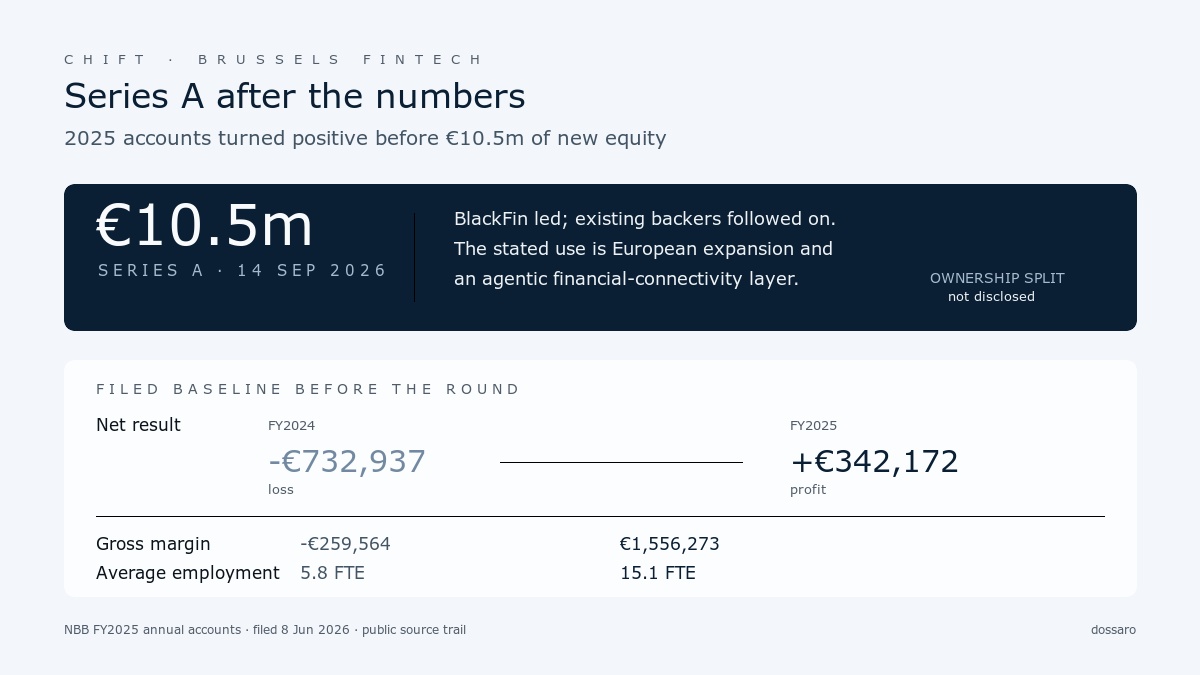
Chift's €10.5 million Series A arrived after a visible operating shift, not against a blank financial record. The Belgian fintech's latest annual accounts show a €342,172 profit for 2025 after a loss of roughly €733,000 in 2024. Gross margin moved from negative €259,564 to €1.56 million, and average employment rose from 5.8 to 15.1 full-time equivalents. The accounts were filed on 8 June 2026, three months before the financing announcement.
That sequence supports an acceleration reading: Chift was reporting better operating indicators before BlackFin Capital Partners led the new round. It does not prove that the company was self-funding, cash-flow positive or free of balance-sheet risk. Nor does it reveal who was diluted. The public financing event is clear; the post-round ownership mechanics are still not visible in the Belgian register material reviewed.
The financing headline is a European expansion bet
Chift's official announcement dated 14 September 2026 says BlackFin led the Series A, with existing investors Entourage, Shapers, Seeder Fund and Wallonie Entreprendre participating again. Chift says the round will fund expansion in Spain, the United Kingdom, the Nordics, Germany and Italy, alongside an agentic layer that can configure financial-data connections and let software agents act on that data.
The product is a unified connectivity layer for financial software. Chift says one integration reaches more than 120 systems across accounting, invoicing, point-of-sale, e-commerce, payments and property management. More than 150 software companies use the platform to connect over 50,000 businesses in 13 countries, according to the announcement. Those are company-reported commercial measures, not audited financial statements.
Computable Belgium independently confirms the €10.5 million amount, BlackFin's lead and the returning investor group. Its report says Chift described revenue as having grown more than tenfold since a €2.3 million 2024 seed round and the team as 35 people. Startup.eu's funding record also classifies the transaction as an equity Series A announced on 14 September. Neither source publishes an issue price, valuation or investor percentage.
The filed numbers changed before the round
The latest NBB annual-account filing covers the year ended 31 December 2025 and was filed on 8 June 2026. Its 2024 comparative figures allow a clean before-and-after view of the operating baseline.
| Metric | FY2024 | FY2025 | Change |
|---|---|---|---|
| Equity | €1,397,079 | €1,932,957 | +38.4% |
| Net result | -€732,937 | €342,172 | €1.075m swing |
| Gross margin | -€259,564 | €1,556,273 | €1.816m swing |
| Average employment | 5.8 FTE | 15.1 FTE | +9.3 FTE |
Companyweb's public profile independently reproduces the rounded values and shows the same direction across 2023 and 2024. The exact NBB values are used for the arithmetic: equity increased by €535,877.92, while the net-result swing was about €1.075 million. Because gross margin crossed from negative to positive, the article reports the €1.816 million swing rather than a misleading growth percentage.
The change is economically meaningful. A company with positive gross margin has more room to cover staff and other internal costs than one whose gross margin is negative. Chift also added 9.3 FTE between the two year-ends. The accounts therefore describe a business that was building operating capacity before the Series A, not simply waiting for a financing event to create its first signs of traction.
What the accounts can and cannot say about a rescue
The improvement should not be mistaken for a full health certificate. Accounting profit is not the same as cash generation. The filing does not disclose a valuation, cash runway or the terms of the September financing. Equity can rise through retained earnings, new capital or other accounting movements, and the public accounts do not identify which changes are attributable to the Series A because the round came later.
The timing still changes the commercial reading. If the round had followed a continuing loss and negative gross margin, the capital could reasonably be framed as balance-sheet support as well as expansion finance. Here, the latest filed year shows the opposite direction before the new money was announced. That makes expansion, product development and geographic scale the better-supported explanation, while leaving cash needs and future execution open.
The contrast also matters for the investor list. BlackFin is a specialist fintech investor, and the returning backers are described as doubling down. Their participation signals support for the growth plan, but it does not tell a reader whether the new shares were issued at a high or low price, whether any investor bought secondary stock or what rights attach to each class.
The legal entity is known; the new ownership is not
The company behind the announcement is CHIFT SRL, CBE number 0784930037, incorporated in Uccle on 19 April 2022. The Belgian CBE profile lists the company as active and identifies directors including co-founder Gauthier Henroz, Henry Hertoghe, Matthieu Hertoghe, Pieterjan Bouten and Pauline Brunel, who was appointed on 3 July 2026.
Those identity and director records establish the company that raised the money. They do not establish who owns it after the round. The public CBE and Gazette material reviewed for this article did not expose a post-round shareholder split, share classes, issue price or voting arrangement. That is a limit on the public evidence, not a conclusion that no ownership change occurred.
| Date | Public or filed event | What it establishes |
|---|---|---|
| 19 Apr 2022 | CHIFT SRL incorporated | Exact Belgian legal entity and CBE number |
| 8 Jun 2026 | FY2025 accounts filed | 2025 profit, positive gross margin, €1.93m equity and 15.1 FTE |
| 14 Sep 2026 | Series A announced | €10.5m equity round led by BlackFin and returning investors |
| September 2026 | Public register material reviewed | No post-round shareholder split visible in the records available |
The gap is important because the funding form allocates risk. A primary equity issue would eventually provide a basis for calculating dilution and investor percentages. A secondary transfer would change who owns the shares without putting the full €10.5 million into Chift. A preferred class, conversion right or shareholder agreement could change payout and control without being legible from the high-level CBE profile. None of those possibilities is established here.
Why the operating sequence matters for Chift's next phase
Chift is selling infrastructure into Europe's fragmented accounting and financial-software market. Its stated expansion plan requires more connectors, local market coverage and staff. The accounts show that the business had already moved its gross-margin line and result in the right direction, giving the Series A a stronger base than a pure rescue narrative would imply.
The commercial test now moves forward. Chift says the round will take it into five additional markets and build agentic connectivity. Investors and customers will need to see whether the 2025 improvement scales with that footprint, rather than being overwhelmed by the cost of expansion. The public record cannot answer that yet, and it does not reveal how much of the new capital is reserved for hiring, product investment or market entry.
Depotcharge's register gap shows why the distinction between a public funding headline and a filed ownership state matters. Open Cosmos' preferred-waterfall analysis shows the related problem from another angle: even when a founder percentage is visible, share-class rights can change the payout order. Chift is earlier in the evidence cycle. Its financial improvement is visible, while the post-round cap table is not.
Evidence boundary and next-document watchpoint
High-confidence findings are the €10.5 million Series A announcement, BlackFin's lead, the returning investors named by Chift, CHIFT SRL's CBE identity and the FY2025 account figures. Confidence is medium-high on the acceleration interpretation because the accounts predate the financing and show a marked reversal, but accounting profit is not cash flow or valuation.
This evidence does not establish investor percentages, founder dilution, share classes, issue price, valuation, liquidation preferences, voting rights, cash runway or investor motive. The next decision-changing record is a Belgian Gazette or CBE ownership or capital-change filing after 14 September 2026. Any disclosed financing terms or shareholder agreement would resolve the economic mechanics sooner.
For now, the precise conclusion is enough: Chift raised €10.5 million after its filed numbers had already improved. The round may accelerate a business that turned profitable and scaled its team, but the public register still does not show who paid for the new ownership or what rights came with it.
Continue reading
Related Research
Depotcharge's €2.7m Pre-Seed Still Leaves Evolve Energy 50/50
Depotcharge announced a €2.7m pre-seed, but Evolve Energy's latest register still shows founder vehicles owning 50% each with no investor allotment visible.
Open Cosmos' Founder Held About 41% Before Its €300m Round
Open Cosmos' €300m round sits above a register where founder Rafael Jorda held about 41% of stated capital and preferred shares ranked ahead of ordinary.
INLEAP’s €20m Funding Headline Was Cumulative; Founders Held 80% in the 2025 List
INLEAP says it has raised about €20m since founding, while its latest filed shareholder list shows founder holding companies with 80% and outside holders with 20%.
SoftBank's $200m Gravis Round Created A 12.63% Series A Class
Gravis's $200m SoftBank round created a Series A class equal to 12.63% of nominal shares and added two board members, not a takeover.