
xorlab's €5m Series A+ Follows A Staged Swiss Capital Programme
xorlab's €5m Series A+ followed a 43.4% 2021 and 20.0% 2026 issued-capital rise, while Swiss filings do not identify investors or dilution yet.
On this page
Conduct your own private market research
Add dossaro to Claude or ChatGPT and run source-backed register research from your own workspace.
 Add to Claude
 Add to ChatGPT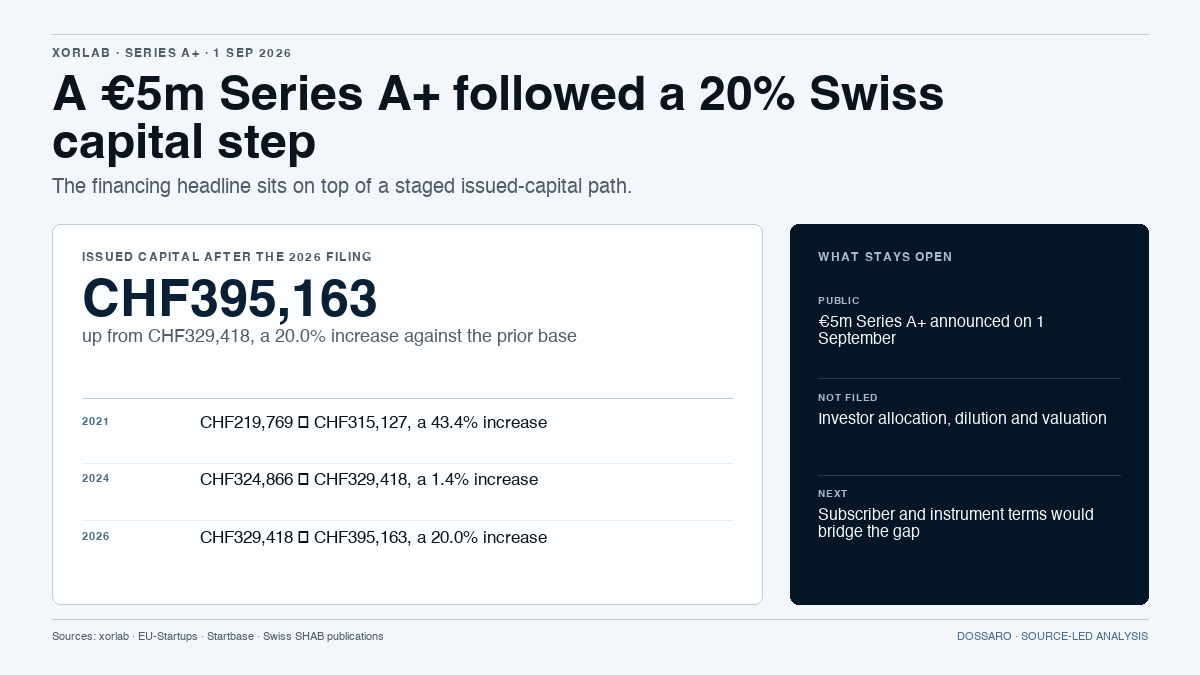
xorlab's €5 million Series A+ arrived after a measurable change in the Swiss company's issued capital, not after a blank five-year stretch. The Zurich email-security company announced the round on 1 September 2026. Two months earlier, a Swiss commercial-register publication recorded an increase from CHF329,418 to CHF395,163, a 20.0% rise against the prior issued-capital base.
That filing does not convert into a €5 million cash figure, an investor allocation or a dilution percentage. It does show that the public financing headline sits on top of a staged capital programme. A 43.4% increase in 2021 was followed by smaller increases in 2023 and 2024, then the larger 2026 step. For investors and counterparties, the useful question is therefore not simply when xorlab last raised money, but which legal instruments and shareholder terms sit behind each stage.
The 2026 raise followed a legal capital step
The Swiss register publication for 17 July 2026 records a 30 June amendment to xorlab AG's statutes. Issued capital moved from CHF329,418 to CHF395,163 and the same number of CHF1 registered shares was stated as fully paid. The publication also says the increase came from conditional capital and that the conditional-capital provision introduced in 2018 was amended. It describes an ordinary increase as well.
The register date is close to, but not the same as, the financing announcement. EU-Startups reported on 1 September that xorlab had secured €5 million in a Series A+ led by existing investor Spicehaus Partners, with Grapha Holding, EquityPitcher Ventures and ZKB Start-up Finance participating. Startbase's independent report gave the same amount, lead and expansion focus.
The timing makes the capital filing a financing clue, not a receipt. Conditional capital can support instruments such as options or conversion rights, and an ordinary increase can be implemented through several legal routes. The publication does not say that €5 million was paid for the 65,745 new nominal shares. It says only what changed in the company's issued capital and how the statutes describe the change.
| Legal date | SHAB publication | Issued capital after filing | Increase from prior state | What the filing records |
|---|---|---|---|---|
| 1 Oct 2019 | 2019 publication | CHF219,769 | CHF6,596, 3.0% | Capital increase; the historical base for later rounds |
| 29 Sep 2021 | 6 Oct 2021 | CHF315,127 | CHF95,358, 43.4% | 27,825 shares issued against a CHF1,451,657.40 setoff; conditional capital amended |
| 24 Mar 2023 | 20 Apr 2023 | CHF324,866 | CHF9,739, 3.1% | Increase from conditional capital |
| 13 Feb 2024 | 19 Apr 2024 | CHF329,418 | CHF4,552, 1.4% | Increase from conditional capital |
| 30 Jun 2026 | 17 Jul 2026 | CHF395,163 | CHF65,745, 20.0% | Conditional-capital increase plus an ordinary capital increase |
Percentages in the table compare each increase with the immediately preceding issued-capital state. They are nominal-capital movements, not returns or ownership shares.
The five-year path was staged, not dormant
The largest historical step before 2026 was the 2021 increase. The 6 October 2021 SHAB publication says capital rose from CHF219,769 to CHF315,127. It also records that 27,825 registered shares were issued against a setoff of CHF1,451,657.40. A setoff means a due claim was used to subscribe rather than a matching cash deposit being described in that notice.
That detail changes the reading of the company's October 2021 Series A announcement. xorlab said the round closed at CHF6.1 million, led by EquityPitcher Ventures with Spicehaus Partners, Zürcher Kantonalbank, Hasler Foundation and private investors. The filing and the release are not contradictory, but they answer different questions. The release gives the financing headline. The filing shows one legal capital step within the broader financing and names a non-cash subscription mechanism for part of it.
The subsequent increases were much smaller: CHF9,739 in 2023, or 3.1% of the prior base, and CHF4,552 in 2024, or 1.4%. In 2026, the CHF65,745 increase was more than four times the combined 2023 and 2024 increases. That is why “A+” is a useful label for a new financing stage, while the legal record points to a sequence of capital actions rather than a single event.
The 2019 entry also matters as a starting point. The register history records capital moving from CHF213,173 to CHF219,769 on 1 October 2019. Against that base, the 2021 increase was a step change. The later record then shows a company using conditional-capital provisions repeatedly before the 2026 announcement.
Issued capital is not the investor cap table
Swiss issued capital is a hard denominator: in July 2026 xorlab stated 395,163 registered CHF1 shares. It does not identify which investor received which shares, whether existing holders were diluted, or whether an instrument was converted at the same time. The 2021 setoff is a reminder that even a fully paid share increase can reflect the settlement of a claim rather than a new cash cheque.
This distinction is practical in diligence. A nominal increase can be paired with a large share premium, a conversion, an employee or option exercise, or a creditor settlement. Conversely, a financing can be agreed at the parent or instrument level without an immediate one-for-one change in issued capital. The filings establish the legal state; they do not disclose the subscription agreement or the commercial price paid for the new shares.
The public 2026 reports name the lead and participating investors, but not their allocations. It is therefore safe to say that existing investor Spicehaus led the Series A+ and that Grapha Holding, EquityPitcher Ventures and ZKB Start-up Finance participated. It is not safe to assign the 65,745 new shares to any one of those investors or to call the 20.0% movement dilution for a specific holder.
That is the same discipline needed when reading private funds. Auxxo's Fund II shows why legal entry counts do not equal commitments. xorlab's register shows a capital denominator, not a negotiated ownership map. The next diligence request is consequently a subscriber list, instrument schedule or post-round shareholder record that connects legal shares to economics.
The Series A+ extends an existing investor base
Spicehaus' lead role in 2026 is consistent with the company's earlier financing history. In 2021, xorlab named Spicehaus among the existing investors and said private investors had extended their stakes. In 2026, the company again described Spicehaus as the existing lead, alongside Grapha Holding, EquityPitcher Ventures and ZKB Start-up Finance.
The continuity matters commercially. The round is not presented as a change of lead from one investor group to another. It is a follow-on financing around a business that is positioning European data control as part of its security proposition. EU-Startups said xorlab plans to expand across DACH, Benelux and the Nordics. The company markets on-premises, hybrid and cloud deployment, with European processing and Europe-based operations, and cites customers including Julius Bär, Swisscom, Vontobel, G+D and CERN in current coverage.
Those product and customer statements are company or media descriptions, not register facts. They explain why a repeat investor might fund expansion, but they do not answer how the new capital was priced or allocated. The legal record supplies the missing chronology: issued capital rose before the public announcement, and that rise followed smaller conditional-capital steps.
The next record should connect the number to the economics
The strongest supported conclusion is narrow but useful. xorlab's €5 million Series A+ was announced after a 20.0% increase in issued nominal capital against the prior base, following a 43.4% increase in 2021 and smaller 2023 and 2024 steps. The sequence is evidence of a staged Swiss capital programme, not proof that CHF65,745 equals the round's cash proceeds.
For investors, the unresolved point is the bridge between those two numbers. A post-round shareholder list or subscription document would show whether the 2026 increase reflected cash equity, conversion, options, employee participation, creditor setoff or a combination. Until that record appears, the public story supports the financing amount, the investor names and the capital chronology, but not a fully diluted ownership outcome.
The next document to watch is therefore not another funding announcement. It is the filing that identifies who subscribed to the 65,745 new shares and on what terms.
Continue reading
Related Research
RunwayVC's €40m Fund II Sits Behind A NOK30,000 Fund Vehicle
RunwayVC's €40m Fund II is registered as a NOK30,000 alternative-investment vehicle, while a separate five-person manager carries the governance layer.
Auxxo's €33.3m Fund Close Shows Why LP Count Is Not Capital Control
Auxxo's €33.3m Female Catalyst Fund II closed after staged LP entries, but Berlin filings show nominal Haftsumme is not a map of capital or control.
The Public Investors Behind White Star Capital Fund IV
White Star Capital's $250 million Fund IV spans France, Quebec and Guernsey, with Aéroports de Paris and La Caisse named as investors in public filings.
Atira's $17.5m raise leaves a 58.54% founder block visible
Atira's $17.5m funding headline maps to 16.92% across three Accel funds, while founder vehicles retain 58.54% of the latest visible register today.