
Inbolt's €11m Round Put Voting Control on a Separate Track
Inbolt's €11m round came with only 1,700 net new shares, 65,495 non-voting shares and a BNP-specific 4.99% voting threshold in its statutes.
On this page
Conduct your own private market research
Add dossaro to Claude or ChatGPT and run source-backed register research from your own workspace.
 Add to Claude
 Add to ChatGPT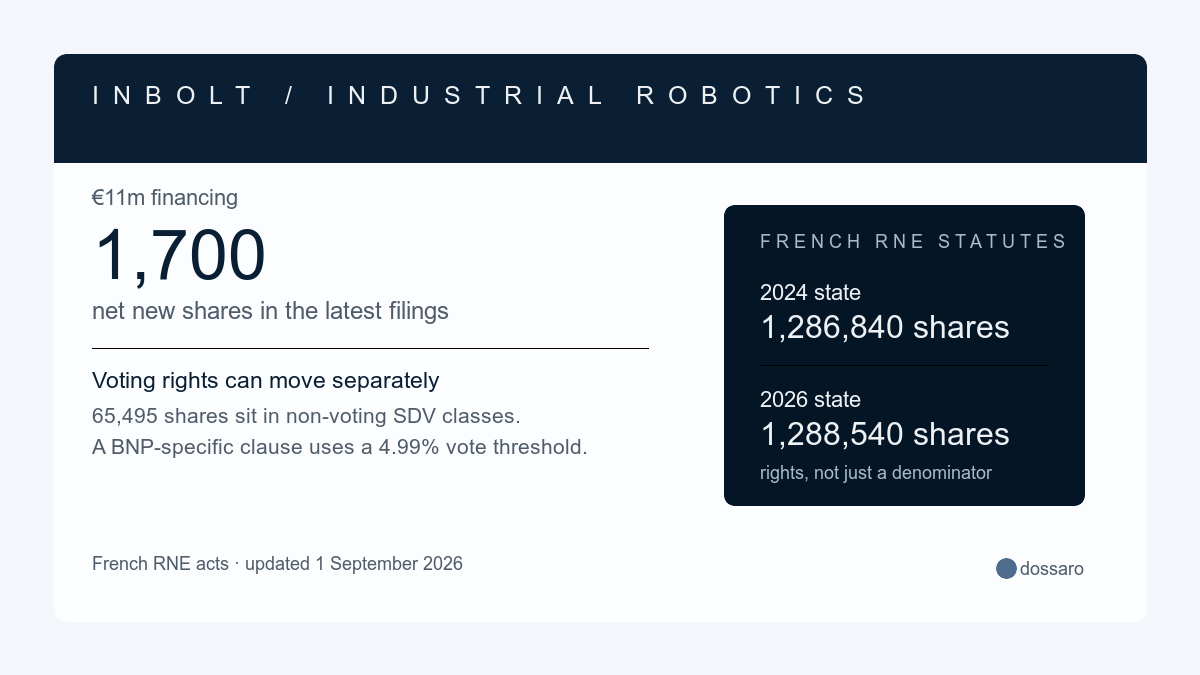
Inbolt's €11 million financing is easy to describe as a growth round for a French robotics company. The latest public statutes tell a more useful story: the financing sits on a capital map where economic rights and voting control can move separately.
Inbolt announced the round on 30 September 2026. Shift4Good said it led the financing with Bridges Climate Transition Partners, BNP Paribas Développement and Ora Global, taking total funding to €30 million. The money is earmarked for expansion in the United States and Asia-Pacific and for new work in data centres and electronics manufacturing. Inbolt says its 3D-vision software is already deployed on more than 200 robots in more than 100 factories.
The French register does not publish a holder-by-holder post-round cap table. It does show a sharp change in the legal form of the capital. The 2024 statutes recorded 1,286,840 shares after two Actions A increases. The statutes updated after decisions dated 31 July 2026 recorded 1,288,540 shares, only 1,700 more. At the same time, 42,799 ADPSeed SDV shares and 22,696 ADPA SDV shares were placed in classes with no general voting rights. A BNP Paribas-specific clause says shares that would push BNP Paribas above a 4.99% voting threshold automatically convert into those non-voting classes.
That is not proof of who received the €11 million, how much BNP Paribas invested or what any investor owns. It is a source-backed reason to read the round as a governance and rights event, not just a larger number on a press release.
The announcement describes expansion; the register describes the rights
The Shift4Good announcement supplies the event facts. It dates the announcement to Paris on 30 September, names the lead and participating investors, and says the proceeds will fund the Detroit office, APAC expansion and entry into data centres and electronics manufacturing. It also describes Inbolt's hardware-agnostic software, which runs with major robot platforms including FANUC, ABB, KUKA, Yaskawa, Comau and Universal Robots.
The independent PE Magazine deal record identifies Shift4Good and Bridges as new entrants and places the financing alongside Inbolt's earlier €15 million Series A. Sesamers and ReFrance independently repeat the €11 million figure and the international expansion plan.
None of those sources explains the class changes in the French filings. The register evidence therefore adds a different layer of information. The announcement answers what Inbolt says the capital will do. The statutes show which legal rights exist around the capital after the latest documented update.
The share count barely moved after the earlier financing
The 26 July 2024 unanimous-associates decision, filed in the French RNE, first multiplied the company's 7,641 one-euro shares into 764,100 shares at €0.01 each. It identified 298,200 of those ordinary shares as Seed shares for identification purposes. The same decision authorised 504,315 Actions A and a further 18,425 Actions A. The first increase could be paid in cash or by compensation of a liquid and due claim; the second was to be subscribed by a named beneficiary using compensation of a claim. The public extract redacts the issue price and premium.
The resulting 2024 statutes recorded 1,286,840 shares and €12,868.40 of nominal capital. The 2026 statutes record €12,885.40 of nominal capital and 1,288,540 shares. The arithmetic is straightforward, but its meaning needs care.
| Documented capital state | Total shares | Nominal capital | What the filing establishes |
|---|---|---|---|
| 2024 statutes after the two Actions A increases | 1,286,840 | €12,868.40 | The earlier capital programme produced 522,740 Actions A alongside 298,200 Seed shares |
| 2026 restated statutes | 1,288,540 | €12,885.40 | The latest documented state adds 1,700 shares, but does not expose a holder-by-holder allocation |
| Net change between the two states | 1,700 | €17.00 | A nominal-capital change of about 0.13%, not a valuation or cash-proceeds measure |
The 1,700-share increase cannot be used to reverse-engineer the €11 million. A share can carry a large premium, a capital increase can be settled against a claim, and a filing can lag a financing announcement. The public documents do not disclose the issue price, premium, beneficiary names or how much of the headline amount was primary equity.
This is the same analytical distinction that matters in other staged financings. ZuriQ's preferred-share stack shows why nominal share counts are not a substitute for preference terms. xorlab's staged Swiss programme illustrates how a sequence of issuances can matter more than a single round label.
The 2026 classes separate economics from the general vote
The 2026 statutes list five groups of shares:
| Class in the 2026 statutes | Shares | General voting position |
|---|---|---|
| Ordinary | 467,600 | Voting |
| Seed | 255,401 | Voting unless another documented restriction applies |
| A | 500,044 | Voting unless another documented restriction applies |
| ADPSeed SDV | 42,799 | No general vote; economic rights retained |
| ADPA SDV | 22,696 | No general vote; economic rights retained |
The two SDV classes total 65,495 shares, or about 5.08% of all 1,288,540 shares. Article 13 of the statutes says those preference shares retain a fraction of the company's assets, profits and liquidation surplus in proportion to the shares outstanding, while the SDV shares do not carry a general vote. They still retain the category rights required by the Federal Reserve's Regulation Y, including votes on an issue senior to the SDV classes and on a dissolution.
The filing therefore supports a limited but important claim: some holders can retain economic exposure without holding the same general voting position as ordinary, Seed or A holders. It does not support a claim that the SDV block belongs to one investor, that it represents 5.08% of value, or that the classes were created for the 30 September round rather than through the earlier capital programme and later restatement.
The BNP clause is a voting brake, not a disclosed BNP stake
Article 13.2 contains a clause written for BNP Paribas. If shares held directly or indirectly by BNP Paribas, or an affiliate, would take its voting securities above 4.99% or give it more than 4.99% of voting rights, the excess is automatically and irrevocably converted into ADPSeed SDV or ADPA SDV shares without voting rights and without consideration.
The round announcement names BNP Paribas Développement as a participant. That establishes participation, not a percentage. The statute's wording refers to BNP Paribas and its affiliates under the Bank Holding Company Act. The public record does not show the number of shares held by BNP Paribas Développement, whether the clause has ever been triggered, or which SDV shares could be connected to it.
Commercially, the clause is a control safeguard. It lets BNP-related capital retain economic exposure while limiting the voting position that would count under the US bank-holding-company rules described in the statutes. That can protect regulatory flexibility, but it also means that a headline investor list is not enough to infer who can influence ordinary shareholder decisions.
What the round changes for investors and customers
For investors, the important question is not simply whether Inbolt raised €11 million. It is which instruments were issued, at what price, with which premium, and whether the resulting shares vote. The latest statutes show that those dimensions can diverge. A holder may have a claim on profits or liquidation proceeds while sitting outside the general vote. The BNP clause adds a conditional conversion mechanism that can change the voting map when ownership crosses a regulatory threshold.
For customers, the immediate commercial consequence is more practical. Inbolt is using the new capital to move from proven deployments into additional geographies and sectors. Its software is designed to upgrade existing robot lines rather than require a full hardware replacement. The capital structure does not change that product proposition, but it matters to counterparties assessing who can approve future issuances, reserved matters or a strategic sale.
The register also limits what can responsibly be said about dilution. A 0.13% increase in nominal share count is not a 0.13% dilution estimate for any investor. Premiums, preferences, warrants, conversion rights and the distinction between voting and non-voting classes all sit outside a simple denominator comparison.
The next document that would change the story
The defensible finding is narrow: Inbolt's €11 million financing was announced alongside a legal-capital state in which only 1,700 net new shares appear between the 2024 and 2026 statutes, while 65,495 shares sit in non-voting SDV classes and a BNP-specific 4.99% voting blocker is written into the constitution.
The remaining evidence boundary is equally clear. The public filings do not show holder names for the latest classes, issue prices, premiums, valuation, proceeds allocation, or whether any BNP threshold has been crossed. They also do not show the terms of the shareholder agreement or the reserved matters of the Surveillance Committee in a way that would map practical control to each investor.
The next decision-changing documents would be a later RNE act or updated statutes that identify the post-round allocations, a shareholder list or equivalent holder schedule, and any filing recording exercise or conversion of the attached instruments. Until then, the strongest reading is that Inbolt has raised growth capital while engineering a cap table in which economic rights and voting power do not move in lockstep.
Continue reading
Related Research
ZuriQ's $25.5m Seed Created A 28.6% Preferred Block
ZuriQ's $25.5m seed closed legally in May, creating a 28.6% preferred block and adding a Quantonation-linked director before its July reveal.
xorlab's €5m Series A+ Follows A Staged Swiss Capital Programme
xorlab's €5m Series A+ followed a 43.4% 2021 and 20.0% 2026 issued-capital rise, while Swiss filings do not identify investors or dilution yet.
StandardX's £10m Seed Round Put Two Preferred Classes Ahead of Ordinary Shares
StandardX announced a £10m isotope seed. Companies House filings show £9.81m of priced allotments, senior preferred rights and a pre-round funding gap.
Open Cosmos' Founder Held About 41% Before Its €300m Round
Open Cosmos' €300m round sits above a register where founder Rafael Jorda held about 41% of stated capital and preferred shares ranked ahead of ordinary.