
Stryker's CMR Surgical Bet Arrived Before Its Preferred Stack Moved
Stryker announced a $400m preferred investment in CMR Surgical, but the same-day filing recorded only 268 ordinary shares and unchanged preferred ranking.
On this page
Conduct your own private market research
Add dossaro to Claude or ChatGPT and run source-backed register research from your own workspace.
 Add to Claude
 Add to ChatGPT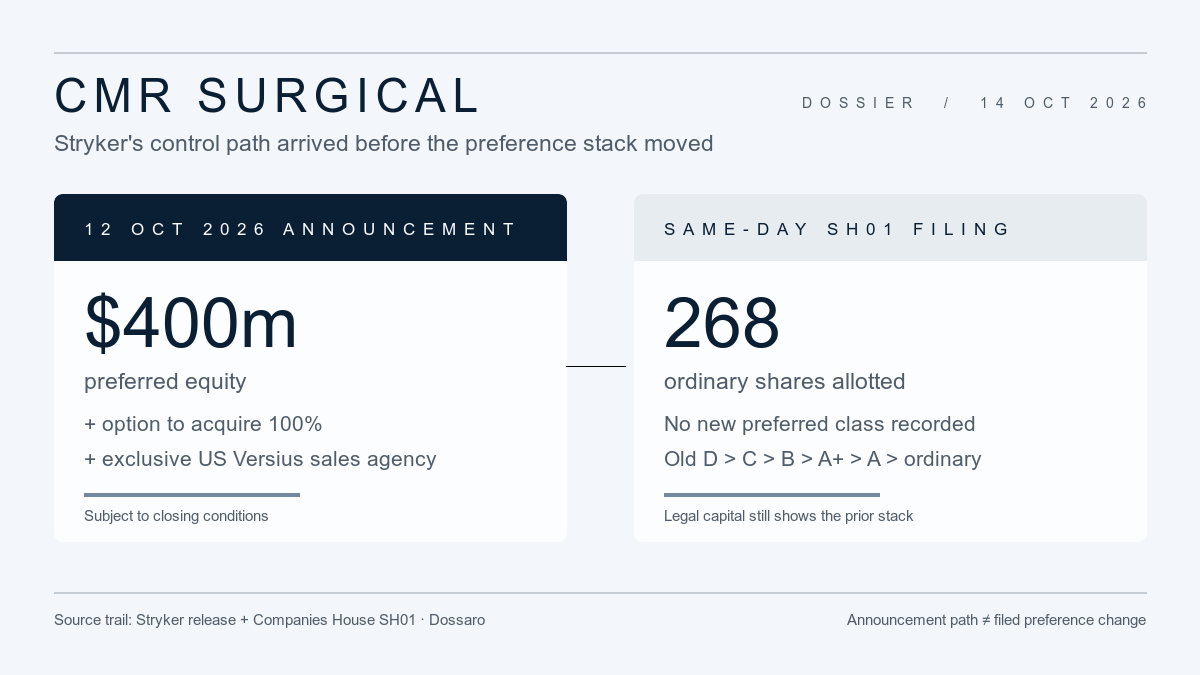
Stryker announced an approximately $400 million preferred-equity investment in CMR Surgical on 12 October, paired with an exclusive option to acquire the remaining equity and exclusive US sales rights for the Versius surgical-robotics portfolio. The Companies House filing submitted that day tells a narrower legal story: it records 268 new ordinary shares and no new preferred class.
That timing matters. The public announcement created a route to future control and an immediate US commercial relationship, but the available same-day filing did not yet rewrite CMR's preference ladder. For investors, lenders and transaction teams, the distinction is between an announced strategic path and a register-visible change in the rights that sit ahead of ordinary equity.
The announcement is a control path, not a completed buyout
Stryker's 12 October announcement describes a strategic equity investment of about $400 million, or £300 million, subject to customary closing conditions. It says the investment is preferred equity and grants Stryker an exclusive option to acquire 100% of CMR Surgical's outstanding equity in the future, subject to the agreement's terms. Stryker will also be the exclusive US sales agent for the Versius portfolio, while CMR continues portfolio development and commercialization outside the United States.
The commercial logic is clear. Stryker gains a way into soft-tissue robotics without announcing an immediate full acquisition, and CMR gets Stryker's sales reach, customer relationships and balance-sheet capacity for further innovation and global commercialization. MedTech Dive's independent coverage places the move in a market where Johnson & Johnson and Medtronic are also bringing surgical robots into competition with Intuitive's da Vinci platform.
The announcement does not say that Stryker already owns CMR, that the option has been exercised or that the investment has closed unconditionally. The companies describe regulatory approvals and customary closing conditions. Those qualifiers leave room for the legal capitalization to move after the announcement date.
The same-day SH01 shows 268 ordinary shares
CMR Surgical Limited, company number 08863657, filed a five-page SH01 statement of capital following an allotment of shares on 12 October. The form records 79 ordinary shares paid at £0.0001 each and another 189 ordinary shares paid at £5 each. Together, those allotments total 268 ordinary shares.
The filing gives the company 6,835,765 shares in total, up from 6,835,497 in the 12 August SH01. It keeps the existing six-class structure. No A preferred, A+ preferred, B preferred, C preferred or D preferred shares are shown as allotted in the 12 October form.
The register's preference ladder is the most useful part of the filing. Every class carries one vote and shares dividends pari passu, but the preferred classes rank ahead of ordinary shares on a return of assets, a return of capital, a share sale or an asset sale. Within that group, D preferred ranks ahead of C, then B, then A+, then A. The filing therefore lets readers see the rights stack that remained visible when Stryker's strategic announcement landed.
| Class | Shares after 12 October filing | Return ranking stated in the filing |
|---|---|---|
| D preferred | 2,340,709 | Ahead of C, B, A+, A and ordinary |
| C preferred | 992,039 | Behind D; ahead of B, A+, A and ordinary |
| B preferred | 837,460 | Behind D and C; ahead of A+, A and ordinary |
| A+ preferred | 446,536 | Behind D, C and B; ahead of A and ordinary |
| A preferred | 642,502 | Behind D, C, B and A+; ahead of ordinary |
| Ordinary | 1,576,519 | Behind every preferred class |
The aggregate nominal share capital is £683.5765. That is a register measure, not the value of Stryker's investment, CMR's valuation or the consideration paid for an option. The filing's rights language is what matters for the control analysis: the seniority order was still the old one in the document available on the announcement date.
Why the preference stack changes the reading
Preferred equity can carry economic priority without giving the holder a majority of votes. The Companies House form does not identify the subscriber for the 268 ordinary shares, and it does not name Stryker as a holder of any existing preferred class. It therefore cannot answer whether Stryker's announced investment was awaiting a later allotment, was documented through another instrument or was being made through a related vehicle.
That is not evidence that Stryker did not invest. It is evidence that the available 12 October SH01 does not record the preferred allotment described in the announcement. The difference is important because a preferred issue could change the return waterfall, the number of shares, the voting balance or the terms that sit ahead of the ordinary class. None of those changes is visible in this particular filing.
The same distinction appears in Universal Quantum's preference-stack analysis: a named financing headline and a filed class structure are related evidence layers, not interchangeable proof of investor economics. CMR's public announcement supplies the deal path. Its SH01 supplies the legal state of the share capital at that filing point.
Earlier 2026 filings show incremental ordinary issuance
The surrounding filing sequence makes the 12 October record more specific. The 16 January SH01 reported 153 ordinary shares allotted on 25 June 2025. A 4 June filing reported 310 ordinary shares allotted across 16 January to 7 April 2026. The 30 June filing added 67 ordinary shares on 24 June, and the 12 August filing added 486 ordinary shares on 7 August.
Those four statements kept the same six preferred classes and the same preference order. They show a pattern of small ordinary allotments while the preferred stack stayed constant. The 12 October filing continues that pattern rather than recording the large preferred issue described in Stryker's announcement.
The filings do not reveal why each ordinary allotment was made or who received it. They should not be treated as a hidden cap table, a proxy for employee equity or proof of a financing instrument. Their value is narrower: they establish what changed in issued share capital and what did not change in the filed class structure.
The Companies House profile also identifies CMR as an active private company incorporated in 2014, with its registered office at 1 Evolution Business Park in Cambridge. A January 2026 confirmation statement is the latest profile confirmation in the Dossaro research run. The public relationship surface returned historical or ceased control records, not a complete current holder map, so this analysis does not assign the preferred classes to named investors.
Stryker gets commercial access before the register shows new seniority
The economic consequence is a split between operating access and legal preference. Stryker can become the exclusive US sales agent for Versius while CMR remains the developer and non-US commercial lead. The acquisition option gives Stryker a contingent route to 100% ownership. Those rights can be strategically valuable before the company files a new preferred allotment or a later instrument becomes public.
For existing preferred holders, the same-day filing is reassuring only in a limited sense: their documented class ranking was not changed in that form. It does not tell them whether a new agreement gives Stryker consent rights, board influence, conversion rights or an option that could alter the eventual sale waterfall. It also does not show whether the 268 ordinary shares are operational housekeeping or part of a closing sequence.
For a buyer or lender, the lesson is equally practical. The announcement date is not automatically the capitalization date. A deal model that treats the $400 million as a completed preferred issue would be adding a legal step that the available register has not yet recorded. The model should carry the announced terms as a contingent transaction layer until the next filing, instrument or closing record resolves the timing.
The next filing is the decision-changing watchpoint
The strongest conclusion is precise. Stryker announced a roughly $400 million preferred investment, exclusive US commercial rights and an option to buy CMR Surgical. On the same date, CMR filed only 268 ordinary shares and preserved the visible A, A+, B, C and D preference ladder. The announcement created a path to control before the available filing showed a new senior preferred position.
That boundary may change quickly. The next useful document is a later SH01 or statement of capital showing whether Stryker's preferred investment was allotted. A new shareholder list, option exercise notice or transaction filing could identify the vehicle, the rights and the point at which the option became exercisable. Until then, the register supports a contingent control story, not a claim that Stryker already owns CMR or that any shareholder has been paid out.
The public announcement explains why Stryker wants the asset. The filing explains what the legal capital still looked like when the announcement was made. The commercial relationship arrived first; the preference-stack evidence is still waiting for its next document.
Continue reading
Related Research
Universal Quantum's $100m Round Entered a Negotiated Preference Stack
Universal Quantum's $100m Series A met existing preference, anti-dilution and participation rights, while post-round ownership remains undisclosed.
Wiener Börse's 80% North Data Deal Was an Existing-Share Transfer
North Data's latest shareholder list shows Wiener Börse took 80% through existing shares, while founder Frank Debatin kept 20% and two 30% blocks exited.
Apheon's Hager & Meisinger Deal Meets an Unchanged 50/50 Operating Register
Apheon announced a majority stake in Hager & Meisinger, but the latest operating-company filing still shows two family holding companies at 50/50.
CarbonFarm's €7m Series A Left a Two-Tranche Equity Trail
CarbonFarm's €7m Series A left two 2026 equity tranches and €3,904.96 of capital, but public acts do not map named investors to legal positions.