
Apheon's Hager & Meisinger Deal Meets an Unchanged 50/50 Operating Register
Apheon announced a majority stake in Hager & Meisinger, but the latest operating-company filing still shows two family holding companies at 50/50.
On this page
Conduct your own private market research
Add dossaro to Claude or ChatGPT and run source-backed register research from your own workspace.
 Add to Claude
 Add to ChatGPT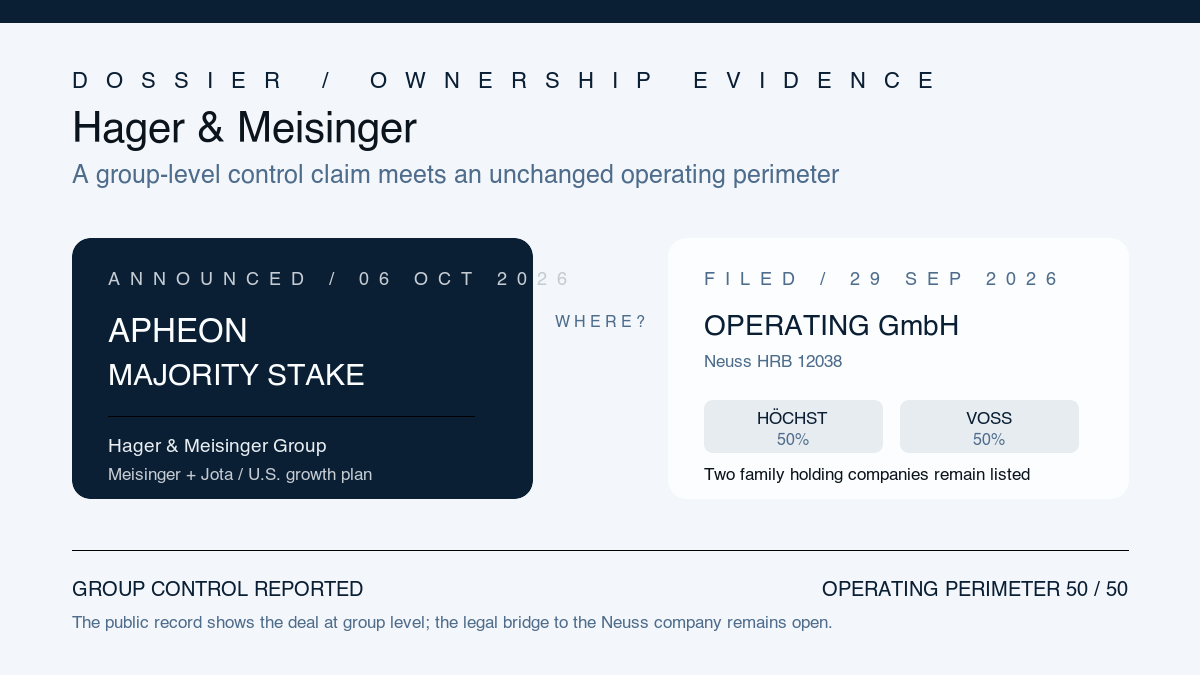
Apheon says it has acquired a majority stake in Hager & Meisinger, a 138-year-old dental-instrument group with manufacturing in Germany and Switzerland. The latest shareholder list for the German operating company, however, still shows two family holding companies owning 50% each. The announcement and the filing can both be accurate, but they answer different questions about where control moved.
That mismatch is the story. Hager & Meisinger’s public transaction announcement identifies a group-level control deal, while the operating GmbH’s list signed on 29 September 2026 and filed on 6 October still names Höchst Beteiligungs GmbH and Voss Beteiligungsgesellschaft mbH as its only shareholders. There is no Apheon entry in that operating-company document, no disclosed purchase price and no investor allocation. The legal location of the transaction therefore remains open.
The announcement describes a group transaction
Apheon’s 6 October announcement says the private-equity firm acquired a majority stake in Hager & Meisinger Group. It describes H&M as the combination of the Meisinger and Jota brands, with more than 12,000 product references, vertically integrated manufacturing in Neuss and Rüthi, Switzerland, and customers in more than 100 countries. The firm says it will work with current shareholders and co-CEOs Dr. Burkard Höchst and Sebastian Voss, who will retain a meaningful shareholding and remain active in the group.
An independent Orrick transaction notice, published on 7 October, uses the same control-stake framing. Orrick says it advised Hager & Meisinger’s previous majority shareholders on the sale and repeats the plan to expand in the United States, strengthen international distribution and pursue selective acquisitions.
Those sources establish a completed or announced transaction at the group level. They do not identify the acquiring legal entity, the precise closing date, the percentage sold, the amount paid or the vehicle through which Apheon holds its interest. They also do not say that Apheon subscribed for shares in the German operating GmbH.
The commercial ambition is clear. Apheon wants to pair the group’s specialist manufacturing and distribution footprint with a buy-and-build plan. The ownership mechanics are not clear, and that matters because a group can contain an operating company, intermediate holding companies and a Swiss affiliate with different shareholders at each layer.
The latest Neuss filing still has a 50/50 perimeter
The decisive public register evidence is the German Handelsregister shareholder list for Hager & Meisinger Gesellschaft mit beschränkter Haftung, Neuss HRB 12038. The list was signed on 29 September 2026 and entered into the register folder on 6 October. It records a total nominal capital of DM 1,000,000 and two shareholders:
| Operating-company shareholder | Filed holding | Register identity | What the filing shows |
|---|---|---|---|
| Höchst Beteiligungs GmbH | 50.00% | Düsseldorf HRB 91555 | One family holding company remains on the operating-company list |
| Voss Beteiligungsgesellschaft mbH | 50.00% | Neuss HRB 16905 | The second family holding company remains on the operating-company list |
The list does not name Apheon, Apheon Advisors or a fund vehicle. It also does not name Jota AG as a shareholder of the Neuss GmbH. That is not evidence that Apheon has no stake in the group. It is evidence that the latest filed ownership of this specific operating entity has not been replaced by a direct Apheon holding.
The two holding companies are not anonymous names. Dossaro’s exact register profiles identify Höchst Beteiligungs GmbH as a Düsseldorf company whose managing director includes Burkard Höchst, and Voss Beteiligungsgesellschaft mbH as a Neuss-registered vehicle whose managing director includes Sebastian Voss. Those relationships explain why the operating list can represent family ownership without showing the ultimate ownership of any new group parent. They do not prove that either founder sold or retained a particular percentage in the transaction.
The unchanged list is a timing and structure signal
The same economic split appears in the prior shareholder list entered on 6 April 2021. That document shows Höchst Beteiligungs GmbH with 50% and Voss Beteiligungsgesellschaft mbH with 50%, divided across numbered shares. The 2026 list reorganises and renumbers the interests but keeps the 50/50 total. Comparing the two lists produces a narrow but useful result:
| Checkpoint | Höchst vehicle | Voss vehicle | Register implication |
|---|---|---|---|
| 6 April 2021 list | 50% | 50% | Family holding companies own the operating GmbH |
| 29 September 2026 signed list | 50% | 50% | No direct operating-company ownership change is visible before the announcement was published |
This is not a contradiction that allows one source to be dismissed. German shareholder lists can lag a transaction, and a control acquisition can close above the operating company. A group-level deal may transfer shares in an intermediate holding company, leave the operating GmbH untouched and still make Apheon the majority owner of the consolidated business. The latest list could also precede a later filing that has not yet appeared in the public document set.
The filing nevertheless blocks an easy reading of the press release. A reader cannot use the announcement to claim that Apheon now owns a majority of Hager & Meisinger GmbH itself. The register supports a more careful sentence: Apheon announced a majority stake in Hager & Meisinger Group while the latest Neuss operating-company list remained 50/50 between the two family holding companies.
Where could the control have moved?
There are several plausible transaction perimeters, and the public evidence does not select among them.
First, the sellers may have transferred a majority of an intermediate German or international holding company that owns the operating GmbH and the Swiss Jota business. In that structure the Neuss shareholder list would remain unchanged, while the group parent above it would show the new control relationship.
Second, Apheon may have acquired a stake in a newly formed acquisition vehicle that now sits above the family holding companies. The operating list would still show the family vehicles as legal shareholders, but their own ownership or voting arrangements could have changed. The 2026 list does not disclose those arrangements.
Third, the transaction may have been signed or closed shortly before the shareholder list was executed, with the relevant filing still pending. The document is strong evidence of the last visible state, not a guarantee that no later change exists.
The public sources also leave the economic split unresolved. “Meaningful shareholding” does not state whether the co-CEOs retained a combined minority, whether either founder rolled all of an existing interest, or whether management received a new incentive plan. No purchase price or debt package is disclosed. It would be incorrect to convert the 50/50 operating list into a seller payout calculation.
The commercial consequence is a perimeter question
For a buyer, lender or supplier, the distinction between the operating GmbH and the group matters. The Neuss entity manufactures and distributes dental instruments, while the announcement says the group includes Jota AG and an international commercial network. Contracts, guarantees, intellectual property, cash flows and debt may sit at different layers. Apheon’s control of the consolidated group could therefore affect strategic decisions without changing the direct shareholder list of the company that employs the German manufacturing operation.
The transaction’s stated plan makes the perimeter economically important. Apheon intends to expand in the United States and pursue selective acquisitions. Those steps can be financed, approved and consolidated at a parent level even when the operating company’s historical family shareholders remain on its register. A future add-on acquisition may sit under Jota, under the Neuss company or under a new group vehicle, producing different creditor and governance exposures.
The family holding companies also remain relevant. They are not proof of continuing founder control over the whole group, but they are the named legal owners of the operating GmbH at the latest checkpoint. That makes them the right starting point for the next document search, not a basis for assuming that the transaction did not happen.
The pattern is similar to Restate’s parent-versus-operating-company financing, where a funding headline did not change the German operating register, and to Osavul’s Luxembourg holding-company formation, where the parent layer was created before the financing announcement. Hager & Meisinger is different in one important respect: the group-level majority acquisition is public, but the latest operating list still preserves the family 50/50 perimeter.
What the next filing should settle
The next decision-changing evidence is not another transaction summary. It is the document that connects Apheon to the legal ownership chain. A later shareholder list for Neuss HRB 12038 could show a direct transfer or confirm that the operating GmbH stayed unchanged. A filing for Höchst Beteiligungs GmbH or Voss Beteiligungsgesellschaft mbH could reveal whether either vehicle moved under a new parent. A group or acquisition-vehicle filing could identify the Apheon fund, its percentage and the management rollover. The Swiss record for Jota AG could clarify whether the deal sits at the Swiss brand company instead.
Until those documents appear, the evidence boundary is clear. Apheon has publicly announced a majority stake in Hager & Meisinger Group, and an independent legal adviser describes the sale of a controlling stake. The latest operating-company filing, signed on 29 September and entered on 6 October, still shows two family holding companies at 50/50. That combination does not disprove the deal. It tells us exactly where the public record stops: the transaction is visible at the group level, while the legal bridge to the Neuss operating company remains undocumented.
Sources and method
This article uses Apheon’s transaction announcement, Orrick’s independent transaction notice, the German Handelsregister portal, and Dossaro’s bounded profiles and shareholder-list documents for Hager & Meisinger GmbH, Neuss HRB 12038. The sources support the group-level majority announcement, the 50/50 operating-company lists and the stated expansion plan. They do not support a purchase price, direct Apheon ownership of the Neuss GmbH, an exact seller payout, a fund percentage, a closing vehicle or individual motives.
Continue reading
Related Research
Restate’s $20m Series A Meets a 79.552% Delaware Parent Stake
Restate's $20m Series A follows a German register snapshot where Delaware parent Restate Software held 79.552%, leaving the round's operating-company cap table unproven.
Osavul's €8.5m Series A Put a Luxembourg Parent Above Its Ukrainian Operating Company
Osavul's €8.5m Series A followed a Luxembourg holdco formation, a 100% Ukrainian operating-company contribution and pre-written investor protections.
Kuro's €10m Round Has A Visible Shareholder Map
Kuro announced a €10m UVC-led round, while its May register filing maps UVC, Foundamental, Realyze and helloworld holdings without revealing cash terms.
Raynet's Main Deal Ends a Four-Step Control Chain
Main's Raynet deal follows a four-step legal control chain from founders to rayASSETS, Rebella 3 and Raynet Holding, while 2026 seller details remain open.