
LO:TECH’s $12m Series A Sits on a Founder-Holding Company Reset
LO:TECH’s $12m Series A follows a holding-company reorganization, preferred seed classes and a Companies House control record that went blank.
On this page
Conduct your own private market research
Add dossaro to Claude or ChatGPT and run source-backed register research from your own workspace.
 Add to Claude
 Add to ChatGPT
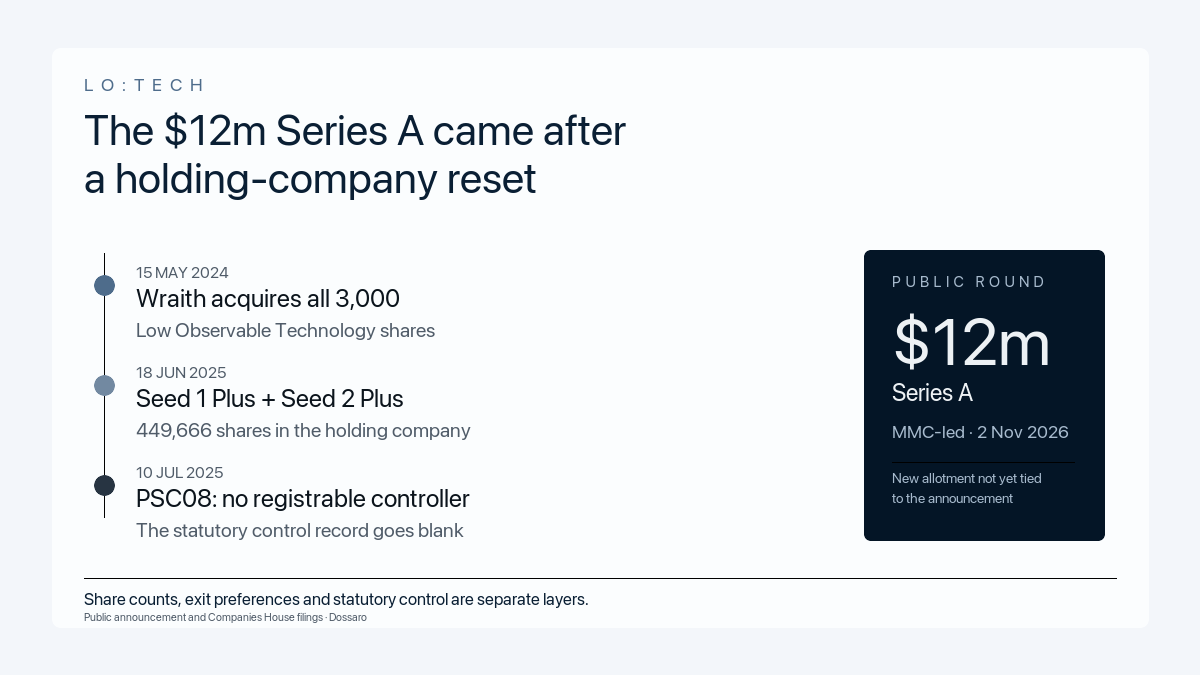
LO:TECH’s $12 million Series A is a growth announcement, but the more consequential financing story started earlier. Companies House records show the founders’ operating companies moving under Wraith Axiom Holdings, followed by preferred seed classes and a control register that no longer named an individual or relevant legal entity. The public round describes new capital for expansion. The filings show the legal layers that determine who holds the shares, which securities rank ahead on an exit and what the public register can actually say about control.
That sequence does not prove who controls LO:TECH economically today, and it does not show how the new Series A was allotted by the article’s evidence cutoff. It does show why a funding headline cannot substitute for the issuer’s capital architecture.
The Series A is public, while the legal reset is filed
In its 2 November announcement, LO:TECH says it raised $12 million in a Series A led by MMC, with existing investors Faction and 13 Books Capital participating alongside Atka. The company says the money will support expansion into the United States and Asia-Pacific, including New York and Singapore, and the growth of execution services for institutional clients across traditional, digital and prediction markets. It also says it serves more than 50 institutional clients.
MMC’s independent investor announcement confirms the lead and the investor group, while 13books Capital’s portfolio page identifies LO:TECH as its seed-stage capital-markets investment and names Tim Meggs, Marcus Horsley and Alex Williams as founders. Those sources establish the current commercial narrative. They do not publish a post-money valuation, a share allocation for the Series A or the rights attached to each investor’s instrument.
The Companies House record supplies a different timeline. Wraith Axiom Holdings Limited was incorporated on 30 April 2024. Its 17 May 2024 SH01 says 297,000 ordinary shares were issued for non-cash consideration: the acquisition of all 3,000 ordinary shares in Low Observable Technology Ltd, the company behind the LO:TECH operating brand. A further 64,285 ordinary shares were allotted on 3 June, followed by 2,142 and 1,071 ordinary shares on 4 and 5 June. By then, the founders’ operating company sat inside a new holding-company layer rather than directly at the top of the structure.
The same pattern appears in Low Observable Trading Ltd’s register. A 23 May 2024 PSC filing names Wraith Axiom as the relevant legal entity holding at least 75% of the shares and voting rights and the right to appoint or remove a majority of the board. The individual founder PSC entries ceased on that date. This is a register-level control result. It is not proof of a cash sale, a loss of founder economics or a change in day-to-day management.
| Layer | Filed or announced fact | What it does not establish |
|---|---|---|
| LO:TECH announcement | $12m Series A led by MMC; Faction, 13 Books and Atka also named | Valuation, investor allocations or new voting rights |
| Wraith Axiom | 297,000 ordinary shares issued for the entire issued share capital of Low Observable Technology | The price paid, indirect economics or Series A proceeds |
| Low Observable Trading | Wraith recorded as an RLE with 75%+ shares, votes and board-appointment rights | Whether founders retained contractual or indirect influence |
| Wraith capital stack | 300,000 ordinary, 73,684 Seed 1 Plus and 75,982 Seed 2 Plus shares in the 2026 statement | Fully diluted ownership or the rights in the new Series A |
Preferred classes changed the denominator
Wraith’s 1 July 2025 SH01 records 75,982 Seed 2 Plus preferred shares allotted at £46.3831 per share and 6,186 Seed 1 Plus shares allotted at £0.001 per share. The form states that the preferred shares carry a preference on a liquidation and on an exit. It also records 449,666 shares in issue after the allotment, comprising 300,000 ordinary shares, 73,684 Seed 1 Plus shares and 75,982 Seed 2 Plus shares. The arithmetic from the stated Seed 2 price is approximately £3.524 million. That is the filed consideration for that allotment, not the size of the later Series A.
The 26 September 2025 confirmation statement names three founders with 92,500 ordinary shares each. Together, those 277,500 ordinary shares are 61.71% of the simple issued-share count. The percentage is useful as a count, but it is not an economic ownership figure. The preferred classes have their own exit preferences, and the filing does not publish a fully diluted cap table or an as-converted waterfall.
The shareholder list also shows how the preferred layer is distributed. 13BOOKS CAPITAL II LP held 56,739 Seed 2 Plus shares, or about 74.67% of that class and 12.62% of all 449,666 issued shares. Lightspeed Faction Fund I LP held 70,177 Seed 1 Plus shares and 1,621 Seed 2 Plus shares, or about 15.97% of the issued count. These calculations identify the register positions. They do not convert class rights into a payout estimate.
The most recent confirmation statement filed in October 2026 repeats the same 449,666-share structure. That makes the earlier capital stack a current public baseline, not merely a historical snapshot. It still does not reveal any Series A issuance that may have occurred after the statement date or outside the filing window covered by the evidence reviewed here.
A blank PSC record is a threshold result, not a cap table
On 18 June 2025, Wraith’s PSC filings recorded the cessation of Alexander Gareth Salter Williams, Timothy William Meggs and Marcus Christopher Horsley as persons with significant control. A 10 July 2025 PSC08 then stated that the company had no registrable person or registrable relevant legal entity in relation to it.
That wording matters. The PSC regime is a threshold disclosure system. A blank result means the company reported no person or entity meeting the registrable tests at that point. It does not say that the founders had no influence, that preferred investors had no consent rights or that control was dispersed in equal proportions. Board appointments, reserved matters, shareholder agreements and indirect holdings may sit outside the public PSC threshold.
The apparent contradiction is therefore the article’s main finding: founders can still be the largest simple ordinary holders while the company’s individual control register is blank, because share counts, preferred exit rights and statutory control thresholds answer different questions. For counterparties, the distinction changes how a diligence request should be framed. A customer or lender asking who controls the business needs the articles, shareholder agreements and current allotment records, not only the PSC page.
The Series A creates a new watchpoint
LO:TECH’s announcement is clear about use of proceeds and geographic ambition. It is not a cap table disclosure. The public article does not identify how much of the $12 million was subscribed by each named investor, whether the round introduced a new preferred class or how any new shares rank against Seed 1 Plus and Seed 2 Plus. The Companies House history reviewed for this article also does not yet show an allotment that can be tied to the announcement with confidence.
That boundary is important for the commercial reading. If the Series A is issued at the holding-company level, the relevant economics may sit in a class stack that is invisible in the operating-company press release. If it is issued after the latest confirmation statement, the next SH01 and updated shareholder schedule should reveal the share count, nominal class and stated paid-in amount. If the round uses an instrument that converts later, the immediate register may show less than the eventual ownership change.
The next decision-changing documents are therefore specific: a post-announcement SH01, the associated statement of capital, any new articles or resolutions varying class rights and a confirmation statement naming the Series A holders. Until those appear, it would be overreach to infer the new investors’ percentage, voting position or exit priority.
The sequence already visible is enough to change the story. Before LO:TECH announced its $12 million Series A, its operating companies had been moved under Wraith Axiom, Wraith had issued preferred seed classes with liquidation and exit preferences, and the individual PSC record had gone blank. The announcement tells us where management wants to go. The filings show the capital and control layers it must travel through.
That is the practical distinction between a financing headline and a financing structure. Epoch Blue’s preferred-share filing shows how a public round can sit beside multiple legal share classes. XRLabs’ founder-control record shows why a register threshold is not the same as an economic cap table. Reflex Aerospace’s capital analysis provides a further comparison for separating an investor narrative from the legal issuer that carries it.
Sources
Continue reading
Related Research
Epoch's $4.25m Seed Came With 670,087 Preferred Shares
Epoch's $4.25m seed sits beside 670,087 preferred shares, $6.26m of filed paid-in amounts, a Burnt Island board appointment and a June issue window.
XRlabs Added Seed-2 Preference Rights While Its Founder Kept Statutory Control
XRlabs raised an $8.4m Playground-led seed while filings show 621,130 Seed-2 shares and a founder still above 50% with majority board rights.
Reflex Aerospace's Planned NVIDIA Investment Has Not Yet Reset Its Filed Cap Table
Reflex Aerospace announced a planned NVIDIA minority investment, yet its latest filed list still shows Alpine at 47.43% and Ballheimer at 30.75%.
Cytix's $7m Series A Reset Its Registered Control
Cytix's $7m Series A ended both founders' significant-control status, added Northern Gritstone to the board and followed a £1m convertible bridge.