
Undecimal's $18m Seed Leaves Its UK Equity Issuer Unmapped
Undecimal launched with an oversubscribed $18m seed, but its UK filings show no post-launch allotment, a ceased founder PSC and an HSBC bank charge.
On this page
Conduct your own private market research
Add dossaro to Claude or ChatGPT and run source-backed register research from your own workspace.
 Add to Claude
 Add to ChatGPT
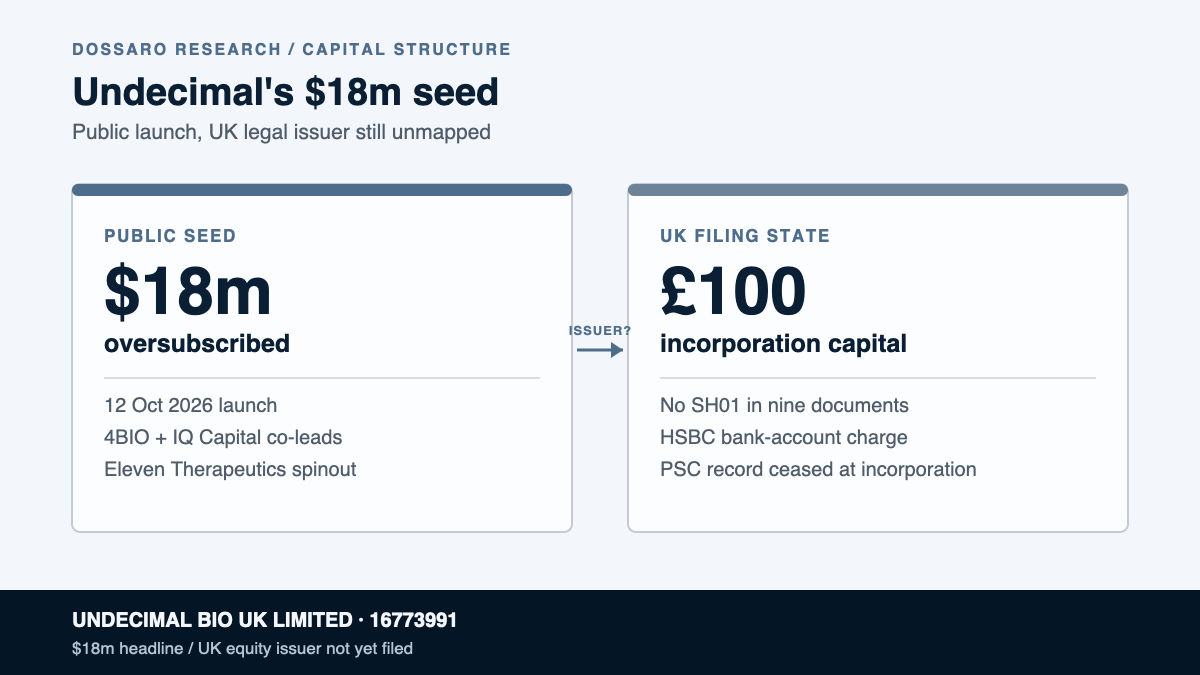
Undecimal Bio launched with an oversubscribed $18 million seed. The UK company linked to that launch was incorporated with £100 of share capital, its founder's initial control record ceased on the incorporation date, and its first visible 2026 financing-related filing is an HSBC fixed charge over bank accounts. The nine-document Companies House history contains no SH01 allotment connecting the UK company to the announced equity round.
That is not evidence that the seed was unpaid or that any investor misled the market. It is a more precise finding: the public financing headline and the UK equity issuer are not yet mapped to each other. For anyone underwriting investor rights, dilution, board influence or cash security, the open legal-entity question is more important than another repetition of the $18 million figure.
The launch describes a funded spinout
IQ Capital's launch announcement, dated 12 October 2026, says IQ Capital and 4BIO Capital co-led an oversubscribed $18 million seed for Undecimal Bio. Verve Ventures, Harel Tech, Entree, Kerna and Saras are named as participants. The announcement describes Undecimal as an Eleven Therapeutics spinout developing the DELiveri platform for siRNA delivery beyond the liver, with an initial focus on renovascular disease.
The same release says Eleven will cease to operate after the Undecimal and ScionxBio spinouts. A BusinessWire report and Startup.eu's financing summary independently repeat the amount, syndicate and spinout framing. IQ Capital says the UK team had 11 people and was expected to roughly double.
Those sources establish the commercial event. They do not say which legal entity issued the shares, whether a parent outside the UK took the subscription, or when a UK allotment would be filed. The UK register answers a narrower question: what is visible in the company named UNDECIMAL BIO UK LIMITED?
The UK company started with £100 and lost its founder-control record
Companies House profile 16773991 shows UNDECIMAL BIO UK LIMITED incorporated in England and Wales on 9 October 2025 at 35 Ballards Lane, London. The incorporation filing records £100 of share capital. Yaniv Erlich was initially notified as a person with 75% to 100% ownership and voting rights, plus the right to appoint and remove directors. That PSC record has a relevant cessation date of 9 October 2025, the same day as incorporation.
The cessation is documented by PSC07, filed on 1 October 2026. A separate PSC08, also filed on 1 October, gives the same historical date and says the company believes there is no registrable person or registrable relevant legal entity.
That is a Companies House control statement, not a conclusion that nobody benefits from the wider Undecimal group. It says the UK company does not currently identify a registrable PSC under the register's thresholds. The officer history adds another timing signal: Omri Amirav Drory, Yaniv Erlich and Tomer Goldberg were appointed at incorporation and all resigned on 23 December 2025. Shaul Ilan is the active director shown in the current record.
The result is a legal shell with a very clear starting point and a less clear post-spinout control state. It is similar in shape to the issuer questions in Sensible's UK operating-company financing, where the public financing story and the legal entity carrying the visible UK filings also needed to be separated.
The first visible 2026 financing act is an HSBC bank charge
The financing-related filing that is visible is not a share allotment. MR01 says a charge was created on 16 September 2026 and delivered to Companies House on 22 September. The person entitled is HSBC Innovation Banking. The instrument records fixed charge over bank accounts and a negative pledge.
The form does not disclose a facility amount, the purpose of the account security, or a connection to the $18 million seed. A bank-account charge can support ordinary banking arrangements. It should not be labelled venture debt without the underlying facility agreement. It also does not identify who owns the equity or who has the right to appoint directors.
The timing still matters. The charge is the first visible post-launch financing signal in this UK filing set, while the public seed announcement names a syndicate of equity investors. The register therefore shows security over cash accounts before it shows a UK equity allotment tied to the headline round.
No SH01 connects this company to the seed
The current CS01 confirmation statement, filed on 16 October 2026, is marked as filed with no updates and gives a statement date of 8 October. The retrieved filing history contains nine documents. It includes the incorporation filing, officer changes, the PSC07 and PSC08, the MR01 charge and the CS01, but no SH01 statement of capital reporting a new allotment.
| Filing | Date | What it establishes | What it leaves open |
|---|---|---|---|
| NEWINC | 9 Oct 2025 | UK company incorporated with £100 of share capital | Whether another group entity issued the seed shares |
| PSC07 | 1 Oct 2026 | Yaniv Erlich's PSC ceased on 9 Oct 2025 | Who holds control now |
| PSC08 | 1 Oct 2026 | Company says no registrable PSC or relevant legal entity | Beneficial interests below the register threshold |
| MR01 | 22 Sep 2026 | HSBC fixed charge over bank accounts, created 16 Sep | Facility size and link to the seed |
| CS01 | 16 Oct 2026 | Confirmation statement filed with no updates | A post-launch UK allotment |
The absence is bounded. It means no SH01 appears in the reviewed nine-document history as of the current confirmation statement. It does not prove that no shares were issued elsewhere, that a parent did not receive the investment, or that a filing could not arrive later. It also does not turn the £100 incorporation capital into a measure of the company's funding.
Three issuer explanations remain open
The first explanation is a parent-level financing. The launch may have funded an Israeli, US or other non-UK parent, with the UK company acting as an operating subsidiary. The public sources do not identify the issuer, so this remains a possibility rather than a finding.
The second is a timing gap. The seed may have closed shortly before the launch and the allotment, if made in the UK entity, may not yet be reflected in the public history. A future SH01 or CS01 would settle that point.
The third is a legal separation between the spinout narrative and the UK company. Eleven's platform, intellectual property or investor agreements may sit in a different entity, while the UK company carries staff, contracts or bank accounts. The current filings cannot choose among these structures.
This is why the article does not name a current owner or assign a percentage to IQ Capital, 4BIO or any other participant. The PSC07 and PSC08 describe the UK register's threshold and historical dates. They do not provide a group cap table.
What the gap means for diligence
For an investor or lender, the practical questions are straightforward. Which entity received the subscription money? Where are the shares, preference rights and board appointment rights recorded? Is the HSBC charge limited to operating cash accounts, or does a wider facility connect it to the spinout's assets? If the UK company is only an operating subsidiary, which parent gives warranties and holds the DELiveri intellectual property?
Those questions affect dilution, priority and enforcement. A seed investor can have strong rights in a parent while holding no shares in the UK subsidiary. Conversely, a UK allotment could later show a new class or shareholder register that changes how the $18 million is understood. The public launch alone cannot answer either case.
The key commercial consequence is therefore not a missing number. It is a missing map between the money headline, the legal issuer and the company carrying bank security. Until that map is filed or published, the round should be treated as a group-level financing event with an unresolved UK equity perimeter.
The next documents that would close the gap
The next UK SH01 or an updated CS01 would show whether the newco has allotted shares after the launch. A parent-level filing, subscription agreement or financing announcement could identify the issuer and the investor rights even if the UK subsidiary never issues equity. The complete HSBC charge instrument or facility agreement would clarify the collateral package and whether the bank relationship is ordinary working capital or part of a larger financing.
Those are specific watchpoints, not an invitation to infer a hidden ownership story. The evidence currently supports a public $18 million seed, a UK company incorporated with £100, a founder PSC record that ceased on the incorporation date, a current no-registrable-PSC statement and an HSBC bank-account charge. It does not yet place the seed shares in the UK register. That is the issuer question Undecimal's next filing must answer.
Continue reading
Related Research
Sensible’s $47m Package Meets a UK Operating Company With £100 of Share Capital
Sensible’s $47m package combines equity and non-dilutive support, while its UK operating company still reports £100 of share capital in its latest accounts.
Matter Machine's £4m Round Changed Founder Control At Launch
Matter Machine's £4m pre-Series A took a one-share founder company to 808,300 shares, cut the founder's PSC band and installed institutional governance.
Microbiotica's £36m Series C Added a Senior Preference Layer
Microbiotica's £36m Series C added 16.8m shares, including senior C1 and C2 classes, while the filing leaves subscribers and full cash reconciliation unresolved.
Epyr's €15m Series A Added a Ratchet-Bearing Capital Stack
Epyr's €15m Series A added ratchet-bearing ABSA A shares and options after a €702k 2025 loss, while French filings keep prices and allocations redacted.