
Sensible’s $47m Package Meets a UK Operating Company With £100 of Share Capital
Sensible’s $47m package combines equity and non-dilutive support, while its UK operating company still reports £100 of share capital in its latest accounts.
On this page
Conduct your own private market research
Add dossaro to Claude or ChatGPT and run source-backed register research from your own workspace.
 Add to Claude
 Add to ChatGPT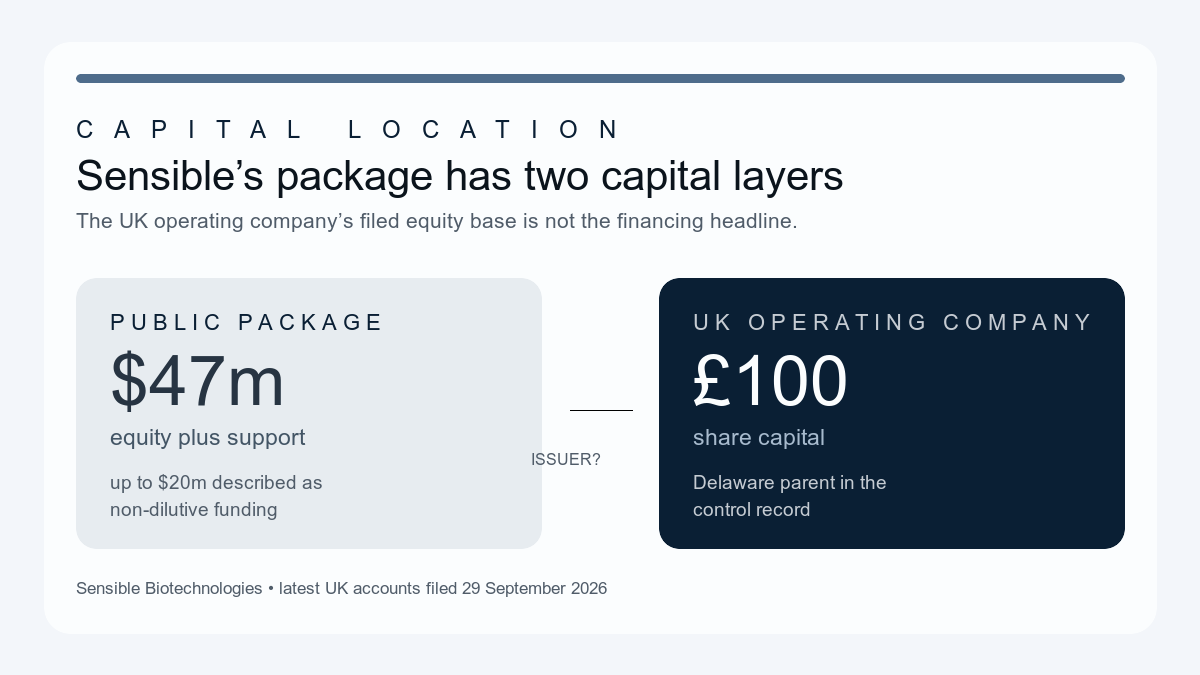
Sensible Biotechnologies describes a package of up to $47 million for its naturally modified mRNA platform. The headline combines a Series A with up to $20 million of non-dilutive support, but the public descriptions disagree on the equity component. OTB Ventures describes a $15 million Series A, while Axios Pro Rata reports a $27 million Series A alongside the same non-dilutive support.
The UK operating company gives the financing story a second, legally separate baseline. Its latest accounts report exactly £100 of share capital, unchanged from the prior year. The Companies House control record names Sensible Biotechnologies, Inc., a Delaware corporation, as the corporate person with significant control. The UK filing history contains no allotment filing that matches the announced package through the latest retrieved period.
That is not evidence that the financing did not happen. It is a more useful finding: the $47 million headline is a mixed capital package, and the equity and investor-rights story is not located in the UK operating company’s public share-capital record.
The $47m headline contains different kinds of capital
Sensible’s official announcement says the company has secured up to $20 million in non-dilutive funding from NATO, the European Union, and the Slovak and German governments. It also identifies In-Q-Tel as an equity funder. The company says its facilities span the United Kingdom, the United States and Slovakia, and that the money will support its production platform for naturally modified mRNA.
The equity number is less settled. OTB Ventures says its investment was part of a $15 million Series A, co-led with Oxford Science Enterprises and joined by Isomer Capital, In-Q-Tel, Recode Ventures, Backed VC, Kaya VC, Civilization Ventures and Y Combinator. Axios Pro Rata reported a $27 million Series A, again alongside up to $20 million of non-dilutive support. A BusinessWire distribution of the company’s release uses the $47 million package framing.
Those figures should not be forced into one arithmetic interpretation. A $15 million equity figure plus up to $20 million of support describes up to $35 million of separately identified components. The $47 million headline may include other equity or financing commitments, while the two public equity descriptions may reflect different reporting conventions or stages of the round. The sources do not publish a definitive instrument-by-instrument reconciliation.
This distinction matters because non-dilutive support is not the same as paid-in equity. Government, NATO and European programmes can have milestones, eligible-cost rules or future-disbursement conditions. The equity component, by contrast, carries shareholder rights and dilution. Treating both as one cheque would hide the question that investors, employees and counterparties actually need answered: which entity issued the securities, and which entity receives or controls the support.
The UK company still carries a £100 equity base
Companies House lists SENSIBLE BIOTECHNOLOGIES LIMITED as an active private company incorporated on 31 January 2023. The registered office is in Altrincham, Cheshire, and the company’s stated activities cover research and development. Its latest accounts, filed on 29 September 2026 for the year ended 31 December 2025, provide a compact balance-sheet snapshot.
| Evidence point | Latest UK record | Commercial reading |
|---|---|---|
| Share capital | £100 in 2025, unchanged from £100 in 2024 | The accounts do not show a UK nominal-capital step matching the public package |
| Net assets | £578,323 in 2025, up from £516,455 | The operating company reports positive net assets, but this is not a valuation or a financing amount |
| Cash at bank and on hand | £67,238 in 2025, up from £51,044 | Cash increased by about 31.7%, without identifying the source of the change |
| Employees | Average of 8 in 2025 and 8 in 2024 | The filed entity remains a small operating-company snapshot beside the global platform headline |
The accounts show net assets rising by £61,868, or about 12.0%, year on year. They do not identify the equity issuer, the price paid by investors or the destination of government and defence-related support. The 4 February 2026 confirmation statement records no updates, and the filing history contains no SH01 capital-allotment filing through the retrieved period that maps the announced package into this UK company.
The absence of an allotment is a boundary, not a conclusion about the group’s cash position. Sensible may raise equity in a parent, use a different group vehicle, or receive support through programme-specific contracts. A £100 share-capital figure is nominal legal capital, not the value of the company, the amount of cash it has raised or the size of its intellectual-property portfolio.
A Delaware parent sits in the control record
The Companies House PSC record names Sensible Biotechnologies, Inc., registered in Delaware as 6197594, as the corporate person with significant control. The source-native record places that company in the 75% to 100% ownership and voting bands and records the right to appoint or remove directors.
That is a control-register fact, not a complete beneficial-ownership conclusion. It establishes that the UK entity is connected to a Delaware corporate parent in the statutory control perimeter. It does not identify the parent’s shareholders, the terms of any Series A securities, or the percentage held by OTB Ventures, Oxford Science Enterprises, In-Q-Tel or any other named participant.
The pattern is familiar in cross-border groups. Wordsmith AI’s Delaware parent and UK operator shows how a parent-level financing story can coexist with a small nominal capital base in the company that employs people and carries local contracts. Spiko’s parent and regulated operating company provides the related financing lesson: a group headline and an operating-company capitalisation can be real at the same time while answering different legal and economic questions.
Where the equity question now sits
For an investor, the next question is not whether Sensible has “£100 of capital.” The question is where the priced equity was issued and which instrument governs the new money. A parent-level share issue would put dilution, preferences and board rights above the UK operating company. A UK allotment would eventually leave a capital or shareholder trace in the Companies House record. A grant or government contract could support facilities and research without changing the shareholder register at all.
The company’s public footprint makes the separation commercially important. Sensible is building a production layer that spans laboratories and partners in several countries. The UK company may be one operating entity within that network rather than the issuer of the group’s financing. That structure can be entirely ordinary, but it changes the diligence path for each stakeholder:
- A venture investor needs the parent cap table, subscription terms, preference rights and any conversion or anti-dilution provisions.
- An employee assessing equity needs to know whether an award relates to the Delaware parent or a local subsidiary, and which future liquidity event would make it valuable.
- A lender, supplier or public funder needs to identify the contracting entity and any guarantee or intercompany funding arrangement rather than treating the $47 million as cash available to every group company.
This is the same entity-first discipline used in private-company ownership research: resolve the legal company, then connect the financing claim to the document that can support it. The current UK evidence gives a precise operating-company baseline, but it cannot substitute for parent-level terms.
What the next document should answer
The next decision-changing record would be a US parent financing or cap-table document that identifies the issue class, price, subscribers and investor rights. A later UK SH01 or updated accounts could show whether any capital was subsequently injected into SENSIBLE BIOTECHNOLOGIES LIMITED. The awards or contracts behind the NATO, EU, Slovak and German support would establish how much of the non-dilutive headline is committed, paid or conditional.
Until those records appear, the defensible retelling is narrow. Sensible has announced a $47 million package that mixes equity with up to $20 million of non-dilutive support, but the UK operating company still reports £100 of share capital, and its control record points to a Delaware parent. The public evidence therefore locates the operating entity, not the parent-level dilution or investor economics.
Continue reading
Related Research
Spiko's $90m Series B Has Two Capital Layers Investors Need to Separate
Spiko says NEA led a $90m Series B. French filings show a €5m parent subscription into the regulated company and a separate ratchet-linked financing stack above it.
Wordsmith's $114m Funding Sits Above A £1 UK Subsidiary
Wordsmith AI has announced $114 million of funding above a one-share UK subsidiary, while Ross McNairn's latest register state preserves founder control rights.
Adaptyv's $40m Series A Sits Above a Parent-Owned Swiss Lab
Adaptyv announced a $40m Series A, while its Swiss Sàrl record shows a US-parent-owned launch and no public post-round investor split or dilution map.
Noah’s $16m Extension Leaves the UK Capital Stack Nearly Unchanged
Noah’s $16m seed extension added only 3,150 visible UK shares, while two corporate ordinary blocks still anchor its UK capital stack and control records.