
Epyr's €15m Series A Added a Ratchet-Bearing Capital Stack
Epyr's €15m Series A added ratchet-bearing ABSA A shares and options after a €702k 2025 loss, while French filings keep prices and allocations redacted.
On this page
Conduct your own private market research
Add dossaro to Claude or ChatGPT and run source-backed register research from your own workspace.
 Add to Claude
 Add to ChatGPT
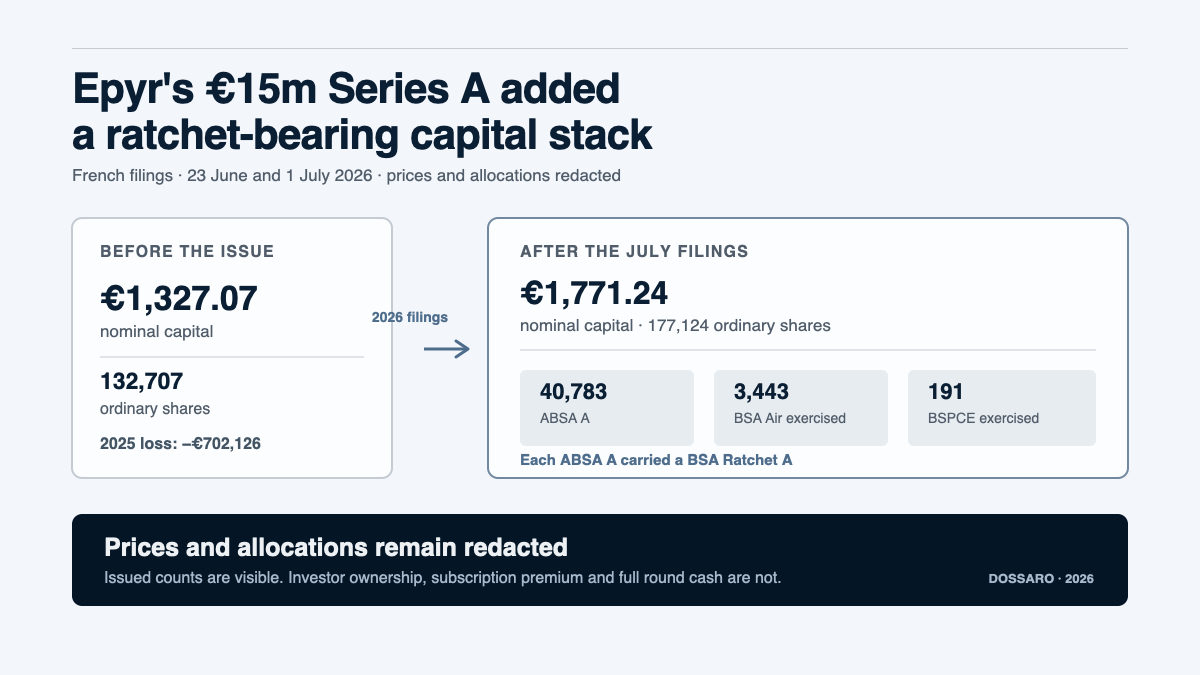
Epyr's €15 million Series A was announced as capital for industrial heat storage. French corporate filings show the round also changed the company's securities map. The June and July 2026 decisions document 40,783 ABSA A, or ordinary shares issued with a BSA Ratchet A attached, followed by 3,443 BSA Air exercises and 191 BSPCE exercises. The updated statutes then show €1,771.24 of capital and 177,124 ordinary shares.
That is a much more precise finding than a reconstructed investor cap table. Epyr's filings keep the subscription prices and allocations redacted, so they do not show who owns what or how much each named investor paid. They do show a ratchet-bearing share issue and an option layer being added while the company reported a €702,126 loss for 2025. The commercial consequence is a financing that buys deployment capacity while leaving the allocation and future dilution questions open.
The public round and the legal event are different views of the same financing
Epyr said on 13 October 2026 that it had closed an oversubscribed €15 million Series A led by SlateVC, with AENU, Daphni, OVNI Capital, WEPA Ventures and Aurum Impact also participating. The company connected the financing to its thermal-storage deployments, including a first industrial unit at WEPA's Troyes site and a 35 MWh project with Papeco. Epyr's announcement sets out the commercial story. Tech.eu's independent report and Startup.eu's round summary confirm the amount, timing and investor group.
The register records a related legal sequence rather than the press-release headline. On 23 June, Epyr's shareholders authorised a cash increase of up to €407.83 nominal value through 40,783 Actions A. Each Action A would carry a BSA Ratchet A, creating an ABSA A. The president's 1 July decision records that all 40,783 ABSA A were subscribed and issued. The same document records the exercise of 3,443 BSA Air into ABSA A and 191 BSPCE into ordinary shares.
Those instruments should not be treated as interchangeable. An ABSA A combines an ordinary share with a warrant. A BSA Air exercise creates another ABSA A under the terms of the earlier instrument. A BSPCE is an employee or founder option instrument that becomes an ordinary share on exercise. The filings establish the existence and quantity of each step, but they do not disclose the commercial price or the identity of every beneficiary.
| Filing event | Quantity or capital effect | What is visible | What remains unresolved |
|---|---|---|---|
| Pre-Seed delegation, December 2024 | Up to 32,709 ABSA Pre-Seed | Pre-emption was waived and the instrument carried a ratchet warrant | Issue price and subscribers are redacted |
| ABSA A decision, 23 June 2026 | 40,783 ABSA A authorised and then issued | Each Action A carried a BSA Ratchet A; the issue was reserved for named persons in a redacted section | Price, premium and allocation by investor |
| BSA Air exercise, 1 July 2026 | 3,443 ABSA A | The president recorded the exercise and €34.43 of nominal subscription | Names and proportions are redacted |
| BSPCE exercise, 1 July 2026 | 191 ordinary shares | 25 and 166 options were exercised, with the beneficiaries redacted | Exercise price and holder identity |
| Updated statutes, July 2026 | €1,771.24 capital and 177,124 ordinary shares | 32,707 Pre-Seed and 44,226 Actions A are identified for tracking | Fully diluted rights and class-allocation economics |
The table is a map of legal events, not a cap table. In particular, the 44,226 Actions A in the final statutes equal the 40,783 ABSA A issue plus the 3,443 BSA Air exercises. They are ordinary shares identified as Actions A in the statutes, while the attached BSA Ratchet A rights can create a further issue under their terms.
Nominal capital rose by a third, but that is not the round value
The final statutes put the earlier capital state into context. The 2025 statutes showed €1,327.07 of capital and 132,707 shares, including 32,707 Pre-Seed shares. The July 2026 statutes show €1,771.24 and 177,124 ordinary shares. The difference is €444.17 of nominal capital and 44,417 additional ordinary shares.
The share-count change is 44,417 divided by 132,707, or approximately 33.47%. That is a useful signal of the legal issuance sequence, but it is not a 33.47% investor dilution calculation. The register does not give the holders of the prior shares, the price paid above the €0.01 nominal value, or the conversion and ratchet outcomes that could change a fully diluted count. The public €15 million headline cannot be divided by 44,417 or 177,124 to infer an issue price.
The distinction matters for anyone reading the round as a valuation event. The filings show the nominal shell into which the securities were issued. They do not disclose the subscription premium, the cash amount received beyond nominal value, or whether any part of the announcement sits in a later completion. As with the Mallow ratchet stack, the existence of a ratchet is a structural fact, not proof that a trigger has occurred or that a holder will receive additional shares.
A €702,126 loss makes the runway question unavoidable
The 23 June 2026 decision refers to Epyr's 2025 loss of €702,126. That figure does not prove financial distress. Early industrial hardware companies can report losses while developing equipment, signing customers and funding deployment. Epyr's public release describes a first unit at WEPA's Troyes site and a 35 MWh Papeco project, giving the financing a concrete operating context.
The loss does change the commercial reading of the securities stack. The company was raising against an operating base that had not yet reached profitability, and the round was accompanied by a ratchet-bearing issue plus exercised warrants and options. The safe conclusion is that the financing supports the next deployment phase while the company remains dependent on future execution and capital. It is not safe to call the round distressed, to infer a runway duration, or to say that any named investor demanded a ratchet because of the loss.
The public announcement also says the financing was oversubscribed. That is evidence of demand for the round, not evidence of a particular post-money valuation or of equal treatment among participants. The French documents separate those questions: the legal issue is visible, while the negotiated price and allocation fields are redacted.
The names are public, the allocations are not
The company names SlateVC, AENU, Daphni, OVNI Capital, WEPA Ventures and Aurum Impact in the announcement. The register names the securities and says the pre-emption right was removed in favour of persons named in the underlying decision, but the relevant names and proportions are replaced by ellipses in the public extracts. No reviewed source maps one of the announced funds to the 40,783 ABSA A, the 3,443 BSA Air exercises or the 191 BSPCE exercises.
That gap blocks the most tempting claims. It is not possible to state that SlateVC owns a particular percentage, that a returning investor received the ratchet, or that founders were diluted to a specific level. Public coverage may describe the founders as retaining majority ownership, but the filings reviewed here cannot independently verify that description. The legal entity is EPYR, a French SAS registered under SIREN 938163904, with Bastien Oggeri as president and Léa Dardenne listed in the public register as director general. Those governance facts do not replace a missing subscriber schedule.
The same caution applies to the BSPCE. The July PV records 25 exercises by one redacted beneficiary and 166 by another. They are evidence that option holders exercised, not evidence of an employee ownership percentage or of a particular founder's position. A later cap table or a filing that identifies the holders would be needed for that conclusion.
What the ratchet changes, and what it does not
The BSA Ratchet A attached to each Action A gives the new class an additional contractual right whose effect depends on its terms and any triggering financing or adjustment event. The public extract does not reproduce those terms. It therefore supports a narrower description: Epyr issued ordinary Actions A with attached ratchet warrants and then updated its statutes to track the resulting class.
That structure can affect future dilution and the relative position of earlier holders, but the direction and size of any effect are not visible here. The warrants may never be exercised, and the article does not assume that they will be. The 3,443 BSA Air exercises are different because the PV records them as completed. The 191 BSPCE exercises are also completed, but their beneficiaries and prices remain redacted.
The useful distinction is between issued capital and contingent rights. The 177,124 ordinary shares are a dated legal count. The ratchet warrants are a future-rights layer that could matter in a later financing or adjustment. Treating the two as one fully diluted number would overstate what the filings prove.
The next document would answer the questions that matter most
The remaining evidence boundary is specific. A subscription agreement, a later SH01 or equivalent capital filing, an updated cap table, or a public copy of the redacted allocation schedule could identify the investors, prices and premiums. A later version of the statutes could expose the BSA Ratchet A terms. The 2025 accounts or a subsequent set of accounts could show how the €702,126 loss translated into cash needs and whether the €15 million was received in one completion.
Until one of those documents appears, Epyr's Series A is best described as a €15 million public financing with a documented securities architecture: 40,783 ABSA A carrying BSA Ratchet A, 3,443 BSA Air exercises, 191 BSPCE exercises and a final €1,771.24 capital base. The filings show how the company made room for the money. They do not show who received each slice or what the round was worth.
Continue reading
Related Research
Mallow's €11m Launch Sits on Ratchet-Linked Seed Shares
Mallow's €11m launch follows two Seed tranches with BSA Ratchet warrants, exposing a protected capital layer and possible future ordinary dilution for investors.
Universal Quantum's $100m Round Entered a Negotiated Preference Stack
Universal Quantum's $100m Series A met existing preference, anti-dilution and participation rights, while post-round ownership remains undisclosed.
Matter Machine's £4m Round Changed Founder Control At Launch
Matter Machine's £4m pre-Series A took a one-share founder company to 808,300 shares, cut the founder's PSC band and installed institutional governance.
Undecimal's $18m Seed Leaves Its UK Equity Issuer Unmapped
Undecimal launched with an oversubscribed $18m seed, but its UK filings show no post-launch allotment, a ceased founder PSC and an HSBC bank charge.