
Mallow's €11m Launch Sits on Ratchet-Linked Seed Shares
Mallow's €11m launch follows two Seed tranches with BSA Ratchet warrants, exposing a protected capital layer and possible future ordinary dilution for investors.
On this page
Conduct your own private market research
Add dossaro to Claude or ChatGPT and run source-backed register research from your own workspace.
 Add to Claude
 Add to ChatGPT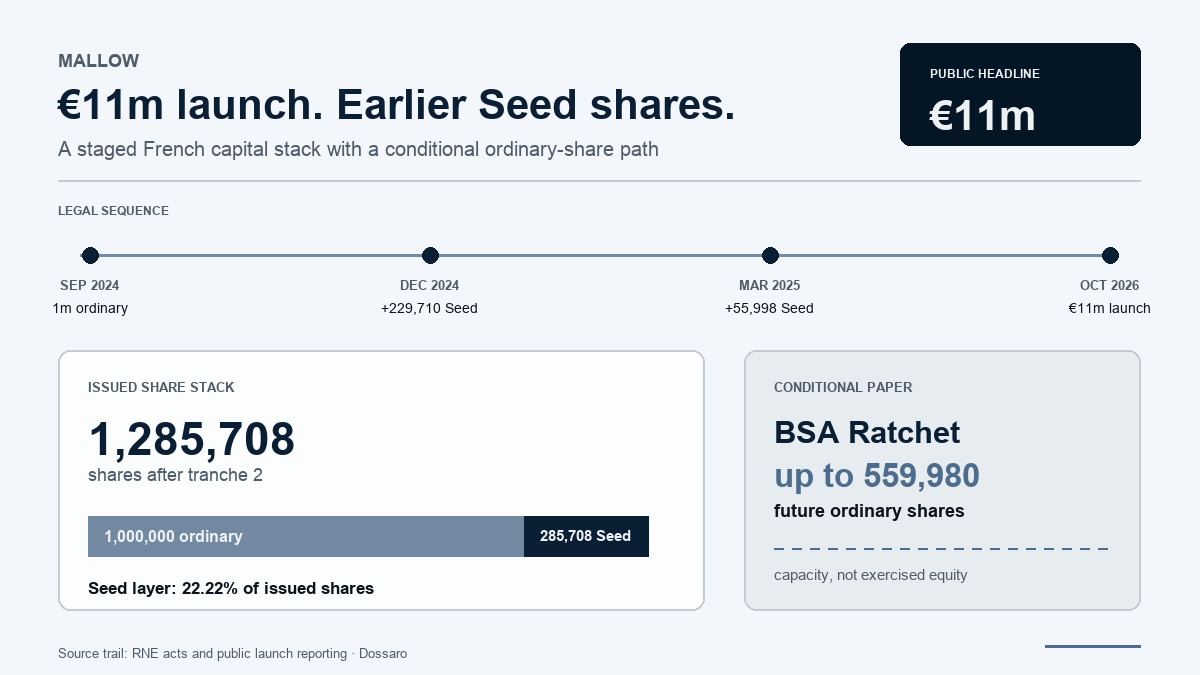
Mallow's €11 million financing was announced as the French startup prepared an international launch for a screen-free AI audio device for children. The legal capital story started earlier: French register documents show two Seed tranches completed in December 2024 and March 2025, each issued with a BSA Ratchet warrant.
The filings put 285,708 Seed shares inside a 1,285,708-share issued base. They also authorize a maximum of 559,980 future ordinary shares if the ratchet warrants are exercised. The public extracts redact the subscription prices and named recipients, so they do not show whether Balderton, Daphni or Motier received any particular block, or whether the 2024–25 instruments are the same financing later summarized as €11 million.
That distinction matters for anyone reading the launch as a clean new-money event. Mallow's public announcement establishes the size and investor headline. The register establishes a staged capital stack with a conditional dilution path. The bridge between the two remains a document request, not a safe assumption.
The launch headline follows a visible Seed stack
Startup.eu reported on 1 October that Mallow raised €11 million led by Balderton, Daphni and Motier. The report described a US expansion and a shift toward European production. Startupresearcher independently reported the same amount and positioned the product as an AI audio device for children.
Mallow's own site describes a screen-free, voice-driven speaker, a parent app and content partnerships. It says more than 300 families tested the product. Those statements explain the commercial launch, but the RNE acts answer a different question: what legal financing structure was already in place before the public reveal?
The answer begins with a 29 November 2024 decision. It authorized 229,710 new shares labeled “Actions Seed.” Each was issued together with a BSA Ratchet, a warrant giving its holder a right to subscribe for ordinary shares under the filed ratchet terms. The extract records a unit subscription price and total subscription amount, but those fields are redacted in the public copy.
The same decision authorized up to 559,980 ordinary shares that could result from exercising the BSA Ratchets. It also removed pre-emption rights for defined investor categories, including existing shareholders and investment funds. That is a concrete future-share capacity, not proof that the capacity was used.
Two tranches changed the denominator
The incorporation record from 30 September 2024 shows The Marshmallow Project with €10,000 of capital divided into 1,000,000 ordinary shares. The subscriber list names Nopeunteo with 396,000 shares, Archibald with 324,000, Cédric O with 99,000, Flore Cousin with 81,000, Veyrach with 50,000, Sébastien Boyer with 25,000 and Nicolas Princen with 25,000.
The first Seed tranche added 229,710 shares. The December completion record states that the ABSA Seed were fully issued, taking the company to €12,297.10 of capital and 1,229,710 total shares. The second tranche followed a February 2025 delegation for up to 55,998 further ABSA Seed. Its March completion record states that all 55,998 were issued, bringing the capital to €12,857.08 and the total to 1,285,708 shares.
| Legal stage | Ordinary shares | Seed shares | Total issued shares | What the record establishes |
|---|---|---|---|---|
| 30 Sep 2024 incorporation | 1,000,000 | 0 | 1,000,000 | Original subscriber base |
| 12 Dec 2024 first completion | 1,000,000 | 229,710 | 1,229,710 | First ABSA Seed tranche completed |
| 10 Mar 2025 second completion | 1,000,000 | 285,708 | 1,285,708 | Second tranche completed; 55,998 new Seed shares |
| 13 Nov 2025 name change | 1,000,000 | 285,708 | 1,285,708 | The Marshmallow Project became Mallow; capital unchanged |
The Seed layer therefore represented 18.68% of issued shares after the first tranche and 22.22% after the second. Those are issued-share percentages, not investor ownership percentages. The public acts do not allocate the Seed shares to named investors.
The chronology is the finding. Mallow did not move from 1,000,000 ordinary shares straight to a public €11 million headline. It used two staged Seed issuances, and the second tranche was completed more than 18 months before the October 2026 launch report.
The ratchet is a capacity, not a current dilution event
BSA Ratchet warrants change the way the visible share count should be read. The filed decisions give the warrant holders a route to subscribe for ordinary shares if the ratchet conditions are met. The November decision sets the maximum future ordinary issuance at 559,980 shares, while the current statutes show 1,285,708 issued shares.
| Scenario | Calculation | Result | Safe interpretation |
|---|---|---|---|
| Current Seed share block | 285,708 / 1,285,708 | 22.22% | Issued Seed share percentage |
| Maximum ratchet capacity versus current base | 559,980 / 1,285,708 | 43.56% | Conditional capacity, not issued shares |
| Illustrative count if every maximum share were issued | 1,285,708 + 559,980 | 1,845,688 | Mechanical denominator only |
| Ratchet shares in that illustrative count | 559,980 / 1,845,688 | 30.35% | Scenario, not a reported fully diluted cap table |
The distinction is important for diligence. A warrant capacity can be large without a single warrant being exercised. The public record does not show an exercise filing, a current fully diluted shareholder statement, or the contractual trigger and pricing outcome for a future issuance. It is safe to say that the register authorizes a possible ordinary-share path. It is not safe to call 43.56% current dilution.
The same discipline appears in Hackuity's €19 million financing, where ratchet-linked instruments changed the analysis without turning a maximum into a completed issuance. StandardX's Seed structure offers a related reminder: the legal class and share count can reveal an economic layer even when the headline financing amount does not disclose its price or allocation.
The €11m headline has two plausible readings
One reading is that the 2024–25 ABSA Seed instruments are the financing later summarized publicly as €11 million. That would make the launch report a delayed commercial description of a staged round whose legal close happened earlier. The timing is compatible with that interpretation, but the redacted extracts do not prove it.
The other reading is that Mallow raised or agreed additional money in 2026 and used the €11 million figure for a later round or a broader financing total. The current public materials do not provide a 2026 RNE issuance, a subscriber schedule, a valuation or a post-round cap table that would settle the point.
Both readings are commercially ordinary. Venture financings can close in tranches, combine instruments or be announced after legal completion. French public extracts can also omit price and recipient detail. Those explanations do not erase the document-based finding: the legal entity already had a warrant-linked Seed layer before the 2026 launch.
What investors can and cannot underwrite
The register answers the capital-formation question more clearly than the launch coverage does. It identifies the original ordinary base, the two Seed additions, the BSA Ratchet mechanism and the maximum future ordinary capacity. It does not identify the economic split among investors, the price paid for the Seed shares, or the current effect on founders and earlier holders.
That gap changes the next diligence request. A subscriber schedule would connect the Seed block to specific funds or individuals. A later RNE act could show whether any ratchets were exercised. A 2026 shareholder statement could reveal whether the €11 million announcement changed the issued denominator or sat above the existing French operating company.
The named investors in the public launch report should therefore remain named investors in the article, not retrofitted into the historical Seed stack. Balderton, Daphni and Motier may be part of the 2026 economics, but the public acts reviewed here do not assign them shares or warrants.
Mallow's product launch is easy to retell: a screen-free children's audio device raised €11 million and is moving toward international distribution. The financing structure is harder and more useful. Two earlier Seed tranches already created a 22.22% visible Seed block, and the attached ratchets created a conditional route to substantially more ordinary shares.
The next document to watch is not another launch article. It is the subscription or shareholder record that connects the €11 million headline to the Seed instruments, names the holders and shows whether the ratchet capacity ever became equity.
Continue reading
Related Research
StandardX's £10m Seed Round Put Two Preferred Classes Ahead of Ordinary Shares
StandardX announced a £10m isotope seed. Companies House filings show £9.81m of priced allotments, senior preferred rights and a pre-round funding gap.
Hackuity's $19m Round Carries a 243,860-Share Ratchet
Hackuity's $19m round includes a €7m cash tranche, a bond conversion and a ratchet ceiling that could add 243,860 shares to the capital structure.
ZuriQ's $25.5m Seed Created A 28.6% Preferred Block
ZuriQ's $25.5m seed closed legally in May, creating a 28.6% preferred block and adding a Quantonation-linked director before its July reveal.
Project Ventures’ £5m Fund Splits General-Partner Vote From Carry
Project Ventures’ £5m fund gives Infra One 75%+ voting rights in the general partner while Project Ventures Consulting holds 75%+ of surplus assets.