
Titanbay's Luxembourg platform predates LFDE's €1,000 ELTIF launch
Titanbay's Luxembourg SICAV was formed months before LFDE's €1,000 ELTIF launch, putting a legal platform behind the public private-markets partnership.
On this page
Conduct your own private market research
Add dossaro to Claude or ChatGPT and run source-backed register research from your own workspace.
 Add to Claude
 Add to ChatGPT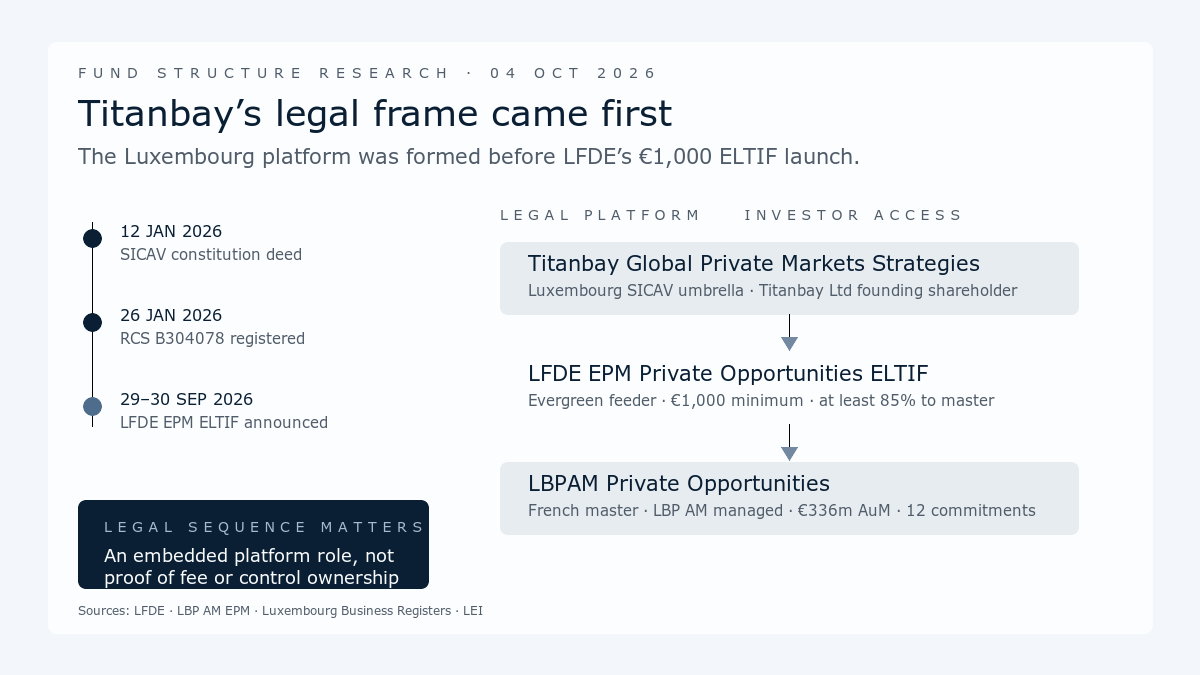
LFDE’s €1,000 private-markets launch did not begin with the press release that introduced it. Titanbay Global Private Markets Strategies, the Luxembourg SICAV named as the feeder’s umbrella, was constituted on 12 January 2026 and registered on 26 January. The public launch followed on 30 September, more than eight months later.
That sequence matters because the Luxembourg vehicle’s constitutional frame already named Titanbay Ltd as founding shareholder and reserved Class S shares for the founding shareholder or eligible successors. The articles also give the relevant holder a route to nominate board candidates. The record shows Titanbay embedded in the vehicle’s legal architecture before the product was marketed to European investors. It does not show who captures fees, who ultimately owns the platform or how the rights operate after any permitted transfer.
The public announcement still describes a genuine partnership. LBP AM European Private Markets manages the French master fund, LFDE distributes the feeder and Titanbay acts as AIFM while supplying the Luxembourg fund infrastructure. The more precise reading is that LBP AM’s existing private-markets exposure is being routed through a separate, Titanbay-incorporated platform rather than placed directly into a newly formed LBP AM vehicle.
The launch announcement leaves out the legal sequence
LFDE’s 30 September announcement says the LFDE EPM Private Opportunities ELTIF is an evergreen vehicle for pan-European distribution under ELTIF 2.0. The feeder is available from €1,000 to professional and non-professional investors. It sits within Titanbay’s regulated Luxembourg SICAV umbrella, invests substantially all and at least 85% of its assets in LBPAM Private Opportunities, and uses Titanbay as AIFM.
The LBP AM European Private Markets version is dated 29 September and gives the same product facts. It says the French master fund, managed by LBP AM, had already reached €336 million of AuM and made commitments to 12 underlying funds. Moneycab’s independent coverage also identifies Titanbay’s Luxembourg SICAV, the master-feeder structure and Titanbay’s AIFM role.
Those sources explain the commercial proposition. They do not explain when the umbrella was formed, who supplied its founding capital or what governance route was preserved in its articles. The LEI record independently identifies Titanbay Global Private Markets Strategies, RCS B304078, as an active Luxembourg SICAV at 9 Rue de Bitbourg and records a 2026 creation date.
Three dates turn a product launch into a platform story
The public and register evidence line up as a short sequence:
| Date | Evidence | What it establishes |
|---|---|---|
| 12 January 2026 | Constitution deed for Titanbay Global Private Markets Strategies | The Luxembourg SICAV’s legal formation began before the public product announcement. |
| 26 January 2026 | Luxembourg registration publication for RCS B304078 | The vehicle was registered with master-feeder and ELTIF capacity in its constitutional frame. |
| 29-30 September 2026 | LBP AM EPM and LFDE launch announcements | The €1,000 feeder was presented for European distribution, with Titanbay as AIFM and LBP AM managing the master. |
The gap between the January registration and September launch is not evidence of a hidden transaction. A fund platform can be incorporated ahead of authorisations, service-provider appointments, distribution approvals and product documentation. The useful finding is narrower: the legal shell was not created in response to the announcement. It was ready first, and the announcement describes the commercial layer later placed on top of it.
The same sequence also prevents a common shortcut. Calling Titanbay only a technology provider misses the founding-shareholder and share-class provisions. Calling Titanbay the investment owner goes too far because the public materials assign management of LBPAM Private Opportunities to LBP AM and do not disclose beneficial ownership or fee arrangements.
The master-feeder structure separates access from investment selection
The new product is easier to understand when each layer is kept distinct:
| Layer | Role in the public structure | Evidence-backed consequence |
|---|---|---|
| Titanbay Global Private Markets Strategies | Luxembourg SICAV umbrella and home of the feeder; Titanbay acts as AIFM | Titanbay supplies the regulated vehicle and operating framework through which the cross-border product is distributed. |
| LFDE EPM Private Opportunities ELTIF | Evergreen ELTIF feeder, available from €1,000 | European professional and non-professional investors enter through the feeder rather than directly into the French master. |
| LBPAM Private Opportunities | French-domiciled ELTIF 2 master managed by LBP AM | The master is the investment destination, with €336 million of AuM and commitments to 12 underlying funds already reported. |
| LFDE and LBP AM EPM | Distribution and private-markets product roles | LBP AM’s existing strategy is extended beyond French networks through the feeder and LFDE’s distribution reach. |
The feeder’s disclosure that at least 85% of assets will be invested in the master is the key economic separation. Investors obtain exposure to LBP AM’s multi-asset private-markets allocation, but the legal and operational path runs through a Titanbay vehicle. LFDE’s release also lists multiple levels of expenses, dependence on the master’s liquidity and limited voting rights among the risks. Those are not side notes: they describe the price of using the access layer.
The master’s reported €336 million and 12 commitments are therefore not assets of the new feeder. They describe the existing French strategy that the feeder is designed to reach. Nor is the €1,000 minimum the amount needed to build the platform. It is the advertised entry point for investors accessing the finished structure.
Founding shares create a governance question, not a control conclusion
The Luxembourg articles provide the differentiated register insight. Titanbay Ltd, UK company 12175760, is named as founding shareholder. Class S shares are reserved to that founding shareholder or eligible successors, including permitted AIFM affiliates or successors. The relevant holder can submit candidates for the board.
That is a legal governance lever. It means the platform’s formation documents anticipated a continuing role for the founding shareholder even as shares could move within the permitted group. It also gives the reader a concrete reason to look beyond the marketing label “in partnership with Titanbay”.
But formation rights are not the same as final control. The public record available for this launch does not include the prospectus, the share register after authorisation, the AIFM agreement or the fee schedule. It does not show whether the Class S holder retained the board route, what votes attach to other classes, or how the economics are split among Titanbay, LBP AM, LFDE and service providers.
The benign reading is plausible. Founder shares and board-candidate mechanics are common ways to stabilise a regulated vehicle while it moves from incorporation to authorisation. The articles may matter less once the AIFM, depositary and investor governance documents are operating. The stronger defensible claim is not that Titanbay controls the fund. It is that Titanbay’s legal platform and founder-share route were in place before investors were offered the feeder.
The next document should connect the shell to its economics
The public materials establish the product’s investment path and commercial roles. The Luxembourg registration evidence adds its legal starting point. Together they support a platform thesis: the European distribution launch is an LBP AM private-markets strategy routed through a separately constituted Titanbay SICAV, not a single new fund created by the announcement.
The unresolved questions are the ones that would change the economic reading. The prospectus and KIDs should show the founder share class, fee layers, liquidity terms and voting rights. The final share register would show who held Class S after authorisation. The AIFM agreement and fee schedule would show how the operating and distribution roles were priced. None is a safe basis for inference from the launch release alone.
Until those documents are available, the strongest finding is chronological and structural. Titanbay’s vehicle was constituted in January, its founding shareholder and reserved Class S route were written into the legal frame, and the €1,000 LFDE feeder was announced in September as a way into LBP AM’s existing €336 million, 12-commitment master. That makes Titanbay an embedded platform participant. It does not prove beneficial ownership, fee capture, investment discretion over the master or investor returns.
The distinction is similar to the one in Project Ventures’ GP carry analysis: legal rights and economic entitlements must be separated before calling a structure controlling. Claret Fund IV’s manager-economics analysis likewise shows why a fund vehicle’s public label does not disclose the full fee path. And Dig Ventures’ UK vehicle analysis traces how a new fund platform can be built in a legal entity before the commercial story reaches the market.
Sources
Continue reading
Related Research
Claret's €575m Fund IV Close Sits Beside a £4.46m Profit Jump
Claret's €575m close expanded lending capacity, while UK filings show £4.46m manager profit, £1.31m ordinary dividends and a €6.7m commitment.
Project Ventures’ £5m Fund Splits General-Partner Vote From Carry
Project Ventures’ £5m fund gives Infra One 75%+ voting rights in the general partner while Project Ventures Consulting holds 75%+ of surplus assets.
DIG's $120m Fund III Was Built Beside a New UK Investment Vehicle
DIG's $120m Fund III launched beside a new UK company whose sole shareholder is the Guernsey fund LP, while its older adviser reported £988,744 due after one year.
Mustard Seed's €150m First Close Is Already a Deployment Vehicle
Mustard Seed + Partners says nearly €150m is closed and €55m is deployed, but public records still leave LP commitments and fund control unallocated.