
Sosteneo's €450m Fund II Headline Blends Commitments and Co-Investment
Sosteneo says Fund II has more than €450m in total commitments, but its first close includes co-investment capital; the Luxembourg RAIF and AIFM are clear.
On this page
Conduct your own private market research
Add dossaro to Claude or ChatGPT and run source-backed register research from your own workspace.
 Add to Claude
 Add to ChatGPT
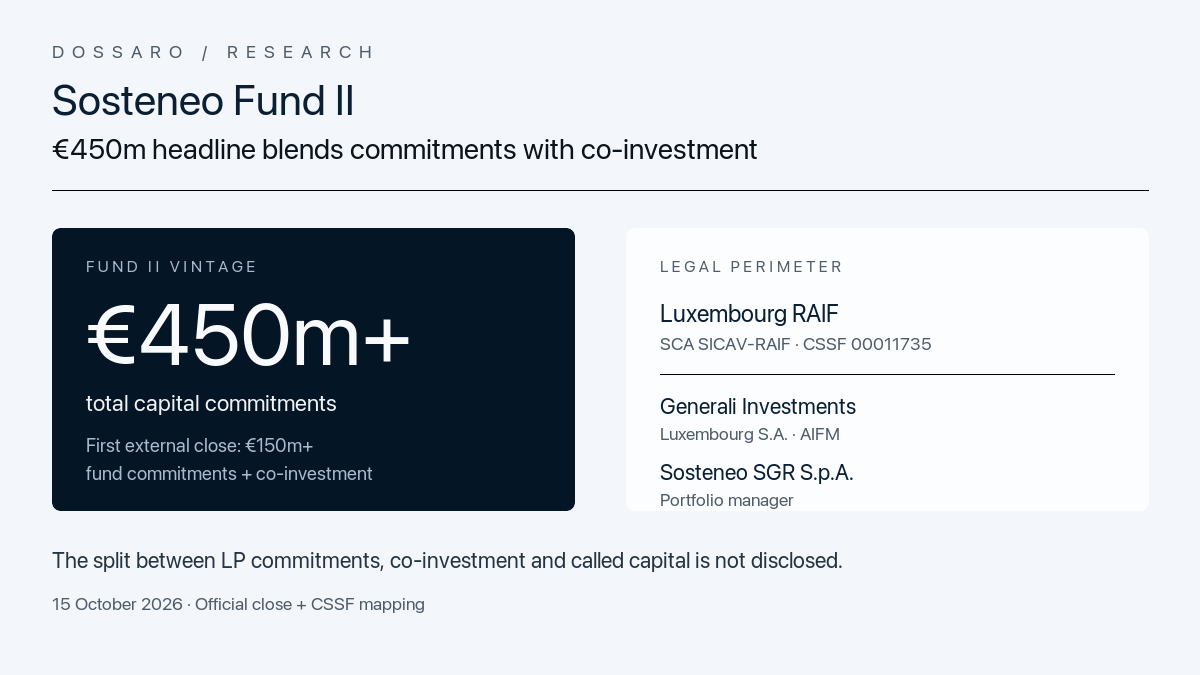
Sosteneo says its second clean-energy infrastructure fund has passed €450 million, but that headline is not a verified total of Fund II limited-partner commitments. The manager’s 15 October announcement says the first external close secured more than €150 million in “new fund commitments and co-investment capital.” It then describes the Fund II vintage as having more than €450 million of total capital commitments.
That wording makes the capital mix the central fact. The announcement does not allocate the €150 million between commitments to the fund and capital available through co-investment arrangements. Nor does it show how much of the €450 million is committed to the Luxembourg fund vehicle, how much has been called, or how much is available for projects. The legal perimeter is clearer than the money split: the named vehicle is Sosteneo Clean Energy Infrastructure Fund II SCA SICAV-RAIF, a Luxembourg reserved alternative investment fund, with Generali Investments Luxembourg S.A. as manager and alternative investment fund manager (AIFM). Sosteneo SGR S.p.A. is identified as portfolio manager.
The result is a useful capital map, not a claim that Sosteneo has a public limited-partner ledger. It also means the first Fund II distributions and partial realisation described for the older Fund I should not be treated as the source of the new close without a transaction document.
The €450m number contains two different buckets
Sosteneo’s official announcement was published from Milan on 15 October 2026. It says Fund II completed its first external close with more than €150 million of new fund commitments and co-investment capital. The close brings total capital commitments for the Fund II vintage above €450 million, while Sosteneo’s platform capital rises above €1.1 billion.
The distinction is not cosmetic. A commitment to the fund normally creates a contractual obligation to that vehicle, subject to its governing documents and drawdown terms. Co-investment capital can be arranged alongside a fund investment and may sit in a separate vehicle or direct investment. It can have different fees, governance, concentration and exit economics. Combining the two in a single first-close sentence tells a reader the scale of the programme, but not the amount that belongs to Fund II itself.
FundOps Daily’s independent coverage repeats the €150 million first external close and the €450 million Fund II total. That confirmation supports the event and its scale. It does not add an LP schedule or a commitment split. Sosteneo’s own wording remains the primary source for the distinction between new fund commitments and co-investment capital.
The earlier Fund I and Fund II announcement provides the longer platform context. It described Fund I at more than €620 million plus €80 million of co-investment capital, with a Fund II target of €1 billion. Those figures are historical programme statements. They should not be added to the current close as if they were the current Fund II balance.
The legal vehicle is a Luxembourg RAIF, not the manager’s balance sheet
The fund named in the release is Sosteneo Clean Energy Infrastructure Fund II SCA SICAV-RAIF. The production Dossaro research run resolved a corresponding CSSF AIF record, registration lu:cssf:00011735, with an authorisation date of 1 July 2025. The CSSF record identifies the fund as an active alternative investment fund mapping and links it to Generali Investments Luxembourg S.A. as AIFM.
The release’s regulatory language supplies an important qualifier. Fund II is a Luxembourg-law AIF that qualifies as a reserved alternative investment fund, or RAIF. A RAIF is an unregulated investment vehicle under Luxembourg’s RAIF framework. The fund is therefore not the same legal balance sheet as Sosteneo’s Italian management company. The announcement says the marketing communication is co-issued by Sosteneo SGR S.p.A. and Generali Investments Luxembourg S.A., and that Sosteneo SGR acts as portfolio manager after appointment by the AIFM.
The CNMV’s foreign-AIF record independently lists Fund II under registration number 6446 in Spain. The CSSF mapping source and the public release establish a regulatory relationship between the fund and its AIFM. Neither is an LP register or beneficial-ownership record.
| Public statement or record | What it establishes | What it does not establish |
|---|---|---|
| More than €150m at first external close | New fund commitments and co-investment capital were secured | The split between those two buckets |
| More than €450m for the Fund II vintage | Sosteneo’s stated total capital-formation figure | Fund II paid-in capital, called capital or available cash |
| Luxembourg SCA SICAV-RAIF | The named fund vehicle and Luxembourg legal form | The identity or commitment of each LP |
CSSF record 00011735 | AIF registration and the Generali AIFM relationship | Ownership, distributions or investor returns |
| CNMV registration 6446 | Spanish foreign-AIF marketing registration | The amount marketed or subscribed in Spain |
This is the same separation that matters in fund-vehicle reporting. A manager can announce a programme, an AIFM can carry regulatory obligations, and a fund vehicle can receive commitments without any one of those public surfaces disclosing the complete investor economics.
Fund I’s distributions are context, not a financing bridge
The Fund II release also describes Fund I’s operating progress. Around three quarters of Fund I’s 39 projects were fully operational. Sosteneo says Fund I started making income distributions to investors in the second quarter of 2026, and in the third quarter it signed the sale of an interest in an operating asset, its first partial realisation.
Those details explain why Sosteneo presents the new close alongside Fund I maturation. They show a portfolio moving from construction and development toward operations, income and an initial sale. They do not state the amount of the distribution, the asset sale consideration, the buyer, or whether any proceeds were reinvested into Fund II. A partial realisation can be economically important while remaining separate from a new fundraising close.
For a reader assessing the platform, the safe sequence is therefore: Fund I has reached operating milestones; Fund II has attracted new commitments and co-investment capital; the fund programme is still fundraising. Nothing in the announcement proves that the Q3 sale funded the €150 million close or that a particular LP received a particular return.
The missing split changes the diligence questions
The blended number affects different stakeholders in different ways. An institutional investor needs the commitment and drawdown terms for the Luxembourg vehicle, then separate terms for any co-investment allocation. A portfolio company needs to know which entity will subscribe, hold the shares and exercise governance rights. A lender or service provider dealing with Sosteneo SGR or Generali Investments Luxembourg is dealing with an AIFM or portfolio-management relationship, not necessarily with Fund II assets.
The public release does not disclose the Fund II offering document, the capital-call schedule, the identities of the new institutional investors, the size of Generali Insurance Companies’ increased commitment, or the amount and structure of any co-investment. It also does not name the operating asset sold by Fund I or give a value for the partial realisation. Those are substantive gaps because they determine who has exposure, when cash is due, and whether platform capital is being measured on a committed, called or asset-value basis.
The comparison with Nauta’s Fund VI close is instructive. Nauta’s public €60 million first close and its UK manager accounts answer different questions because the fund and service company sit in separate layers. Sosteneo’s release goes one step further by explicitly combining fund commitments and co-investment capital in the first-close figure. The result should be read as a programme-level capital-formation milestone, not as a disclosed Fund II LP total.
What the next document would settle
The most valuable next document is Fund II’s issuing or offering document, or a later closing notice that states the commitment split. It would show the legal issuer, the capital classes, the calculation of the first close and the rights attached to co-investment. A fund report or capital-call notice could then distinguish committed, called and invested capital.
For Fund I, an annual or semi-annual report could identify the operating asset sold in the third quarter, disclose the sale proceeds and show how income distributions were calculated. None of those documents is present in the public CSSF AIF mapping used for this run, and the Luxembourg public register surface did not expose an LP table or a complete filing set.
The evidence supports a precise conclusion. Sosteneo has announced more than €450 million for the Fund II vintage, but the first external close explicitly includes both new fund commitments and co-investment capital. The Luxembourg RAIF, Generali AIFM and Sosteneo portfolio-manager roles are identifiable. The LP split, amount called, co-investment vehicle and Fund I realisation economics remain open. That boundary is the difference between a credible capital map and a headline that implies more precision than the sources provide.
Continue reading
Related Research
Nauta's €60m Fund VI Close Sits Above a £2.25m UK Manager
Nauta’s €60m Fund VI first close sits at fund level, while its UK manager reports £2.25m of service revenue, £161,189 cash and a £767,578 parent debtor.
Graduate Ventures' €125m Fund II Sits in a Dutch Cooperative
Graduate Ventures' €125m Fund II maps to a Dutch cooperative beside separate manager and seed-capital companies, clarifying structure without LP economics.
Forbion's €2.3bn Close Has a Visible $1.014bn US Split
Forbion's €2.3bn close spans growth and venture vehicles; SEC filings show $1.014bn sold across 37 investors, not one pool, with no LP allocation published.
Sava's $36m Round Meets an Existing All-Assets Security Package
Sava's $36m Series B is led by Ascensia, but an outstanding Companies House charge gives a security agent fixed and floating claims over the business.