
Graduate Ventures' €125m Fund II Sits in a Dutch Cooperative
Graduate Ventures' €125m Fund II maps to a Dutch cooperative beside separate manager and seed-capital companies, clarifying structure without LP economics.
On this page
Conduct your own private market research
Add dossaro to Claude or ChatGPT and run source-backed register research from your own workspace.
 Add to Claude
 Add to ChatGPT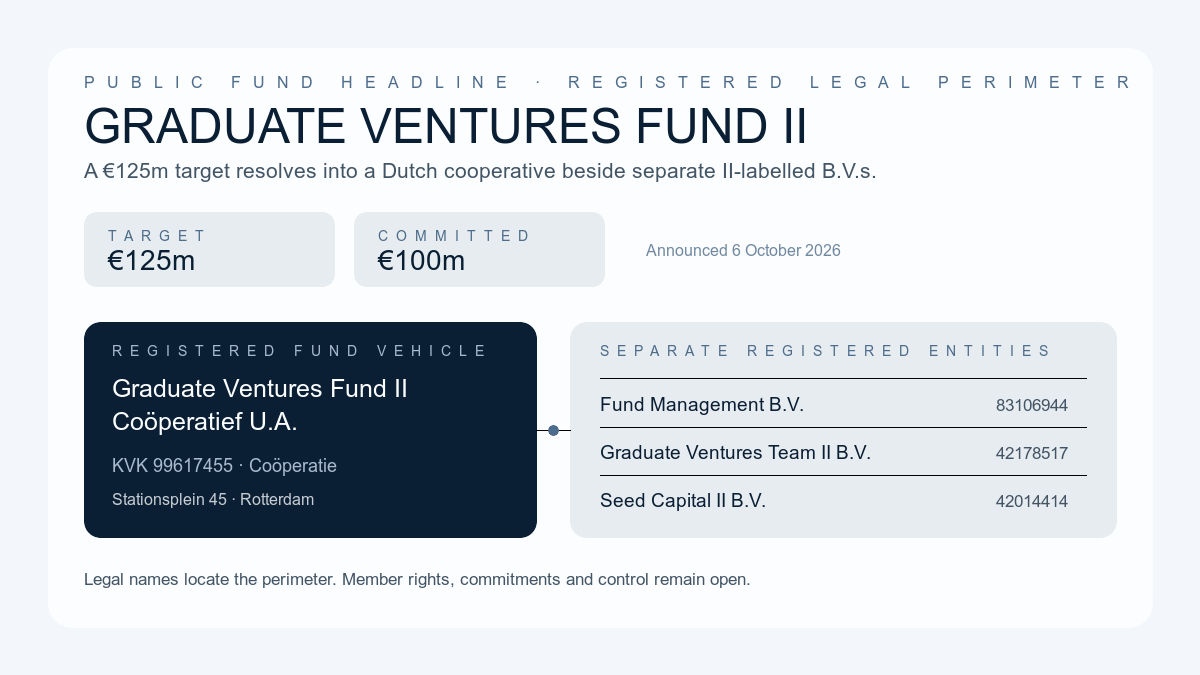
Graduate Ventures has announced a €125 million second seed fund, with €100 million already committed. The useful detail behind that headline is legal rather than promotional: the Dutch register resolves Fund II to a cooperative, alongside a separate management company and two II-labelled B.V.s.
That distinction changes the diligence map. Graduate Ventures is a platform with a national university network, a pre-seed fund and two seed funds. It is not, on the evidence available, a single Dutch B.V. that can be used as a shorthand for every fund, management and investment function. The public sources establish scale and partners. The register identifies the perimeter. Neither publishes the member, commitment or control economics.
The €125 million headline describes a platform, not one legal record
Graduate Ventures' official announcement is dated 6 October 2026. It says the second seed fund has a €125 million target and €100 million committed. The announcement places the fund in a wider platform that works with eight universities and three university medical centres. It names entrepreneurs including Frank Slootman, Michiel Muller, Jonas Ruyter and Peter Wennink, and says Invest-NL and Oost NL are participating.
The release also describes a pre-seed fund and two seed funds investing in artificial intelligence, deep tech, healthcare and climate. Graduate says it has invested in more than 90 technology start-ups since its 2021 founding and has a network of more than 200 entrepreneurial alumni. Those facts explain why the public brand spans more than one vehicle or company.
Independent coverage from Kijk op Zuid-Holland confirms the 6 October date, the €125 million target and the €100 million committed figure. It also describes the university network and the pre-seed fund. Neither public account names the vehicle that legally holds the second fund, lists its members or allocates the named backers to a particular entity.
The two public figures have a simple relationship: €100 million committed against a €125 million target is 80%. That arithmetic does not show that €100 million has been paid into a bank account, that every commitment is irrevocable, or that all of it is recorded in the cooperative found in the register.
The register puts Fund II in a cooperative
The exact Dutch identity is Graduate Ventures Fund II Coöperatief U.A., KVK 99617455. The completed register search records it in Rotterdam as a Coöperatie at Stationsplein 45 Unit A4.004, 3013AK Rotterdam.
That legal form is the first material difference between the public brand and the statutory record. A cooperative is not the same form as a Dutch B.V. Its name is strong evidence that this is the Fund II vehicle, but the legal form alone does not disclose who its members are, how voting works, whether members have different classes, how liabilities are allocated or what commitments have been accepted.
The distinction is important because a fund announcement and a register entry answer different questions. The announcement explains the amount Graduate wants to deploy and the network supporting it. The cooperative identity tells a counterparty which legal name to search for when asking where fund-level documents, commitments or governance might appear. It does not turn a target into a balance-sheet fact.
Three separate B.V.s sit beside the fund vehicle
The same bounded search resolves a distinct management company and two II-labelled companies. They should be kept separate from the cooperative until primary filings or agreements connect them:
| Registered entity | KVK | Legal form | What the public record supports | What it does not prove |
|---|---|---|---|---|
| Graduate Ventures Fund II Coöperatief U.A. | 99617455 | Coöperatie | Exact Fund II vehicle identity | Members, commitments, voting rights or control |
| Graduate Ventures Fund Management B.V. | 83106944 | B.V. | Separate manager identity at the same Rotterdam address | Appointment, fee flow, AIFM status or ownership |
| Graduate Ventures Team II B.V. | 42178517 | B.V. | Separate II-labelled registered entity | Team services, investment authority or relationship to the fund |
| Graduate Ventures Seed Capital II B.V. | 42014414 | B.V. | Separate II-labelled seed-capital entity | Whether it invests, co-invests, owns assets or controls a vehicle |
The names are useful clues, not a completed organisation chart. Graduate Ventures Fund Management B.V. may be the entity that performs management work, but the exact search result does not publish an agreement showing that. Team II and Seed Capital II may relate to staff or adjacent investing activity, but their names do not prove ownership, cash flows or authority. The fund vehicle and these B.V.s are distinct legal registrations, not four descriptions of one company.
Why the legal perimeter changes the commercial reading
For a founder, investor or counterparty, the €100 million first-close figure is only the beginning of the diligence question. The relevant follow-up is where a commitment is legally made, which entity signs the investment, and which company has authority to make or administer it.
The cooperative form matters first. A cooperative can be designed around a member relationship rather than the share-capital language used for a B.V., but the public identity does not reveal the actual rights. A prospective investor cannot infer admission rules, voting thresholds, liability or return mechanics from “Coöperatief U.A.” alone.
The manager matters second. Even when a fund vehicle is clear, management economics can sit in another company. Fees, carried interest, delegated authority and conflicts are contractual questions. The separate Graduate Ventures Fund Management B.V. shows that the brand and the manager are not the same legal record; it does not say how the relationship works.
The II-labelled entities matter third. A team company or seed-capital company can sit near a fund without being the fund, its general partner or its investor register. Treating every II-labelled vehicle as an investor or as a controlled subsidiary would assign economics that the evidence does not contain.
This is the same entity-perimeter discipline visible in Forbion's two-fund close, where one public announcement covered separate strategies and regulatory records exposed a different layer of the fundraising. Headline's EU VIII manager map likewise shows why a fund label should not be treated as a complete manager or governance record. Graduate's structure is less about a contradiction than about locating the next document.
The public record supports scale, not LP economics
The evidence supports four positive findings. Graduate Ventures announced a €125 million second seed-fund target on 6 October 2026. It said €100 million was committed and named public-sector and entrepreneur backers. The Dutch register resolves an exact Fund II cooperative, KVK 99617455. It also resolves separate Fund Management, Team II and Seed Capital II B.V.s.
The evidence does not support a member list, a percentage for any named backer, a final close, called capital, carried interest, fee allocation, beneficial ownership or a conclusion that one of the B.V.s controls the cooperative. It also does not identify which entity will sign each portfolio investment or receive the proceeds of an exit.
That boundary is commercially useful. A founder can distinguish the vehicle presented as Fund II from the management and adjacent entities that may appear in contracts or filings. An investor can avoid treating the €100 million headline as a public commitment schedule. A counterparty can search the exact legal names instead of assuming that every Graduate Ventures document belongs to one B.V.
The next document should connect names to economics
The decision-changing watchpoint is a primary filing or agreement that connects the cooperative to the surrounding companies. A cooperative charter or member register could show admission, voting and liability terms. A management agreement could identify the manager's authority and fee relationship. A fund memorandum or commitment schedule could show which vehicle accepted the €100 million and whether that figure is committed capital, paid-in capital or a platform-level statement. Later filings for Team II or Seed Capital II could clarify whether they invest, provide services or hold assets.
Until those records appear, the strongest reading is precise and positive. Graduate Ventures has raised a large second seed-fund commitment for a nationwide university-linked platform. The legal anchor is a Dutch cooperative, not an undifferentiated brand or a single B.V. Separate management, team and seed-capital registrations sit beside it. The structure explains where to look next, while the economics of membership, capital and control remain the next documents' job to reveal.
Continue reading
Related Research
Forbion's €2.3bn Close Has a Visible $1.014bn US Split
Forbion's €2.3bn close spans growth and venture vehicles; SEC filings show $1.014bn sold across 37 investors, not one pool, with no LP allocation published.
Headline's $400m Fund Is Real. Its Manager Map Is Not Yet Singular
Headline's $400m EU VIII is an active Luxembourg AIF, but CSSF and CNMV records map it to two AIFM relationships while LP economics remain undisclosed.
Reverion's $175m Round Rebuilt the Ownership Map Before the Factory
Reverion's $175m Series B added 20,597 nominal shares, introduced new investment vehicles and diluted founder holdings to roughly 8-10% each.
RunwayVC's €40m Fund II Sits Behind A NOK30,000 Fund Vehicle
RunwayVC's €40m Fund II is registered as a NOK30,000 alternative-investment vehicle, while a separate five-person manager carries the governance layer.