
Reverion's $175m Round Rebuilt the Ownership Map Before the Factory
Reverion's $175m Series B added 20,597 nominal shares, introduced new investment vehicles and diluted founder holdings to roughly 8-10% each.
On this page
Conduct your own private market research
Add dossaro to Claude or ChatGPT and run source-backed register research from your own workspace.
 Add to Claude
 Add to ChatGPT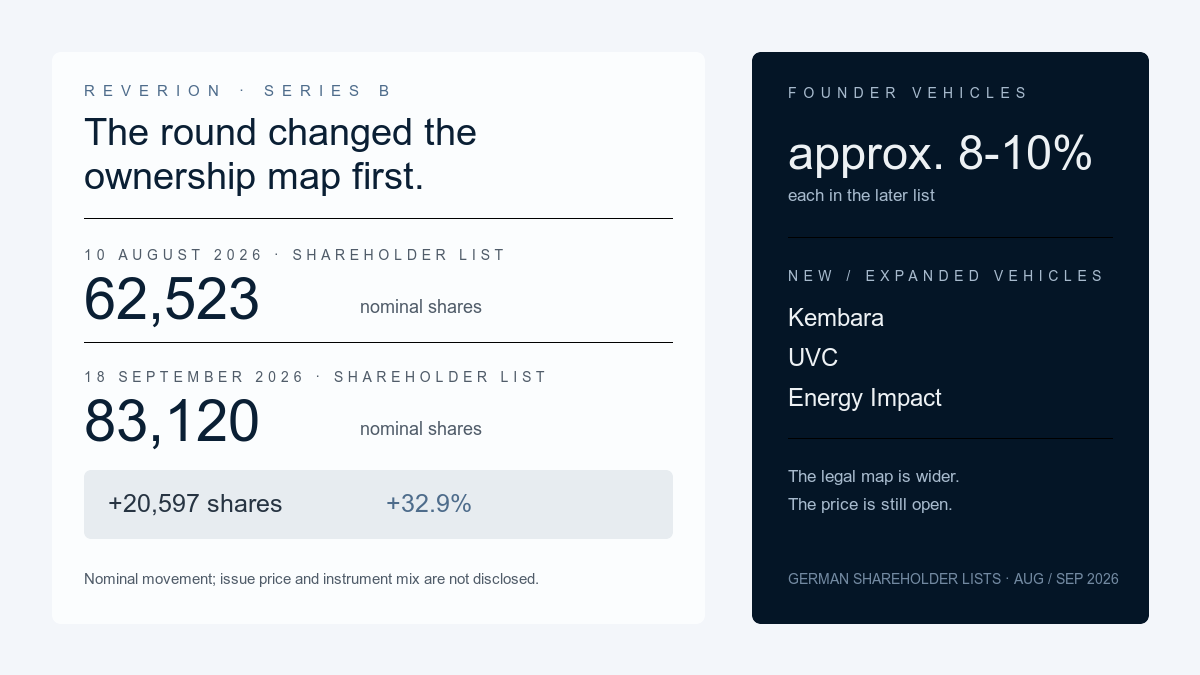
Reverion's $175 million Series B changed the ownership map before the German energy company builds the factory that will make its next stage possible. The latest shareholder list shows 83,120 nominal shares, up from 62,523 in the prior list. That is 20,597 additional shares, or 32.9% more nominal equity in a little over a month.
The same before-and-after view shows a broader set of investment vehicles and a lower percentage range for the founder vehicles. Holdings that had sat at roughly 10% to 12% each in the earlier list sit at roughly 8% to 10% each in the later one. The legal record therefore adds something the financing announcement does not: a visible change in the denominator and the identity of the vehicles around it.
It does not show the issue price, any premium, the instrument mix or the amount subscribed by each investor. The 20,597-share increase is a nominal-capital movement, not a claim that €20,597 or any other simple share-count calculation equals the round's $175 million of cash.
The public round came before the register's economic detail
Reverion published its Series B announcement on 28 September 2026, with the release dated 29 September. The company said the round was led by Kembara and that Allianz, KfW Capital, Aurum Impact and Carbon Equity joined existing backers. It said most of the capital would support a new German production site with annual capacity of 250 megawatts and up to 800 jobs. Reverion's announcement is a scale-up story: industrial production, demand from energy-intensive industry and data centres, and a technology the company describes as dispatchable and carbon-negative.
Independent coverage from FYB confirms the $175 million amount, Kembara's lead role and the mix of new and existing investors. It also describes the planned 250-megawatt site and up to 800 jobs. The investor list is public. The legal before-and-after cap table is not.
That is where the German shareholder lists matter. The German commercial register portal records a list dated 10 August 2026 and a later list dated 18 September 2026. The earlier list contains 62,523 shares. The later list contains 83,120. Both are legal snapshots, not press-release summaries.
20,597 shares changed the denominator
The arithmetic is straightforward:
| Shareholder-list snapshot | Nominal shares | Change from prior list | Economic reading |
|---|---|---|---|
| 10 August 2026 | 62,523 | Baseline | The pre-Series B register state used for comparison |
| 18 September 2026 | 83,120 | +20,597, or +32.9% | A larger denominator with new and expanded investment vehicles |
The later list repeatedly refers to a capital-increase resolution dated 7 August 2026. That timing is important. The legal share change appears before the public Series B announcement, so the September press story was a public explanation of a financing process whose nominal equity state had already moved.
The increase should still be read narrowly. Nominal shares can be issued at a price above nominal value. They can also be connected to conversion, option or other capital mechanics. Without the subscription schedule and issue price, the register establishes the size of the legal share movement, not the size of the cheque attached to each line.
The new map is more layered than the investor list
Extantia Climate Flagship II is the largest individually identified holder in the later list, with 8,461 shares and 10.1793%. The founder-linked vehicles for Stephan Herrmann, Felix Fischer, JW, MH and LP Energy Ventures each sit in an approximate 8.1% to 9.6% range. Other visible holders include Unternehmertum VC Fonds III at 5.5181%, Green Generation Fund at 3.6600% and Doral at 3.0323%.
The later snapshot also shows multiple exposure paths that are easy to flatten into a single investor name. Energy Impact Partners appears through several lines totalling approximately 8.38%. European Innovation Council lines total approximately 7.13%. Kembara Fund I FCR holds 3,409 shares, or 4.1011%. UVC Reverion Co-Invest holds 1,977 shares, or 2.3775%; UVC Growth Opportunities II holds 1,363, or 1.6395%; and Energy Impact Fund holds 1,211, or 1.4565%.
That vehicle-level detail is the commercial contribution. A round can be described publicly as a list of institutions, while the legal exposure is split across funds, co-investment vehicles and special-purpose entities. The list also contains smaller Carbon Equity, Aurum, alfa8, Argos, Honda and Possible vehicles. They may matter for future consents or follow-on participation even when each line is below a headline investor threshold.
The public name and the legal holder are not always interchangeable. The German announcement says KfW Capital participated through a special-purpose vehicle managed by UVC. The shareholder list should therefore not be used to relabel every UVC line as KfW, or every institutional line as a direct corporate holding. The evidence supports the vehicle names that appear in the list and the public investor descriptions separately.
Founder dilution happened before the factory build-out
The denominator change makes the founder outcome legible without pretending to know the round price. If a founder-linked vehicle held a similar number of shares across the two lists, its percentage would fall when total shares rose from 62,523 to 83,120. The lists show that the founder vehicles moved from roughly 10% to 12% each into a later range of roughly 8% to 10% each.
That is dilution in the ordinary percentage sense, not a statement about a founder's cash value. A lower percentage can accompany a higher company value if the financing is priced up. It can also be affected by transfers, conversions or other changes in the shareholder list. The public record does not disclose whether every founder vehicle subscribed, sold, converted or simply stayed in place while other shares were added.
The distinction is visible in other private-company financings. Universal Quantum's Series A entered a documented preference and anti-dilution architecture even though the public round did not disclose post-round ownership. Wiremind's first outside funding likewise separates founders' stated control from the exact share mechanics. Reverion's lists offer a different, complementary view: a before-and-after denominator and the legal vehicles around it, but not the contractual rights attached to each line.
The register cannot turn nominal shares into a $175m price
The most tempting mistake would be to divide $175 million by 20,597 and call the result a share price. That would mix currencies, a public round headline and nominal share counts without evidence that the round was issued at one price or that all 20,597 shares belong to one instrument.
The later list does not disclose an issue price, share premium, liquidation preference, conversion ratio, warrant package or debt component. Nor does it show a cash-versus-conversion split. The capital-increase resolution may package ordinary issuance with a conversion or another nominal restructuring. The register is therefore decisive on the existence of the share-count change but silent on the economic price of the claims.
This boundary matters for investors and counterparties. A nominal increase can be a small legal slice of a large financing if most value is recorded as premium. A converted instrument can change the share count without a new cash payment on the filing date. A future round can then rank behind or ahead of the new class depending on terms that the shareholder list does not publish.
The right reading is consequently a map, not a valuation. Reverion has a larger legal equity base, more visible vehicles and a lower founder percentage range. It is not yet possible to say who paid what, who received a preference or whether any holder's economic value increased or fell.
A wider cap table now carries the industrialisation bet
The ownership change has a practical consequence for the planned factory. The capital is meant to move Reverion from pilot and pre-series production toward a site with 250 megawatts of annual capacity. That shifts the company's financing problem from proving the technology to funding manufacturing, delivery and working-capital risk at scale.
The wider set of vehicles spreads that risk across lead, follow-on and co-investment structures. It can also make future decisions more procedural. New allotments, a later acquisition or a strategic partnership may require the company to identify which legal vehicles hold enough shares or rights to participate or consent. The register does not show those governance thresholds, but it does show why the next legal document will matter: the cap table is no longer a simple founder-plus-fund picture.
For founders, the trade-off is equally concrete. Their approximate 8% to 10% positions remain meaningful, but they now sit beside a more diversified investor base and a larger denominator. The public announcement's industrial ambition and the register's ownership movement are the same financing story viewed from different sides.
The next filing should answer the price question
The decision-changing follow-up is a document that connects the 20,597 shares to economics. A later shareholder list may show the post-round state more clearly. The capital-increase filing, subscription schedule or amended articles could disclose the issue price, premium, class and any conversion mechanics. A document mapping the public investor names to the legal vehicles would also clarify whether the public list is direct, pooled or managed exposure.
Until that record appears, the defensible retelling is narrow and useful. Reverion's $175 million Series B changed the ownership map before the megafactory was built: the German register added 20,597 nominal shares, new or expanded vehicles became visible and founder vehicles moved into an approximate 8% to 10% range. The legal share movement is clear. The price and investor-by-investor economics remain open.
Continue reading
Related Research
Universal Quantum's $100m Round Entered a Negotiated Preference Stack
Universal Quantum's $100m Series A met existing preference, anti-dilution and participation rights, while post-round ownership remains undisclosed.
Wiremind's €35m Round Meets a Filed Founder-Control Architecture
Wiremind's €35m first financing says founders keep control. June statutes show how voting seats and quorum rules make that claim legally meaningful.
ZuriQ's $25.5m Seed Created A 28.6% Preferred Block
ZuriQ's $25.5m seed closed legally in May, creating a 28.6% preferred block and adding a Quantonation-linked director before its July reveal.
CarbonFarm's €7m Series A Left a Two-Tranche Equity Trail
CarbonFarm's €7m Series A left two 2026 equity tranches and €3,904.96 of capital, but public acts do not map named investors to legal positions.