
Nauta's €60m Fund VI Close Sits Above a £2.25m UK Manager
Nauta’s €60m Fund VI first close sits at fund level, while its UK manager reports £2.25m of service revenue, £161,189 cash and a £767,578 parent debtor.
On this page
Conduct your own private market research
Add dossaro to Claude or ChatGPT and run source-backed register research from your own workspace.
 Add to Claude
 Add to ChatGPT
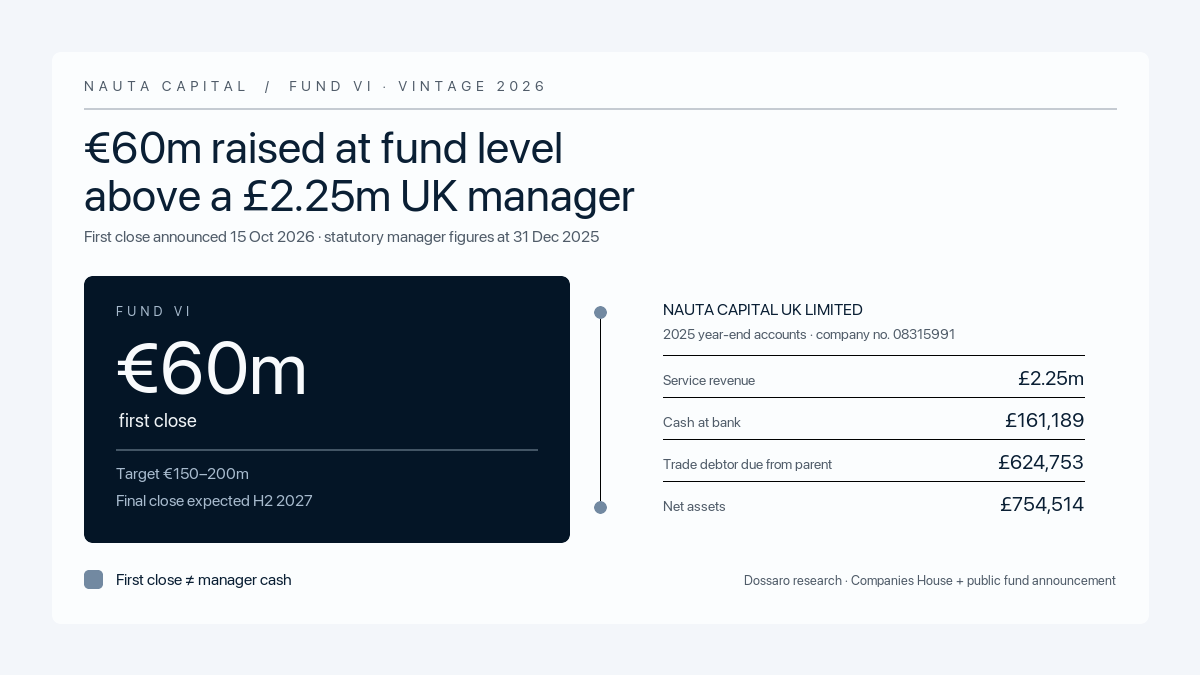
Nauta Capital’s €60 million first close for Fund VI is a fund-level capital-formation event, not a €60 million cash balance at its UK manager. Nauta’s announcement on 15 October 2026 describes the first close of the sixth European technology fund. The latest accounts of NAUTA CAPITAL UK LIMITED, the group’s Companies House-registered UK company, report £2,250,318 of service revenue and £161,189 of cash for the year ended 31 December 2025. They also show £767,578 of trade debt due entirely from the parent company.
Those figures do not measure the fund’s commitments, and they do not say that Nauta cannot earn fees or carry from Fund VI. They establish a more useful boundary: money raised by a fund vehicle is not automatically an asset of the management company that advises it. That distinction affects how investors, founders and counterparties read a headline first close, assets under management, and the economics of the manager behind them.
The €60m headline belongs to a new fund close
Nauta’s first-close announcement says Fund VI has reached €60 million, with a target of €150 million to €200 million and a final close expected in the second half of 2027. The fund is intended to back European business-to-business software and deep-tech companies from pre-seed to Series A. Nauta names the British Business Bank-backed SETT programme, Merifin Capital and Institut Català de Finances among the institutional support and says family offices are also participating. The announcement says 75% of the limited partners in the close have backed an earlier Nauta fund, while total assets under management are approaching €750 million.
Cinco Días independently describes the first close as €60 million and the target as €200 million, with the British Business Bank as an anchor investor. The two public accounts are consistent on the commercial event: Nauta has announced a new fund and is still raising toward a larger final target.
A first close is not the same as the final size. It is the amount committed or secured at an initial closing point, subject to the vehicle’s terms and later subscriptions. The public release therefore supports a €60 million first-close claim, not a statement that €60 million has already been deployed into portfolio companies or booked as revenue by the UK manager.
This is the same separation that matters in fund-vehicle reporting: a fund, its general partner or management company, and their service entities can sit in different legal and accounting layers. A headline about one layer should not be used as a balance-sheet shortcut for another.
The UK manager reports a service business, not a fund ledger
The exact UK entity is NAUTA CAPITAL UK LIMITED, company number 08315991, an active company incorporated in England and Wales on 3 December 2012. Its 2025 annual report says the principal activity is providing investment advice services to Nauta Capital VC Partners SGEIC SA, described as the group management company. The strategic report says the company’s only source of revenue is intercompany services.
The income statement records £2,250,318 of turnover in 2025, up from £2,082,380 in 2024. Operating profit was £309,097, compared with £286,499. The company reported £230,841 of profit after tax and paid a £200,000 dividend. These are manager-company figures for a year that ended nine months before the Fund VI first-close announcement. They are not a valuation of Nauta’s funds or a disclosure of limited-partner commitments.
The balance sheet is equally specific. Cash at bank and in hand was £161,189 at 31 December 2025, down from £278,012. Total debtors were £767,578, of which the accounts say the trade debtor balance related entirely to amounts due from the parent company. Net assets were £754,514, versus £723,673 a year earlier. The accounts also state that the parent company is expected to meet the UK company’s ongoing liabilities and that the group will continue to require its services.
| UK manager measure | 2025 | 2024 | What the accounts establish |
|---|---|---|---|
| Turnover from services | £2,250,318 | £2,082,380 | Revenue is described as services, not fund subscriptions |
| Operating profit | £309,097 | £286,499 | The manager was profitable in both years |
| Cash at bank and in hand | £161,189 | £278,012 | Cash is far below the public first-close headline |
| Trade debtor due from parent | £624,753 | £407,745 | The largest debtor category is intercompany, not an LP account |
| Net assets | £754,514 | £723,673 | Statutory equity of the UK service company |
The table is not a proxy for Fund VI’s size. It is a reminder that the manager’s statutory accounts answer a different question from Nauta’s fundraising announcement.
A parent-company debtor is not limited-partner capital
The £767,578 debtor balance includes £624,753 of trade debtors, and the note says that trade debtors in both years were entirely amounts due from the parent company. That wording matters. It describes a receivable between group companies, consistent with the manager’s service model. It does not describe cash subscribed by limited partners, assets held in a fund vehicle, or a portfolio position.
The accounts do not provide a schedule of Fund VI commitments, the vehicle’s bank balance, or the amount of capital already called from investors. They also do not show whether the manager will receive a particular fee percentage, how carried interest is allocated, or when any fund-level commitments will be deployed. Those terms may exist in agreements that are not part of the UK company’s public annual report.
The parent debtor is therefore useful evidence of group-level settlement mechanics, but it should not be promoted into a claim about investor money. The same caution applies to cash. £161,189 is the reported cash of NAUTA CAPITAL UK LIMITED at one year-end. It is not a statement that the wider Nauta group has only that amount available, and it is not evidence that Fund VI is underfunded.
AUM, repeat LPs and manager assets answer different questions
Nauta’s announcement says assets under management are approaching €750 million. AUM is an aggregate measure of the capital a platform manages or advises, usually across multiple vehicles and vintages. It is not the same as cash owned by a management company. Likewise, the 75% repeat-limited-partner statistic describes the fundraising cohort in the announcement; it is not a disclosed register of every investor, commitment or beneficial interest.
For a limited partner, the relevant rights normally sit in the fund’s legal documents: commitment amount, drawdown obligations, reporting, distributions, governance and exit economics. For a portfolio company, the relevant counterparty may be the fund or an investment vehicle, even when a Nauta group company provides advice or administrative services. For a creditor, the UK accounts show the entity that owes or is owed money, not the full asset perimeter of every affiliated vehicle.
This is why a public €60 million first close should be read alongside, not substituted for, the manager’s accounts. The public event demonstrates fundraising progress and a capacity to launch a new investment programme. The accounts show the scale and settlement pattern of one UK service company. Neither source alone answers the other source’s question.
The commercial consequence is a cleaner capital map
The separation has practical consequences for diligence. A founder assessing a Fund VI term sheet should ask which entity will subscribe, hold the shares and exercise governance rights. A lender or supplier dealing with the UK manager should look to that company’s own cash, receivables and liabilities, not to the fund headline. An investor comparing managers should distinguish fee-generating service revenue from assets held for limited partners.
The 2025 report also says the group’s strategy for managed funds to include UK investments is expected to remain in force in 2026. That is a forward-looking operating statement, not evidence that Fund VI has already invested in a UK company. It shows the manager expects continued work for the group; it does not turn the UK balance sheet into the fund’s balance sheet.
The distinction protects against two opposite errors. Treating the €60 million as manager cash overstates the company’s own liquidity and assets. Treating £161,189 of UK cash as the group’s available investment capital understates the fund and parent structure. The evidence supports neither shortcut.
What the public record still leaves open
The first-close announcement and the UK accounts do not identify Fund VI’s exact legal vehicle, its full limited-partner commitment schedule, the amount called at the first close, or the fees and carried-interest arrangements between the fund, its manager and the wider group. They also do not disclose whether the parent debtor has been settled since 31 December 2025 or how the group allocates costs across funds.
Those are the next-document watchpoints. A fund-vehicle filing, offering document, subsequent accounts or a closing notice with legal-entity details could connect the €60 million to a specific issuer and commitment base. A later UK filing could update the manager’s parent balance and cash after Fund VI’s launch. Until then, the strongest safe conclusion is also the most useful one: Nauta’s €60 million first close is fund-level capital formation, while NAUTA CAPITAL UK LIMITED remains a profitable intercompany services company with £2.25 million of turnover, £161,189 of cash and a £767,578 debtor balance at its latest public year-end.
Continue reading
Related Research
Graduate Ventures' €125m Fund II Sits in a Dutch Cooperative
Graduate Ventures' €125m Fund II maps to a Dutch cooperative beside separate manager and seed-capital companies, clarifying structure without LP economics.
Forbion's €2.3bn Close Has a Visible $1.014bn US Split
Forbion's €2.3bn close spans growth and venture vehicles; SEC filings show $1.014bn sold across 37 investors, not one pool, with no LP allocation published.
Spiko's $90m Series B Has Two Capital Layers Investors Need to Separate
Spiko says NEA led a $90m Series B. French filings show a €5m parent subscription into the regulated company and a separate ratchet-linked financing stack above it.
Universal Quantum's $100m Round Entered a Negotiated Preference Stack
Universal Quantum's $100m Series A met existing preference, anti-dilution and participation rights, while post-round ownership remains undisclosed.