
Sava's $36m Round Meets an Existing All-Assets Security Package
Sava's $36m Series B is led by Ascensia, but an outstanding Companies House charge gives a security agent fixed and floating claims over the business.
On this page
Conduct your own private market research
Add dossaro to Claude or ChatGPT and run source-backed register research from your own workspace.
 Add to Claude
 Add to ChatGPT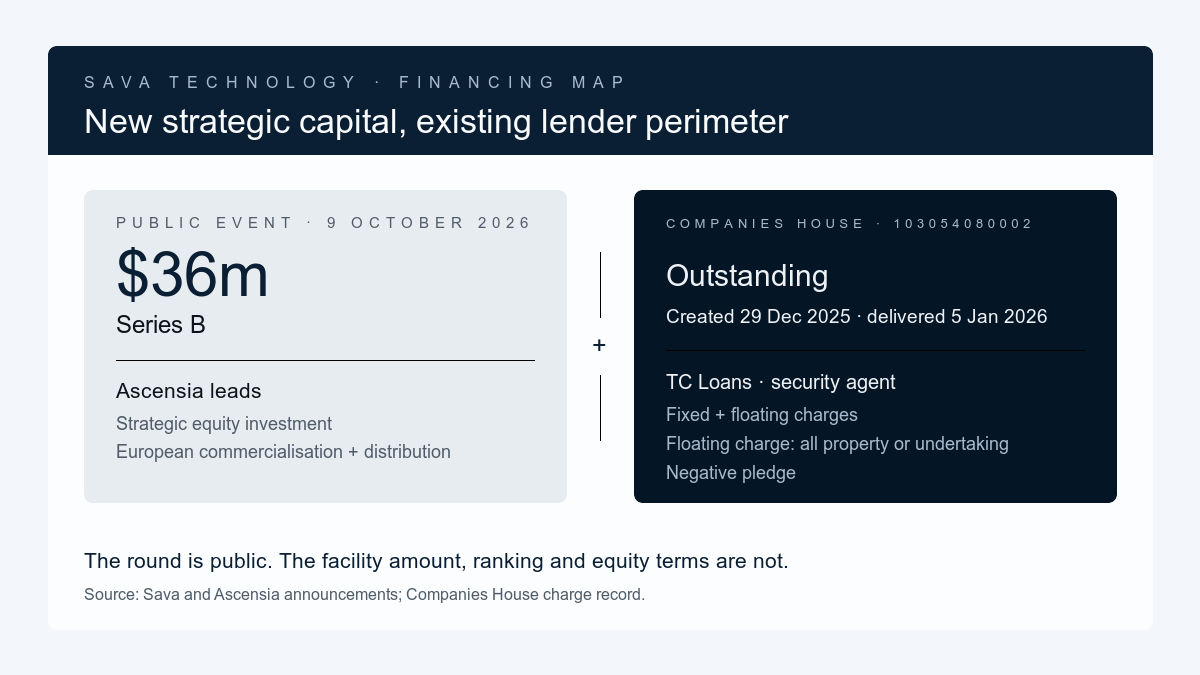
Sava's $36 million Series B comes with a detail that the funding announcement does not foreground: Companies House still records an outstanding all-assets security package granted months earlier to TC Loans as security agent.
That does not make the round suspect. It changes the diligence question. Sava has fresh strategic capital and a route to market through Ascensia, but the company is also operating within an outstanding fixed-and-floating charge and negative pledge. The facility amount, lender ranking and interaction with Ascensia's equity investment remain undisclosed.
The strategic deal and the lender protection run on different clocks
Sava announced the Series B on 9 October 2026. Its release says the round was led by Ascensia Diabetes Care, with participation from Balderton Capital, Norrsken VC, Simplyhealth Ventures, JamJar Investments, Pentland Ventures and others. The money is intended to support manufacturing scale-up and commercial readiness for Sava's next-generation glucose microsensor.
The announcement paired the financing with a commercial agreement. Ascensia, a subsidiary of PHC Holdings Corporation, is Sava's commercialisation and distribution partner, initially in Europe. The official Sava announcement describes the planned pivotal study and a target of CE approval for non-adjunctive use within 18 to 24 months. Ascensia's own release calls the arrangement an exclusive European commercialisation and distribution agreement alongside a concurrent financing agreement, and says Ascensia made a strategic equity investment.
That public-versus-legal timing echoes the ownership question in Dossaro's analysis of Reverion's Series B: the financing headline and the register can describe different layers of the same transaction.
The Companies House record starts earlier. Sava's legal entity, SAVA TECHNOLOGY LIMITED, is company 10305408. The charge that matters here was created on 29 December 2025, delivered on 5 January 2026 and remained outstanding on the latest public recheck. That is not a press-release detail. It is a registered claim on the company's asset and undertaking perimeter.
What the public charge record actually says
The official charge page shows two registered charges: one outstanding and one satisfied. Charge 103054080002 is the outstanding one. The summary identifies TC Loans Limited as trustee for the secured parties and the security agent. It also says the filing contains a fixed charge, a floating charge, and a negative pledge. The floating charge covers all the property or undertaking of the company. The linked Companies House charge detail identifies the transaction as an MR01 registration and links a 68-page instrument.
| Registered fact | What the public record establishes | What it does not establish |
|---|---|---|
| Charge 103054080002 | Created 29 December 2025, delivered 5 January 2026, outstanding | The principal amount, interest rate or maturity |
| Secured party | TC Loans Limited as trustee for the secured parties and security agent | The identity of every secured party or the economic split between them |
| Security scope | Fixed and floating charges; floating charge over all property or undertaking; negative pledge | The enforcement ranking in every scenario or whether any default has occurred |
| Later public event | $36m Series B led by Ascensia on 9 October 2026, with strategic equity and European distribution | Ascensia's share percentage, valuation, instrument terms or any lender consent |
Those distinctions are the point. A charge is not a debt balance. The page does not say how much was borrowed, what the cash was used for, or whether the loan is drawn. It does show that a security agent has a documented protection package connected to the company.
An all-assets perimeter changes the financing reading
Fixed and floating charges divide lender protection between identified assets and a changing pool of assets. In Sava's case, the public summary gives the important boundary without disclosing the commercial numbers: the floating charge covers all property or undertaking, and the negative pledge constrains the creation of competing security interests.
For a medtech company moving from technical development toward manufacturing and a pivotal study, that perimeter matters. Inventory, receivables, bank accounts, intellectual property and future operating assets can be central to a scale-up plan. The summary does not tell us how each category is treated in the instrument, but it does tell a counterparty that the company's asset base is not legally unencumbered.
This is why the charge belongs in the same diligence file as the Series B. The Companies House charges page shows the earlier charge was satisfied on 15 January 2026, while the December charge remains outstanding. That sequence is consistent with a refinancing, a replacement security package or a new facility. It is not proof of distress. It is evidence that the lender relationship changed and persisted before the strategic round was announced.
Independent coverage reinforces the operating purpose of the financing rather than changing the legal conclusion. Techflier's report describes the $36m Series B as funding manufacturing scale-up and commercial readiness, and identifies Ascensia as the route to European distribution. The commercial plan makes the security package more relevant, not less: manufacturing growth creates assets and contracts against which a lender's protections may matter.
The Ascensia agreement is more than a normal lead-investor line
Ascensia is both the lead investor and Sava's prospective European route to market. That combination can accelerate adoption, but it also creates several separate legal questions. The announcement does not state whether Ascensia subscribed for ordinary shares, preferred shares, a convertible instrument or another form of equity. It does not state a valuation or percentage. The Companies House charge page does not connect Ascensia to the secured parties, and it does not say whether the financing required a waiver, consent, release or amendment.
The clean commercial interpretation is still plausible: Sava may have raised equity while keeping a working-capital or venture-debt facility in place. A negative pledge can coexist with permitted security, intercreditor arrangements and ordinary financing activity. Nothing in the public summary says the facility is in default or that the Series B proceeds are trapped.
But the opposite shortcut is also unsafe. Calling the round “new capital” without mentioning the outstanding charge hides a material part of the capital stack. Equity investors take residual risk; a secured lender has contractual protections that may affect the order and flexibility of future asset sales, refinancings or insolvency recoveries. The public record does not permit a more precise priority conclusion, so the article stops at the registered encumbrance.
What the next filing should answer
The decisive watchpoint is not another funding article. It is the next primary filing that connects the October transaction to the legal structure. A post-round confirmation statement or allotment filing could show the share class and number issued to Ascensia. A charge variation, satisfaction or new registration could show whether the lender package was amended. The full debenture and intercreditor documents could clarify permitted security, ranking, consent rights, repayment and enforcement triggers.
Until then, three facts should be held together. Sava announced a $36m Series B. Ascensia led it, made a strategic equity investment and agreed to distribute the product in Europe. Sava also has an outstanding Companies House charge in favor of a security agent, with fixed and floating protections, all-property floating coverage and a negative pledge.
That is not a contradiction. It is a more useful financing map. The strategic deal may give Sava the capital and channel to reach the glucose-monitoring market, while the security package defines the lender protections that sit around the company's assets and future cash generation. The amount of debt, the equity instrument and the practical priority remain the next documents' job to reveal.
Continue reading
Related Research
Reverion's $175m Round Rebuilt the Ownership Map Before the Factory
Reverion's $175m Series B added 20,597 nominal shares, introduced new investment vehicles and diluted founder holdings to roughly 8-10% each.
Nscale's $3bn AI Debt Sits on a New Holding-Company Security Stack
Nscale's $3bn AI-data-centre facilities follow a holding-company roll-up, a $3.695bn premium reset and GLAS charges over parent and Arkon equity.
Qureight's $20m Round Sat Above Preferred Equity and HSBC Security
Qureight's $20m Series B followed a £2m senior C1 issue and four HSBC security filings, placing lenders and preferred capital ahead of older equity.
KmB's Mutares Control Chain Was Still Intact When Insolvency Hit
KmB moved from EMAG and Scherer to Mutares' wholly owned FERRAL vehicle before its October 2026 provisional insolvency, clarifying who sat above the risk.