
Skylance’s €500k NRW.BANK Round Turns Debt Into a Control Question
NRW.BANK is putting €500,000 into Skylance through debt conversion and fresh capital, while the last known register remains founder-owned 50/25/25.
On this page
Conduct your own private market research
Add dossaro to Claude or ChatGPT and run source-backed register research from your own workspace.
 Add to Claude
 Add to ChatGPT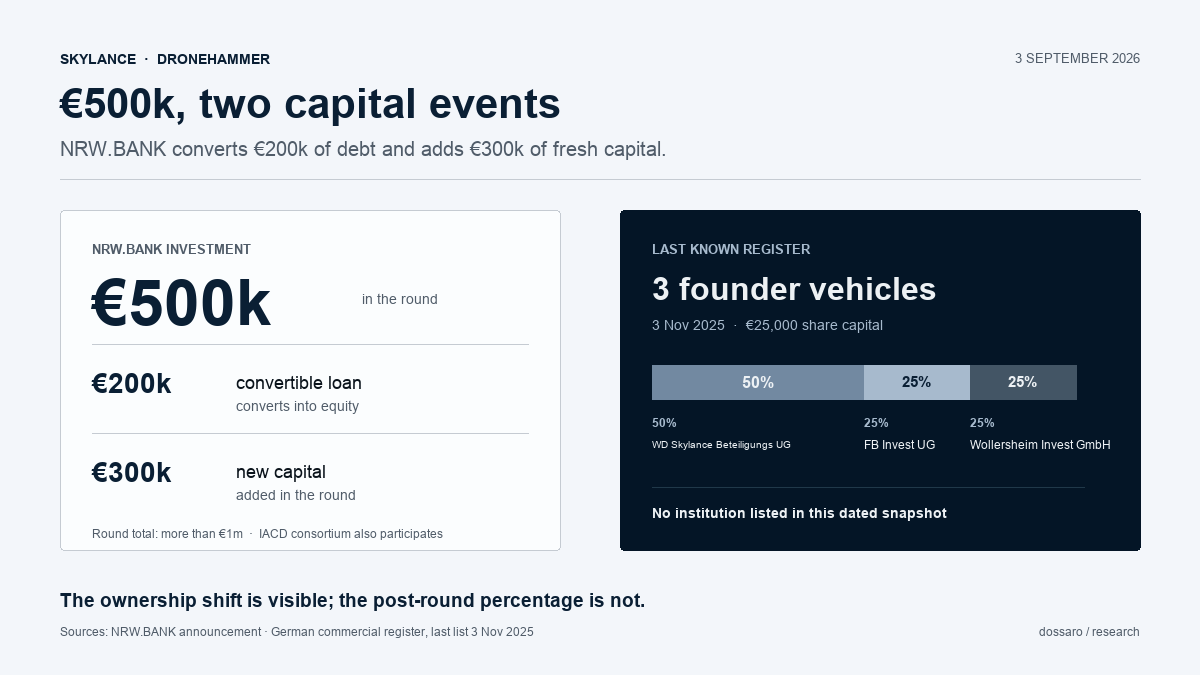
Skylance’s new NRW.BANK financing is a two-part ownership event, not simply a €500,000 cash injection. The bank is converting a €200,000 convertible loan into an equity participation and adding €300,000 of fresh capital. The round is larger than €1 million once the Investment Advisory Club Düsseldorf consortium is included.
That structure lands on a very concentrated last-known ownership base. A shareholder list for Skylance GmbH filed on 3 November 2025 records three holding vehicles at 50%, 25% and 25%, with no institution listed. The public announcement names three founders, but the available register evidence does not map each person to a particular vehicle. It does show the starting point for the financing question: NRW.BANK is entering a founder-only register state, and the resulting percentage cannot yet be measured.
The €500,000 has two different economic parts
NRW.BANK’s 3 September announcement says it is investing €500,000 in Hürth-based Skylance in a financing round above €1 million. The bank’s existing €200,000 convertible loan becomes an equity participation, while another €300,000 is invested as new capital. The announcement also identifies an investor consortium from the Investment Advisory Club Düsseldorf, or IACD, as a participant.
The distinction between the two amounts matters. Fresh capital increases the money available to the company. Conversion changes the legal form of an existing claim and can create a shareholder position without adding the same amount of new cash. Combining them gives the correct headline arithmetic:
| Publicly described component | Economic reading | What remains undisclosed |
|---|---|---|
| €200,000 convertible loan | Existing debt converts into an equity participation | Conversion price, number of shares and class rights |
| €300,000 new capital | Fresh money enters the financing round | Subscription terms, investor allocation and post-money value |
| €500,000 NRW.BANK total | Conversion plus fresh capital | NRW.BANK’s final percentage and governance rights |
Defence Network’s independent account confirms the €200,000 conversion and €300,000 fresh-money split, and says the current round exceeds €1 million. The Gruenderkurier report also reports the €500,000 NRW.BANK investment and the more-than-€1 million round. None of these sources publishes an investor-by-investor cap table.
The last known register is still founder-only
The legal entity behind the announcement is Skylance GmbH, registered at the Cologne local court as HRB 125354, with its registered seat in Hürth. Its stated purpose covers the development and prototyping of devices and methods for threats from unmanned vehicles. The register profile identifies Philipp Bohne as managing director.
The latest shareholder list in the returned register history was taken into the register folder on 3 November 2025. It records share capital of €25,000 and three direct holders:
| Direct holder in the dated list | Stated share of capital | What the list proves |
|---|---|---|
| WD Skylance Beteiligungs UG (haftungsbeschränkt) | 50% | A founder-linked holding vehicle held half of the stated capital at that date |
| FB Invest UG (haftungsbeschränkt) | 25% | A second holding vehicle held one quarter |
| Wollersheim Invest GmbH | 25% | A third holding company held one quarter |
The three percentages add to 100%. No bank, venture fund or other institution appears in that historical list. NRW.BANK’s public release says Skylance was founded in 2025 by Philipp Bohne, Dr. Tobias de Taillez and Dr. Olaf Wollersheim. It does not identify which founder sits behind which holding vehicle, so this analysis keeps the register names and the public founder names separate.
That separation is more than a legal nicety. A holding company can have its own shareholders, voting arrangements and financing, while the operating company’s shareholder list only shows the direct owner. The register therefore supports a precise statement about Skylance GmbH’s nominal capital at a date. It does not, by itself, establish each founder’s ultimate beneficial ownership or any agreement among the vehicles.
A debt conversion can change ownership without revealing the price
The conversion is the round’s decisive unknown. A convertible loan can convert under a previously agreed valuation cap, discount, fixed share price or another formula. Without the conversion terms and the resulting share count, the €200,000 amount cannot be translated into a percentage. The same is true of the €300,000 subscription: its economic impact depends on the issue price and the class of shares issued.
This is why the 50/25/25 register is a starting point rather than a post-round cap table. If the conversion occurs at a low price, NRW.BANK could receive a larger stake than the fresh-money headline suggests. If the price is higher or the instrument carries a modest conversion entitlement, the bank’s percentage could be smaller. Preferences, veto rights and board appointment rights could also matter even if the nominal percentage is limited.
The public materials do not settle any of those questions. They establish that NRW.BANK will participate as an equity holder after the conversion and that new capital is being added. They do not establish that the bank controls Skylance, that any founder has lost control or that the IACD consortium has a particular voting position.
The contrast with other private-market financings is useful. HyImpulse’s public-private round shows why named public investors and a large commercialisation cheque still leave investor-level economics open. INLEAP’s cumulative funding analysis shows the inverse problem, where a precise dated ownership snapshot sits beneath a cumulative funding headline. Skylance combines both gaps in one transaction: the instrument is partly debt and the register is older than the announcement.
Fresh money is tied to a production test
Skylance is developing the DroneHammer, a small counter-drone interceptor that is being tested and further developed with the Bundeswehr. NRW.BANK describes the device as a roughly 700-gram, laser-guided projectile that can travel at more than 600 kilometres per hour. The bank says the product is intended to defeat smaller drones at a lower cost, with a price below €3,000 per unit according to the company.
Those product figures are company and bank claims, not a disclosed procurement contract. Their commercial relevance is still clear. The new capital is earmarked for accelerating development and preparing industrialisation and series production. That means the round has to fund the work between a promising prototype and a repeatable defence product: testing, manufacturing readiness, quality processes and customer acceptance.
The IACD participation gives the round an additional private-market layer, but its allocation is not public. The more-than-€1 million total tells readers that other investors supplied capital alongside NRW.BANK. It does not show whether they invested in the same share class, supplied additional convertible instruments or received rights that differ from the bank’s position.
The commercial consequence is a higher evidence bar for the next financing. Skylance must turn Bundeswehr development work into delivery evidence while the investors decide how much additional capital is needed. The company’s operating progress can be strong even if the public ownership outcome remains unresolved. Conversely, a large round does not remove the execution risk that comes with moving from test hardware to series production.
The control question is real, but not yet measurable
It is tempting to describe a public-bank investment as a change in control. The evidence supports a narrower reading. NRW.BANK is moving from lender to equity participant, which changes its economic exposure and may give it rights that a creditor did not have. The last visible cap table contains only three direct founder-linked vehicles. Those facts make a control transition possible and economically important.
They do not prove the result. A post-round list could show NRW.BANK with a small minority position, a material blocking stake or a larger holding shared with IACD investors. The founders could remain firmly in control, or their nominal percentages could fall while their voting arrangements remain unchanged. No public source currently gives the conversion price, issued shares, preferences, board rights or a post-transaction shareholder list.
That uncertainty should not be mistaken for a weak financing. The announced structure gives Skylance both balance-sheet support and a public institutional partner at a moment when European defence buyers are looking for affordable counter-drone systems. It simply means the economic outcome is not the same as the headline amount. The money is documented; the allocation of the resulting risk is not.
The next filing should connect the cheque to the cap table
The decision-changing watchpoint is a post-round shareholder list or capital-increase filing for Skylance GmbH. It should show whether the €200,000 conversion created new shares, whether the €300,000 was subscribed in the same issue, and how the three existing vehicles’ percentages changed. A related deed or subscription document could also clarify the issue price, share classes and any preference or governance rights.
Until that material appears, the fairest conclusion is bounded. NRW.BANK’s first defence-tech investment is a €500,000 combination of converted debt and fresh capital, inside a round above €1 million. It is entering a company whose latest known register state was still 50%, 25% and 25% across three direct founder-linked vehicles. The financing therefore makes a future ownership change visible, but the public record does not yet measure who owns what after the money arrives. Advanced Electric Machines’ capital-stack analysis offers a further reminder that the legal layer carrying a financing can matter as much as the headline amount.
Sources and scope
This analysis uses NRW.BANK’s official announcement, Defence Network’s independent coverage, Gruenderkurier’s report, and the public German commercial-register portal. The shareholder percentages are a dated register snapshot from 3 November 2025. No valuation, conversion price, investor-specific proceeds, ultimate beneficial ownership, post-round percentage or control right is inferred.
Continue reading
Related Research
HyImpulse's €50m Series A Turns Rocket Sovereignty Into a Public-Private Risk Bet
HyImpulse's €50m Series A extension pairs public and private capital with a €350m order book, but filings do not yet show who bears the new equity risk.
INLEAP’s €20m Funding Headline Was Cumulative; Founders Held 80% in the 2025 List
INLEAP says it has raised about €20m since founding, while its latest filed shareholder list shows founder holding companies with 80% and outside holders with 20%.
Advanced Electric Machines’ £16m Funding Is a Parent-Level Equity and Debt Stack
AEM's £16m funding headline combines parent-level preferred equity with government-backed debt secured over the operating company's IP, receivables and assets.
Olenbee’s €7m Round Follows €2.82m of Priced Equity and Share-Convertible Debt
Olenbee announced a €7m round after French filings recorded €2.82m of priced share issues and €475k of obligations converted into 22,568 shares, without naming holders.