
Skeleton’s Siemens Deal Puts an 11.25% Stake Beside an Exclusive Data-Centre Channel
Estonian filings list Siemens International Holding with 11.25% of Skeleton’s holding group as Siemens gains an exclusive data-centre sales channel.
On this page
Conduct your own private market research
Add dossaro to Claude or ChatGPT and run source-backed register research from your own workspace.
 Add to Claude
 Add to ChatGPT
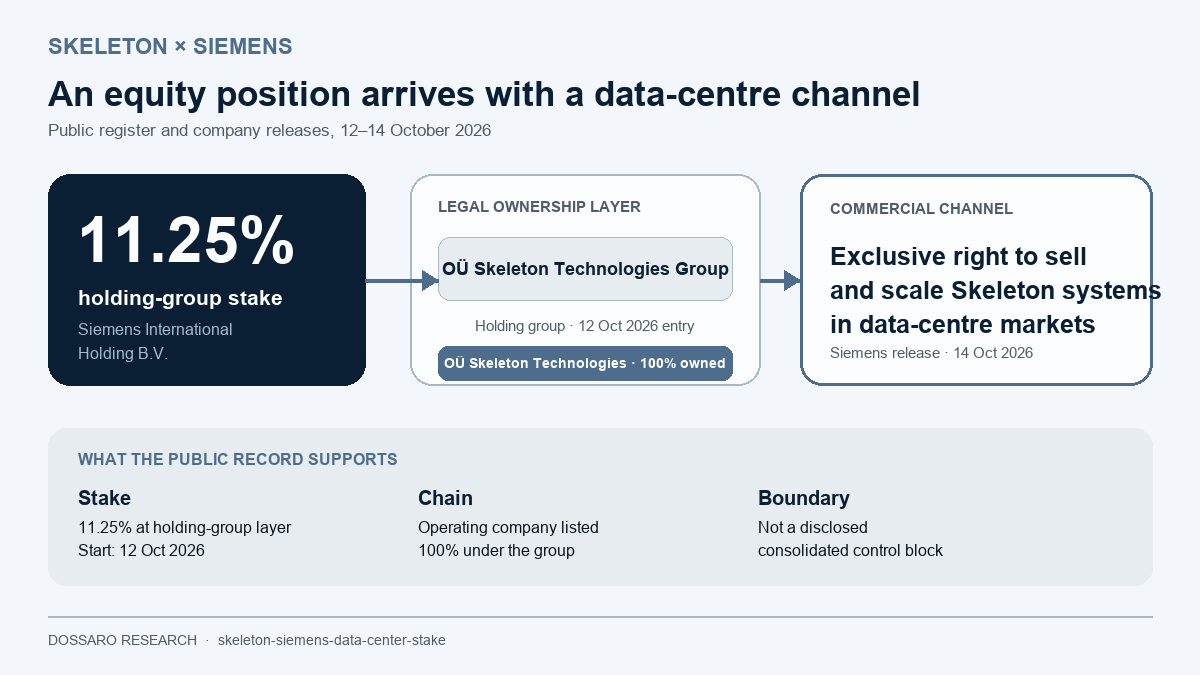
Skeleton Technologies’ Siemens-led strategic investment is already visible as an 11.25% holding-group stake dated two days before the public announcement. The Estonian e-Business Register lists Siemens International Holding B.V. at 11.25% of OÜ Skeleton Technologies Group from 12 October 2026. Skeleton’s announcement came on 14 October and described a nine-digit investment round, a valuation above $1 billion and a plan to put more than $200 million into US manufacturing and Silicon Valley research. Siemens separately says it has an exclusive right to sell and scale Skeleton’s systems in the data-centre market.
That combination is more precise than a generic “Siemens invested” headline. The legal operating company, OÜ Skeleton Technologies, is listed as wholly owned by the holding group, not directly by Siemens. The register also shows a separate 5.18% holding for Siemens Project Ventures GmbH, which began in 2023. Those rows cannot simply be treated as one consolidated Siemens control block. They do show a dated equity position at the group layer beside a commercial channel that reaches from grid infrastructure to AI server racks.
The register puts a date on Siemens’ new group position
OÜ Skeleton Technologies Group, registry code 12421505, is the entity in which the current shareholder rows appear. Its registered capital is €34,542.21, and the register records an articles amendment on 22 October 2026. The 11.25% Siemens International Holding row carries a start date of 12 October, with a recorded contribution of €3,887.01. The row is a legal-register participation, not a published valuation or a statement of the cash consideration for the strategic investment.
The same table lists Siemens Project Ventures GmbH at 5.18% from 28 September 2023. Siemens says in its release that it has supported Skeleton as a technology partner since 2022 and an investor since 2023, which is consistent with that earlier group-level entry. A simple addition of the two Siemens-named rows is 16.43%, but the register names two separate legal entities and does not establish that Siemens consolidates them for voting, economic or contractual purposes. The safer finding is that a new Siemens International Holding position appears at 11.25%, while an older Siemens Project Ventures position remains separately recorded.
The register also dates a 3.09% CBMM International B.V. row to 12 October. That timing makes the group table look like part of a broader capital event, but it does not identify which participant funded which part of the round or whether every new row reflects the same instrument. The register is useful here because it gives a dated legal perimeter. It is not a substitute for the investment agreement or a fully diluted cap table.
| Register layer | Holder or owner | Participation | Start date | What the entry supports |
|---|---|---|---|---|
| Operating company, OÜ Skeleton Technologies | OÜ Skeleton Technologies Group | 100.00% | 5 Dec 2025 | The operating company sits under the holding group |
| Holding group, OÜ Skeleton Technologies Group | Siemens International Holding B.V. | 11.25% | 12 Oct 2026 | A new Siemens-named group-level participation is recorded |
| Holding group, OÜ Skeleton Technologies Group | Siemens Project Ventures GmbH | 5.18% | 28 Sep 2023 | A separate earlier Siemens-named participation is recorded |
| Holding group, OÜ Skeleton Technologies Group | CBMM International B.V. | 3.09% | 12 Oct 2026 | Another investor row starts on the same date as SIH |
The announcement adds a channel, not a disclosed cap table
Skeleton’s release gives the financing its strategic context. It says the investment will accelerate a US manufacturing footprint and Silicon Valley R&D to meet demand from hyperscalers building AI data centres. Skeleton says the programme will support more than $200 million of operational scale-up and research, including a full US value chain for its supercapacitor systems. The company also highlights potential energy savings and performance improvements, claims that are best read as company-reported product positioning rather than independent measurements.
Siemens’ release describes a different asset in the package: an exclusive partnership to sell and scale Skeleton products in the data-centre market. Siemens says it can combine Skeleton’s high-power energy-storage systems with its own grid and electrical infrastructure, extending its offer from the grid connection to the AI rack. The commercial right matters because the buyer relationship and integration layer can determine whether a hardware technology becomes a repeatable infrastructure component.
Independent coverage from ERR reports that Siemens is investing at least €100 million and that Skeleton’s valuation has reached €1 billion. ERR also says the parties did not disclose the exact investment amount or the stake Siemens will receive. That public gap is now narrower, but it has not disappeared. The register supplies an 11.25% participation row and a date. It does not say that the row was issued solely for the announced investment, nor does it publish the round’s price, preference terms or fully diluted denominator.
The operating company still sits under the group
The operating-company register page lists OÜ Skeleton Technologies as 100% owned by OÜ Skeleton Technologies Group from 5 December 2025. This is the legal chain that keeps the article’s claim at the holding-company level. Siemens International Holding is not listed as the direct shareholder of the operating company on that page.
The Estonian register itself adds an important qualifier: shareholder data for private limited companies in the Central Register of Securities is informative, while the Central Register of Securities data has legal force. The percentages are therefore a valuable public snapshot, but they should not be presented as a complete beneficial-ownership conclusion or as a final answer on contractual control. The same caution applies to the two Siemens-named rows. Their simple sum is arithmetic, not proof of a single voting bloc.
For commercial counterparties, the distinction changes the diligence question. A supplier or hyperscaler assessing Skeleton is dealing with an operating company whose ownership chain runs through the group. A strategic investor assessing the transaction must ask how the 11.25% group position interacts with the older Siemens Project Ventures stake, investor consent rights and any preference or conversion terms that are not published on the register page.
Equity and distribution reinforce each other
The economic story is therefore a package with two layers. The group-level stake gives Siemens a visible financial position alongside other shareholders. The exclusive data-centre channel gives Siemens a route to monetise Skeleton’s systems through a portfolio it already sells into critical electrical infrastructure. Skeleton receives capital to build capacity and a distribution partner with an established customer interface. The public sources support that combination without proving that Siemens has taken operating-company control.
That structure is different from a financing headline that only changes the share count. The Universal Quantum analysis shows why the legal class and rights around a round can matter as much as the announced amount. And the nscale holding-company analysis illustrates why the entity level carrying the instrument can change how counterparties assess a capital structure. Skeleton’s case adds a channel question: who has the right to take a product from an engineering platform into a demanding infrastructure market?
The answer matters because AI data-centre demand is constrained by power quality, grid connection and the time required to expand physical capacity. Skeleton’s release frames its supercapacitors as a response to rapid power swings and dense computing loads. Siemens’ channel gives that technical proposition a route into a broader electrical-infrastructure sale. The commercial value may therefore be larger than the 11.25% row alone suggests, even though the public record cannot price the channel or the investment separately.
The next filing should resolve the economic gap
The current evidence supports a narrow but consequential conclusion: Siemens International Holding B.V. appears at 11.25% of Skeleton’s holding group from 12 October 2026, while Siemens says it has an exclusive data-centre sales and scale-up role. The operating company remains 100% owned by the group. That is an equity-plus-channel arrangement, not a disclosed transfer of direct operating-company control.
Several questions remain open. Was the 11.25% row issued for the announced investment, or did it reflect a separate step in a wider financing? What price and preference terms attach to it? Should the Siemens Project Ventures and Siemens International Holding positions be analysed together under a contractual control framework? Does the group’s amended article package reserve consent rights for Siemens or other investors? And how much of the announced US programme is funded by equity rather than operating cash, debt or commercial commitments?
The next useful evidence is a post-round shareholder or capital filing that identifies the allotment terms and holder-level changes, followed by any public investment or articles document that explains the rights attached to the new group position. Until then, the dated 11.25% row and the exclusive channel are the clearest public signals of how Siemens’ Skeleton relationship has moved from technology partnership to a combined financial and commercial position.
Continue reading
Related Research
Universal Quantum's $100m Round Entered a Negotiated Preference Stack
Universal Quantum's $100m Series A met existing preference, anti-dilution and participation rights, while post-round ownership remains undisclosed.
Reflex Aerospace's Planned NVIDIA Investment Has Not Yet Reset Its Filed Cap Table
Reflex Aerospace announced a planned NVIDIA minority investment, yet its latest filed list still shows Alpine at 47.43% and Ballheimer at 30.75%.
Nscale's $3bn AI Debt Sits on a New Holding-Company Security Stack
Nscale's $3bn AI-data-centre facilities follow a holding-company roll-up, a $3.695bn premium reset and GLAS charges over parent and Arkon equity.
Enact's $30m Pre-Seed Arrived After Its Swiss Company Built a Preferred-Share Stack
Enact’s $30m pre-seed followed months of Swiss filings that created 2.996m preferred shares and a new board structure before its robotics debut.