
Enact's $30m Pre-Seed Arrived After Its Swiss Company Built a Preferred-Share Stack
Enact’s $30m pre-seed followed months of Swiss filings that created 2.996m preferred shares and a new board structure before its robotics debut.
On this page
Conduct your own private market research
Add dossaro to Claude or ChatGPT and run source-backed register research from your own workspace.
 Add to Claude
 Add to ChatGPT
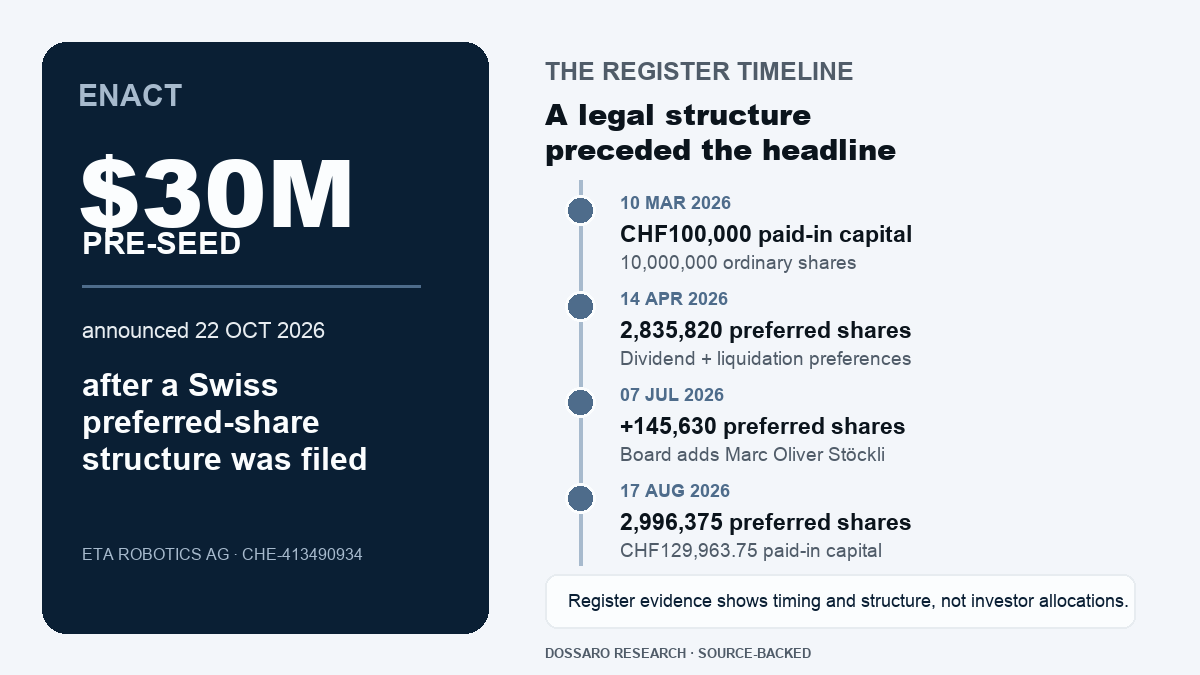
Enact Intelligence’s $30m pre-seed was announced after its Swiss legal vehicle had already built a preferred-equity and governance structure. The company behind the Zurich robotics brand is Eta Robotics AG, CHE-413490934. Its published Swiss filing history shows CHF129,963.75 of paid-in capital, 10,000,000 registered ordinary shares and 2,996,375 preferred shares by 17 August 2026. The funding announcement followed on 22 October.
That timing is the useful finding. It does not show which named fund received which shares, what price was paid above nominal value, or whether the October money is fully reflected in the August capital increases. It does show that the round was announced on top of a legal structure that had been assembled over several months, including preferred dividend and liquidation rights and a board that expanded beyond founder Manuel Galliker.
The funding headline and the legal identity are different stories
Public coverage describes a large early financing for a physical-AI company. The Zurich Chamber of Commerce account, published on 23 October, says Enact raised $30m to develop an artificial nervous system that lets robots sense force and touch. Sesamers’ funding report and Dealroom’s coverage put the announcement on 22 October and identify redalpine, Notion Capital and firstminute Capital among the backers, alongside named angels including Yann LeCun, Arthur Mensch, Andrew Lonsberry and Thomas Wolf. They do not publish a valuation or an investor-by-investor allocation.
The legal entity is not named in those funding accounts. Enact’s own website presents the brand as “Solving Dexterity through Force & Touch,” while the register history resolves the company to Eta Robotics AG. That distinction matters because a financing headline can describe a brand, a group or a new operating project, whereas the filings identify the company whose shares and board changed.
A capital structure appeared in four filing steps
The Swiss Official Gazette of Commerce publications, available through the Zefix profile and filing service, show a sequence rather than one event. The dates below are publication dates; where a filing refers to an earlier shareholder or board decision, that decision date is included in the description.
| Published | Filing event | What the register records |
|---|---|---|
| 10 March 2026 | New-entry publication | CHF100,000 paid-in capital, 10,000,000 registered ordinary shares at CHF0.01, and Manuel Galliker as the sole board member with individual signature. SHAB 1006591082 |
| 14 April 2026 | Publication of the 30 March decision | Paid-in capital rose to CHF128,358.20. The company had 10,000,000 ordinary and 2,835,820 preferred shares. The purpose expanded to robotics and automation hardware and software; the preferred class received dividend and liquidation preferences. Galliker became president and Harald Nieder joined the board. SHAB 1006623752 |
| 7 July 2026 | Publication of the 29 June decision | Paid-in capital rose to CHF129,814.50 through 145,630 additional preferred shares. Marc Oliver Stöckli joined the board. SHAB 1006699180 |
| 17 August 2026 | Publication of the 5 August decision | Paid-in capital rose to CHF129,963.75 through 14,925 additional preferred shares, taking the preferred total to 2,996,375. The capital-band provision was removed. SHAB 1006732055 |
The chronology establishes a pre-announcement structure. In March, Eta Robotics was a Swiss AG with one ordinary class and a single board member. By April, it had a preferred class with explicit dividend and liquidation preferences, a robotics-focused purpose and a broader board. The July and August notices then added preferred shares and changed the capital-band position.
The share count is meaningful but not a cap table. On a simple issued-share count, 2,996,375 preferred shares represent about 23.1% of the 12,996,375 ordinary and preferred shares recorded by August. That calculation says nothing about voting rights, conversion, preference seniority or who subscribed. The filings do not publish a shareholder list or an investor-by-investor allocation.
What the filings establish, and what they do not
The evidence is strong for timing and legal form. Eta Robotics had created the preferred class before the public $30m announcement. The April publication says the class carried dividend and liquidation preferences, so the structure was designed to separate economic rights from the ordinary shares. The board also moved from Galliker alone to Galliker as president with Nieder, and later Stöckli, as additional board members. Those are concrete changes in the company’s legal perimeter.
The evidence is not strong enough to map those changes to the named backers. No filing reviewed for this article states that redalpine, Notion Capital, firstminute Capital or any angel held a specific number of preferred shares. No source gives an issue price, premium, valuation or liquidation multiple. The August CHF129,963.75 is paid-in capital in Swiss francs, while the public financing headline is $30m. It would be an error to treat the two amounts as the same transaction value, especially when any cash premium may sit outside nominal capital.
Nor can the chronology prove that the October round closed in August. The March-to-August steps could represent staged incorporation, a bridge, pre-closing housekeeping or preparation for a larger issue. The public announcement may cover cash, share premium and instruments that are not visible in the nominal-capital figures. The filings support a before-and-after sequence, not a conversion of CHF129,963.75 into a $30m valuation.
Why the sequence changes the commercial reading
The market story is that a very young Zurich robotics company raised an unusually large pre-seed to develop force and touch capabilities for robots. The register adds a second story: the company had already done the legal work needed to receive different kinds of capital and to allocate governance before it emerged from stealth.
For investors, that distinction is practical. A preferred class with dividend and liquidation preferences can shape downside protection and the order of proceeds even when the public announcement gives only a headline amount. A broadened board can signal an operating or financing step without proving who controls the votes. The register therefore tells us that the legal wrapper was prepared; it does not tell us whether any fund had a blocking position or whether the founder retained a stated percentage.
The same discipline is useful in Dossaro’s analysis of Universal Quantum’s preference stack. A funding announcement and a later class entry can belong to one economic sequence, but they should not be collapsed into a single ownership claim until the instruments and denominator are visible.
For Eta Robotics, the commercial consequence is a more precise watchpoint. The $30m can fund a much larger team, hardware work and first industrial deployments, as the independent coverage reports. But the next value transfer will depend on the terms hidden behind the preferred class: issue price, conversion, liquidation priority and any new shares issued at closing. Those terms determine how much of the company’s future robot revenue belongs to the founder, the named funds and any later investors.
The next filing should show who received the shares
The next decision-changing source would be a post-closing Swiss filing, shareholder document or company statement that identifies the subscribers, the issue price and any premium. It should also show whether the 2,996,375 preferred shares were converted, supplemented or left outstanding when the $30m was announced. A current shareholder list would allow the preferred count to be translated into ownership and voting positions rather than just chronology.
Until that evidence appears, the strongest conclusion is narrower and more useful than an invented cap table. Enact’s $30m pre-seed was announced after Eta Robotics AG had already created nearly three million preferred shares, added preference rights and reshaped its board. The register proves the structure and the timing. It does not yet say who got the shares, what they paid or how the round changed control.
Continue reading
Related Research
Universal Quantum's $100m Round Entered a Negotiated Preference Stack
Universal Quantum's $100m Series A met existing preference, anti-dilution and participation rights, while post-round ownership remains undisclosed.
XRlabs Added Seed-2 Preference Rights While Its Founder Kept Statutory Control
XRlabs raised an $8.4m Playground-led seed while filings show 621,130 Seed-2 shares and a founder still above 50% with majority board rights.
Skeleton’s Siemens Deal Puts an 11.25% Stake Beside an Exclusive Data-Centre Channel
Estonian filings list Siemens International Holding with 11.25% of Skeleton’s holding group as Siemens gains an exclusive data-centre sales channel.
Adsilico’s £10m Series A Made Series A 47.24% of Issued Shares
Adsilico’s £10m Series A created two large Series A allotments, but Companies House leaves the investor-by-investor ownership map unresolved.