
Seaya's €600m Nova Close Raises a Fund-Identity Question for Europe's Growth Capital
Seaya says Nova reached a €600m first close, while EIF earlier named a €1bn-target Growth Tech Fund I; the public names are not yet reconciled.
On this page
Conduct your own private market research
Add dossaro to Claude or ChatGPT and run source-backed register research from your own workspace.
 Add to Claude
 Add to ChatGPT
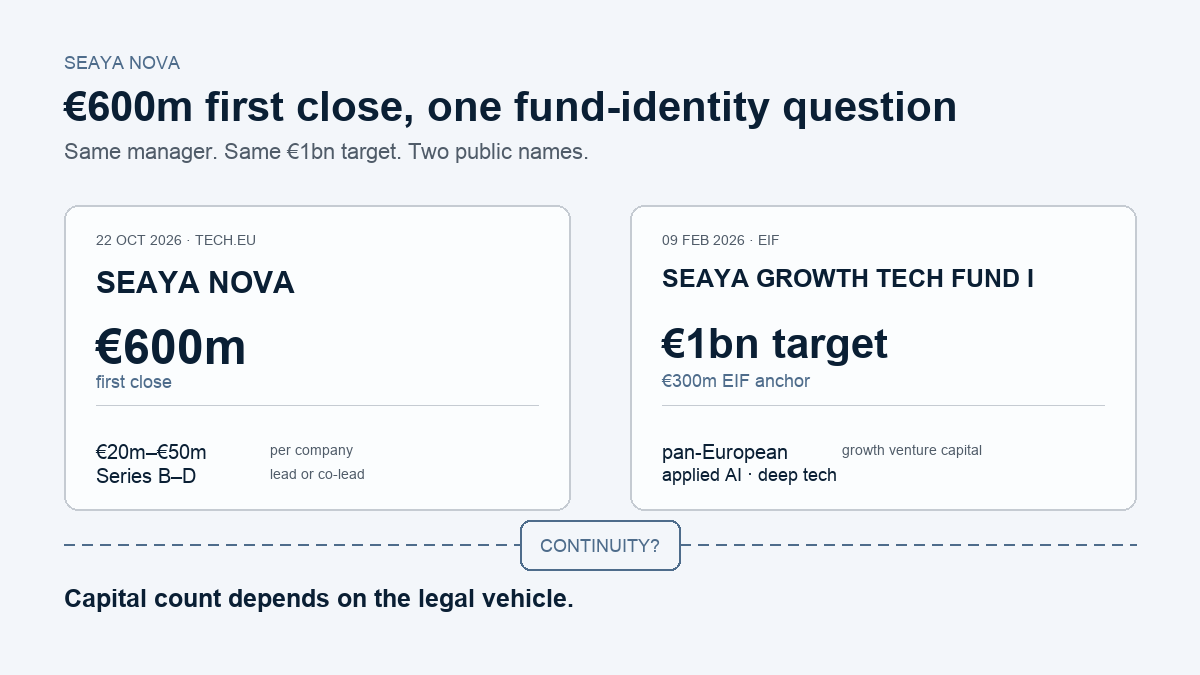
Seaya says its new growth strategy, Seaya Nova, reached a €600 million first close in six months. Eight months earlier, the European Investment Fund had announced a €300 million commitment to Seaya Growth Tech Fund I, a pan-European vehicle targeting €1 billion. Both announcements describe Seaya, the same manager, a €1 billion growth mandate and European technology scale-ups.
The public record supports both capital signals. It does not yet establish whether Seaya Nova is the legal name of the EIF-backed fund, a public brand for that vehicle, or a separate fund with an overlapping target. That distinction matters before anyone treats the headline as €600 million of new capital on top of the earlier commitment.
Two announcements, one unresolved fund identity
The EIF's February announcement names Seaya Growth Tech Fund I. It says the fund is managed by Spain-based Seaya, targets €1 billion and invests in European growth companies in applied artificial intelligence, deep technology, financial technology, climate solutions and commerce. The EIF describes its €300 million as an anchor commitment under the European Tech Champions Initiative.
The 22 October account from Tech.eu calls the new vehicle Seaya Nova. It reports a €600 million first close, a target of roughly €1 billion and tickets of €20 million to €50 million for Series B to D rounds. EU-Startups independently reports the same first close, while Fund Momentum identifies the European Investment Fund as the €300 million anchor and says other institutional investors, corporates and family offices were not named.
The sequence is easy to repeat and harder to count:
| Date and source | Public fund name | Capital signal | Mandate described |
|---|---|---|---|
| 9 February 2026, EIF | Seaya Growth Tech Fund I | €300m EIF commitment; €1bn target | Pan-European growth venture capital for technology scale-ups |
| 22 October 2026, Tech.eu | Seaya Nova | €600m first close; roughly €1bn target | €20m to €50m Series B to D leads or co-leads |
The same manager and the same target are visible in both records. A fund-level legal identifier, prospectus or official Seaya document connecting the names is not.
The wording also changes the status of the capital. The February release describes a pledge by a public fund-of-funds investor. The October coverage describes a first close after fundraising from the EIF and other institutional sources. A pledge can be part of a close, but the public statements do not say how much of the commitment was called, when the first close legally occurred or whether the vehicle name changed between those milestones.
Why the €300m anchor changes the €600m headline
The European Investment Fund's commitment is not background decoration. In the February release, the EIF says it is the anchor investor helping the fund reach its target. In the October coverage, Seaya Nova is described as backed by the EIF alongside other institutions, corporates and family offices. Those descriptions fit a later first close of the same vehicle, but they do not prove it.
If Nova is the public name for Seaya Growth Tech Fund I, the €600 million is a progress update on a fund that already had a documented €300 million anchor. The numbers should not be added as €900 million of separate capital. If Nova is a separate vehicle, the market needs two legal names, two targets and two commitment ledgers before treating the figures as additive. The public sources do not make that choice for investors.
This is not a claim that Seaya overstated the close. Growth funds often use a brand name in public communications while their regulated vehicle carries a different legal name. An initial anchor can also precede a later first close. The issue is narrower: the headline is economically meaningful, but the public naming does not yet show whether it describes one capital pool or two.
The manager is identifiable; the fund vehicle is not
Seaya's official legal notice identifies Seaya Capital Gestion SGEIC S.A., with Spanish tax number A86460227 and a Madrid address. That establishes the management company behind the platform. It does not identify the legal fund vehicle, its registration number or the commitments of its limited partners.
The platform now presents three strategies in public coverage: Seaya Ventures at the early stage, Seaya Andromeda in sustainability and Seaya Nova in growth. That is a coherent commercial architecture. A manager can build a relationship with a company at an early round and offer larger cheques later. The capital question remains separate from the product story: which regulated vehicle receives the commitments, and which vehicle is responsible for the €20 million to €50 million cheques?
The distinction is familiar in private markets. Sprints Fund V's manager analysis separates a €725 million fund headline from the UK manager's own balance sheet. Nauta Fund VI's record likewise distinguishes a fund wrapper from the advisory company that reports the service income. Seaya's public record currently requires the same separation, even though the Spanish legal notice makes the manager easier to identify than the fund.
What the close changes for European growth investors
The commercial signal is still substantial. Seaya Nova says it will lead or co-lead Series B to D rounds with €20 million to €50 million per company. That is a different role from Seaya Ventures' early-stage ticket and a different capital need from Seaya Andromeda's sustainability mandate. For founders, the new strategy is a potential route from first institutional capital to international expansion without changing platforms at every stage.
For limited partners, however, a first close is a commitment pool, not deployed capital. The public reports do not name the other investors or show how much of the €600 million is legally committed, called or reserved for follow-ons. The EIF's role is visible, but a policy anchor does not reveal the allocation among private institutions or the economics of the management company.
That information matters because a growth fund's headline size is not the same as its usable capacity. A manager may reserve part of a first close for follow-on rounds, hold back recycling rights or divide the mandate between new investments and existing portfolio support. None of those terms can be inferred from the €600 million figure. The legal vehicle determines which commitments are binding, which investors share the economics and which companies fall inside the mandate.
For companies seeking growth capital, the practical question is not whether Seaya has a large headline. It is whether Nova can write the stated ticket sizes from a vehicle whose mandate, investment period and remaining capacity match the round. That requires the legal fund identity and the terms attached to the commitments, not another description of the platform's strategy.
The sequence is also relevant to managers competing for European scale-ups. Seaya is presenting an integrated platform: early-stage venture capital, a sustainability strategy and a growth strategy able to lead larger rounds. If Nova is the continuation of the EIF-backed vehicle, the platform has turned a policy anchor into a larger, publicly branded fundraising story. If it is a new vehicle, the manager has added capacity, but the market still needs to know how the mandates coexist and whether the targets overlap.
The next filing should connect the names to the money
The decision-changing record would be a fund-level prospectus, Spanish regulatory filing, official Seaya announcement or EIF update that names the legal vehicle behind Seaya Nova and links it to Seaya Growth Tech Fund I. That document could settle whether the €600 million is a first close of the EIF-backed fund, a rebrand, or a separate vehicle with an overlapping €1 billion target.
Until then, the strongest source-backed conclusion is precise: Seaya has announced a €600 million first close for Nova, while the EIF had already named a €1 billion-target Seaya Growth Tech Fund I and committed €300 million to it. The European growth-capital signal is real. The amount of genuinely separate capital is the question the public fund identity still leaves open.
Continue reading
Related Research
Sprints’ €725m Fund V Sits Above a £654,887 Manager Balance Sheet
Sprints says Fund V closed at a €725m hard cap, while UK filings show £2.07m cash, £654,887 net assets and two new HSBC security filings remain outstanding.
Nauta's €60m Fund VI Close Sits Above a £2.25m UK Manager
Nauta’s €60m Fund VI first close sits at fund level, while its UK manager reports £2.25m of service revenue, £161,189 cash and a £767,578 parent debtor.
Gaius' €50m Fund Changed Its Registered Limited-Partner Layer
Gaius' €50m succession fund moved its registered limited-partner layer into carry and team vehicles, while the €200 liability is not fund capital.
Pigment's $250m Series E Sits on a 298m-Share, Eight-Class French Structure
Pigment announced a $250m Series E at a $2.3bn valuation, while French filings show 298.1m shares across eight classes and no investor allocation yet.