
Gaius' €50m Fund Changed Its Registered Limited-Partner Layer
Gaius' €50m succession fund moved its registered limited-partner layer into carry and team vehicles, while the €200 liability is not fund capital.
On this page
Conduct your own private market research
Add dossaro to Claude or ChatGPT and run source-backed register research from your own workspace.
 Add to Claude
 Add to ChatGPT
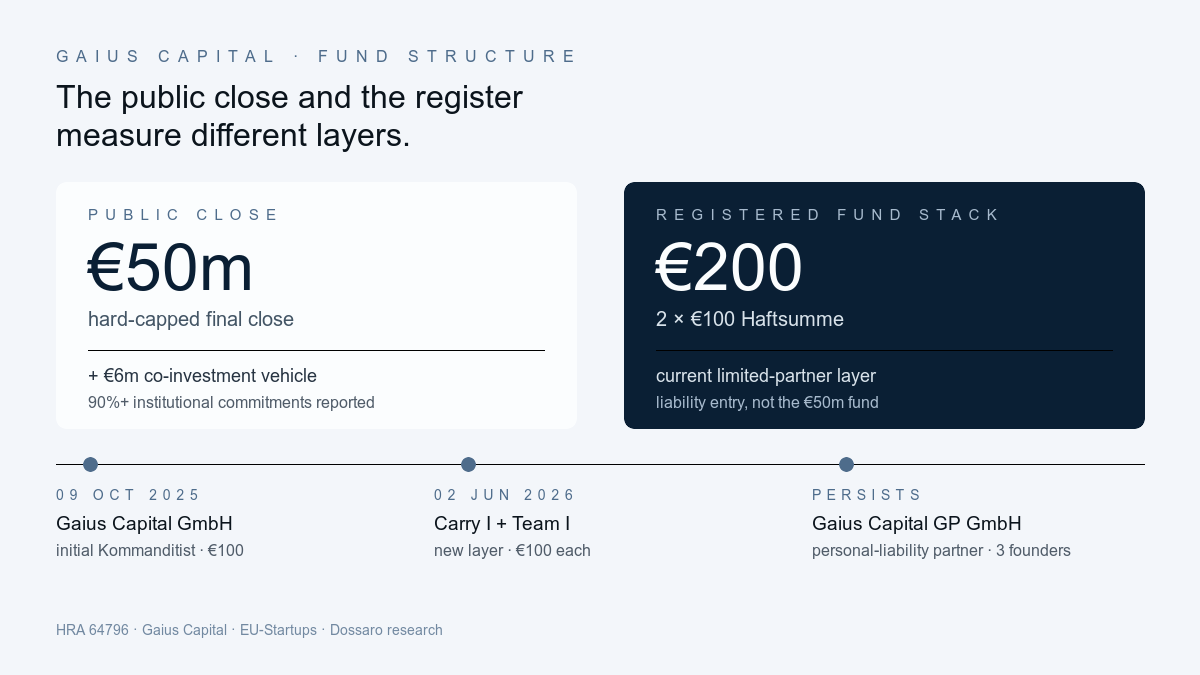
Gaius Capital's debut succession fund reached a €50 million hard-capped final close, with another €6 million raised through a co-investment vehicle. The German register tells a narrower story: the fund's current limited-partner layer consists of separate carry and team vehicles carrying €100 of registered Haftsumme each. The aggregate €200 is a liability amount under German partnership law, not the fund's capital or the amount institutions committed.
That distinction makes the June 2026 filing useful. It shows how Gaius moved from a management-company limited partner at formation to a sponsor-side structure that separates the fund, its general partner, and carry and team vehicles. It does not identify the fund's LPs, disclose their commitments or prove who controls the economics.
The €50m close and the €200 register number answer different questions
On 12 October 2026, EU-Startups reported that Gaius Capital had closed its debut fund at a €50 million hard cap and raised a further €6 million co-investment vehicle. The report said more than 90% of commitments came from institutions in Germany, France, the Benelux, the United States and the United Kingdom. It described a strategy of buying majority stakes in profitable, mid-sized service companies and supporting succession and buy-and-build transactions.
The Gaius Capital website identifies the Berlin firm as founded in 2025 by Jan Mickel, Joscha Radeck and Dr Lukas Klipper. It describes institutional investors, family offices and entrepreneurs as sources of capital and lists Gaius Nachfolgekapital I among the firm's active funds. Those sources establish the fundraising event and the sponsor's strategy.
The register answers another question. The exact vehicle is Gaius Nachfolgekapital I GmbH & Co. KG, registered with Amtsgericht Berlin (Charlottenburg) under HRA 64796. Its current chronological record shows two Kommanditist vehicles, each with a €100 registered Haftsumme. Adding those two figures gives €200. It does not turn the registered liability into a proxy for a €50 million close.
Formation put Gaius Capital in the limited-partner seat
The HRA 64796 formation entry dated 9 October 2025 named Gaius Capital GmbH as the initial Kommanditist with a registered €100 Haftsumme. Gaius Capital GP GmbH was recorded as the personally liable partner. The formation therefore placed the manager's company in the limited-partner slot while the GP sat in the unlimited-liability role required by the GmbH & Co. KG form.
That chronology is evidence of the initial legal arrangement, not evidence that Gaius Capital GmbH was the fund's only investor or that it funded the public close. A registered Haftsumme is the amount entered for a limited partner's liability contribution. It is not a subscription schedule, a capital account, a paid-in amount or a valuation.
The distinction is practical. A reader who searched only the formation record could incorrectly read the €100 entry as the size of the fund. A reader who treated Gaius Capital GmbH as the fund's economic owner could also assign control that the public register does not disclose. The formation entry supports neither conclusion.
Carry and team vehicles replaced that layer
The 2 June 2026 chronological entry records a change in the Kommanditist layer. Gaius Capital GmbH was removed. Two separate limited partnerships were added:
| Register state | Limited-partner entry | Registered Haftsumme | What the evidence supports |
|---|---|---|---|
| 9 October 2025 formation | Gaius Capital GmbH | €100 | Management-company limited partner at formation |
| 2 June 2026 change | Gaius Capital Carry I GmbH & Co. KG | €100 | Separate carry vehicle in the current layer |
| 2 June 2026 change | Gaius Capital Team I GmbH & Co. KG | €100 | Separate team vehicle in the current layer |
The filing makes the role separation visible. Carry I and Team I are not the fund itself, and their names do not disclose a carried-interest waterfall, employee participation plan, voting agreement or distribution schedule. They do show that sponsor-side economics have their own registered entities instead of remaining under the management company named at formation.
This is a familiar private-equity architecture, but familiarity is not proof of the terms used here. The change could support incentive alignment for a team, the holding of carry rights, or an internal reorganisation before or during fundraising. The public documents do not say which. The defensible finding is the legal separation, not a motive assigned to it.
The GP stayed in the personal-liability layer
The current fund record continues to name Gaius Capital GP GmbH as the personally liable partner. Its exact HRB 277975 profile identifies the company in that role and lists Lukas Klipper, Joscha Radeck and Jan Mickel as managing directors. The three names match the founders described on Gaius Capital's own website.
That continuity matters for the structure map. The limited-partner seat changed from Gaius Capital GmbH to Carry I and Team I, while the GP remained the legal partner exposed to personal liability at the fund-vehicle level. The record therefore distinguishes at least three layers: the fund vehicle, the GP and the sponsor-side carry/team vehicles.
It does not establish that the three managing directors own the GP, that the GP has unilateral investment authority, or that Carry I and Team I have voting rights. Those questions sit in the partnership agreement, the fund terms and the relevant corporate registers. A managing-director listing is not a beneficial-ownership record.
Why €200 must not be read as fund size
The public close and the register can look contradictory only if their numbers are treated as the same kind of fact. They are not.
The €50 million figure describes commitments to a private-equity fund at final close, as reported publicly. The additional €6 million describes a co-investment vehicle. The €200 figure is the sum of two registered liability amounts for limited-partner entities in the HRA record. It is not a reported capital call, an LP commitment or the value of assets held by Gaius Nachfolgekapital I.
The arithmetic is simple: €100 plus €100 equals €200. No economically meaningful ratio should be drawn between that sum and the €50 million close, because the numbers measure different things. The register's silence about LP commitments is not evidence that the commitments do not exist, just as the press report's close figure is not evidence about the partnership's registered Haftsumme.
The same discipline applies to the €6 million co-investment vehicle. The sources reviewed do not identify that vehicle's legal name, LPs or relationship to HRA 64796. It should remain a separate public claim until a primary filing connects it to the fund structure.
The new layer changes the diligence map, not the disclosed economics
For institutional investors, the chronology points to the documents that matter next. The partnership agreement and subscription materials should show who committed capital, how voting works and which entity is entitled to distributions. Carry and team agreements should show whether Carry I and Team I hold economic rights, merely administrative interests, or something else. The GP's corporate filings could clarify ownership and decision rights, but an officer list alone cannot do that.
The distinction is also useful for owners considering a succession transaction. Gaius' public strategy is to acquire majority stakes in profitable mid-sized service companies in the DACH region. A seller or adviser should therefore map the contracting entity, fund commitment and investment authority separately rather than treating “Gaius Capital” as one legal counterparty. The current HRA record supplies the first part of that map; it does not replace transaction documents.
This is the same perimeter problem visible in Graduate Ventures' cooperative Fund II, where a fund headline sits beside separate manager and team entities. Forbion's two-fund close shows why one public fundraising figure can cover more than one vehicle, while Headline's EU VIII manager map illustrates the need to separate fund labels from manager records. Gaius adds a dated change in the sponsor-side limited-partner layer.
The next document is contractual
The evidence supports a precise conclusion: Gaius' €50 million fund is legally anchored in HRA 64796, its GP remains Gaius Capital GP GmbH, and the current registered limited partners are Carry I and Team I with €100 each. The €200 aggregate Haftsumme is a liability entry, not a small-fund signal and not a substitute for LP data.
The unresolved question is economic rather than clerical. A partnership agreement, fund memorandum, subscription schedule or later filing would need to show whether the carry and team vehicles hold rights to distributions, voting, or only sponsor-side participation. Until that document is public, the register establishes the legal stack and its chronology, while the €50 million close establishes the fundraising outcome. Neither source discloses the other layer.
Continue reading
Related Research
Graduate Ventures' €125m Fund II Sits in a Dutch Cooperative
Graduate Ventures' €125m Fund II maps to a Dutch cooperative beside separate manager and seed-capital companies, clarifying structure without LP economics.
Forbion's €2.3bn Close Has a Visible $1.014bn US Split
Forbion's €2.3bn close spans growth and venture vehicles; SEC filings show $1.014bn sold across 37 investors, not one pool, with no LP allocation published.
Headline's $400m Fund Is Real. Its Manager Map Is Not Yet Singular
Headline's $400m EU VIII is an active Luxembourg AIF, but CSSF and CNMV records map it to two AIFM relationships while LP economics remain undisclosed.
Seaya's €600m Nova Close Raises a Fund-Identity Question for Europe's Growth Capital
Seaya says Nova reached a €600m first close, while EIF earlier named a €1bn-target Growth Tech Fund I; the public names are not yet reconciled.