
Pigment's $250m Series E Sits on a 298m-Share, Eight-Class French Structure
Pigment announced a $250m Series E at a $2.3bn valuation, while French filings show 298.1m shares across eight classes and no investor allocation yet.
On this page
Conduct your own private market research
Add dossaro to Claude or ChatGPT and run source-backed register research from your own workspace.
 Add to Claude
 Add to ChatGPT
Pigment announced a $250 million Series E at a $2.3 billion valuation on 21 October 2026. The round is led by EQT's Scaleup Europe Fund, with WIL and existing investors Greenoaks, ICONIQ, IVP and Meritech participating. Pigment also said NVIDIA planned to invest and that annual recurring revenue had passed $100 million.
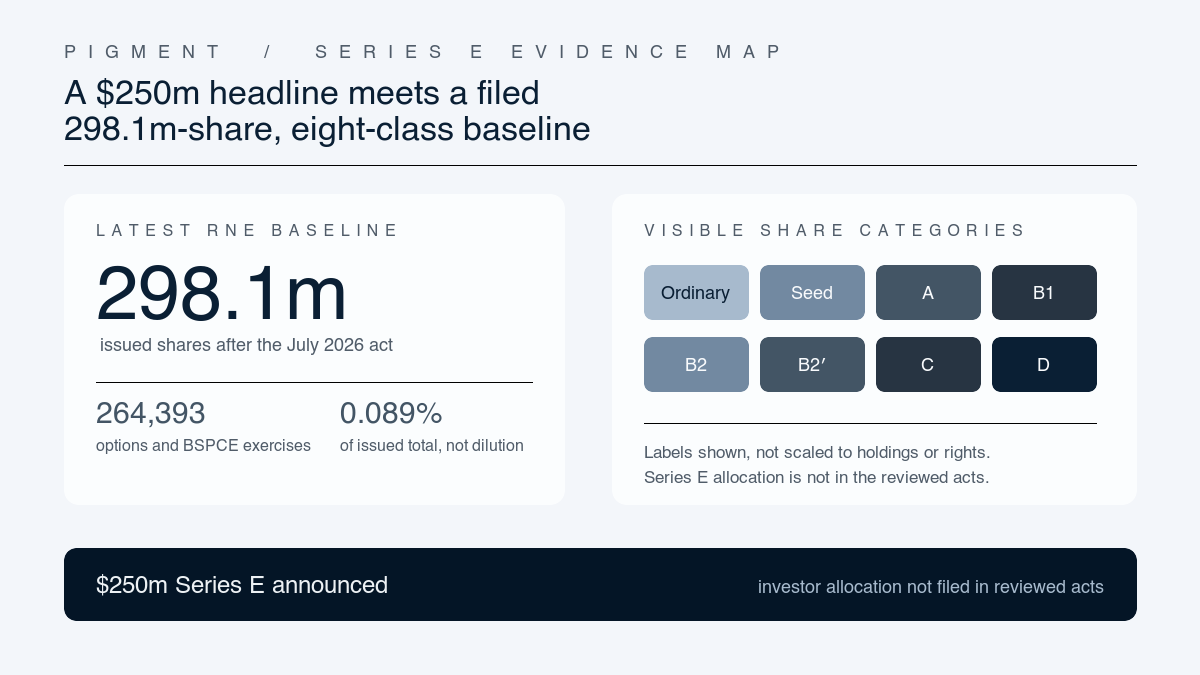
The latest French register record puts a different fact at the centre of the financing story. PIGMENT SIREN 852 785 914 had 298,135,820 issued shares after a July 2026 act recorded 264,393 option and BSPCE exercises. The statutes and capital acts show eight share categories, from ordinary shares through Seed, A, B1, B2, B2-prime, C and D. They do not identify the Series E investors, the new issue price or the number of shares issued for the round.
That is not evidence that the financing failed to close or that the named investors are absent. It is a precise boundary around what the public record currently proves: a large primary-equity announcement sits above a complex, employee-equity-active capital structure whose post-round economics have not yet been filed.
The headline is a primary-equity event, not a public cap table
Pigment's official announcement describes a $250 million primary equity Series E at a $2.3 billion valuation. It names Scaleup Europe Fund, managed by EQT, as lead and lists WIL, Greenoaks, ICONIQ, IVP and Meritech. The release also describes a planned NVIDIA investment and the company's growth in enterprise planning and AI-enabled metrics.
The independent account from EQT Ventures confirms the lead fund and the participation of NVIDIA's venture arm and WIL. MarketScreener's transaction report describes convertible preferred shares and the $2.3 billion post-money valuation. Those sources establish the commercial event and the public framing. They do not publish an issuer-level cap table, an issue price, a preference schedule or an investor-by-investor allocation.
The legal identity is clear. Societe.com lists PIGMENT as an active French SAS with SIREN 852 785 914. The RNE acts are more useful for the capital arithmetic. Their dates precede the Series E announcement, which makes them a pre-announcement baseline rather than a post-money answer.
July filings show 298.1 million shares after repeated equity exercises
Pigment's register history shows a sequence of option and BSPCE activity rather than a single clean financing block. An RNE act dated 30 June 2025 records 37,685 options, 235,496 BSPCE and 3,125 BSA exercises, or 276,306 new ordinary shares. The resulting total was 296,811,555 shares.
The 20 March 2026 act records another 5,812 options and 56,436 BSPCE exercises. That added 62,248 ordinary shares and brought the total to 297,871,427. The 17 July 2026 act records 237,093 options and 27,300 BSPCE exercises, adding 264,393 shares and taking the total to 298,135,820.
| Register point | New shares recorded | Total issued shares | What the entry establishes |
|---|---|---|---|
| Act dated 30 June 2025 | 276,306 | 296,811,555 | Option, BSPCE and BSA exercises had already created a large ordinary-share base |
| Act dated 20 March 2026 | 62,248 | 297,871,427 | Further option and BSPCE exercises increased the ordinary pool before the announcement |
| Act dated 17 July 2026 | 264,393 | 298,135,820 | The latest visible pre-announcement total and another large exercise step |
The arithmetic matters because it prevents a common shortcut. The July increase is 264,393 shares, or about 0.089% of the resulting issued total. It is not a proxy for the $250 million raise, a dilution percentage or the round's price per share. The acts describe the legal share movements and nominal capital, not the cash consideration or the value of the Series E instruments.
Eight classes are visible, but no Series E issue block
The July filing keeps eight categories visible in the company statutes: ordinary, Seed, A, B1, B2, B2-prime, C and D. The labels indicate that Pigment has carried multiple financing or rights layers over time. They do not, by themselves, reveal the number of shares in each class, the liquidation preferences, conversion mechanics, voting differences or the investor that holds any particular block.
The 30 June 2026 RNE act is therefore useful as a structural document, not as a Series E allocation schedule. The 29 July 2026 shareholders' meeting act records the renewal of four board mandates, including co-founders Romain Niccoli and Eléonore Crespo, with 263,137,827 votes for and no votes against or abstentions. It does not name the Series E investors or allocate the announced capital.
This is the same timing problem that appears in other private financings. xorlab's Series A+ analysis separates an issued-capital step from the later financing announcement. Universal Quantum's preference-stack record shows why a round headline cannot substitute for the filed rights attached to the shares. Pigment's public evidence currently supports the same discipline: read the register as a legal baseline, not as an inferred post-money table.
The commercial consequence is an underwriting gap
For a new investor, the missing fields are decision-relevant. The public material does not say how many shares the $250 million bought, whether the full amount was primary at Pigment SAS, whether any secondary transfer occurred alongside it, or which of the eight classes received the new money. Without that information, no defensible calculation can be made for founder dilution, employee-pool dilution, investor ownership or the value of the existing preferred layers.
Employees face a related question. The July act shows substantial option and BSPCE exercise activity before the announcement, so the fully diluted denominator may differ from the issued ordinary-share count. Yet the public acts do not provide the outstanding, unexercised pool, strike prices or the treatment of those instruments in the Series E. The visible 298.1 million figure is therefore a register count, not a fully diluted cap table.
Counterparties and analysts should also keep the legal entity in view. Pigment's announcement is a group-level financing story, while the French RNE record is an issuer-level legal state. A new investor may have subscribed through an instrument or a closing document that will appear later, and a planned NVIDIA investment may not have been legally completed on the dates of the acts reviewed here.
The next document that would settle the question
The decision-changing watchpoint is a post-announcement RNE act, updated statutes or shareholder document that records a new capital amount and the Series E class. That filing could disclose the number of new shares, the class, the issue price and, depending on the document, the contribution mechanics. A later document naming the issuer and the NVIDIA instrument would clarify whether the planned investment closed with the announced round.
Until that material appears, the strongest source-backed conclusion is narrower and more useful than a guessed dilution number: Pigment raised a publicly described $250 million Series E at a $2.3 billion valuation, while its latest visible French legal baseline shows 298.1 million shares, eight share categories and repeated employee-equity exercises. The register makes the structure visible. It does not yet tell the market who bought the round or how the economics moved.
Continue reading
Related Research
xorlab's €5m Series A+ Follows A Staged Swiss Capital Programme
xorlab's €5m Series A+ followed a 43.4% 2021 and 20.0% 2026 issued-capital rise, while Swiss filings do not identify investors or dilution yet.
Universal Quantum's $100m Round Entered a Negotiated Preference Stack
Universal Quantum's $100m Series A met existing preference, anti-dilution and participation rights, while post-round ownership remains undisclosed.
ZuriQ's $25.5m Seed Created A 28.6% Preferred Block
ZuriQ's $25.5m seed closed legally in May, creating a 28.6% preferred block and adding a Quantonation-linked director before its July reveal.
Seaya's €600m Nova Close Raises a Fund-Identity Question for Europe's Growth Capital
Seaya says Nova reached a €600m first close, while EIF earlier named a €1bn-target Growth Tech Fund I; the public names are not yet reconciled.