
Rezzil’s $10m Round Met a 19,300-Share Parent Option
Rezzil’s $10m growth round sits beside parent-level allotments, a 19,300-share option authority and an unresolved strike-off notice for Exar.Live.
On this page
Conduct your own private market research
Add dossaro to Claude or ChatGPT and run source-backed register research from your own workspace.
 Add to Claude
 Add to ChatGPT
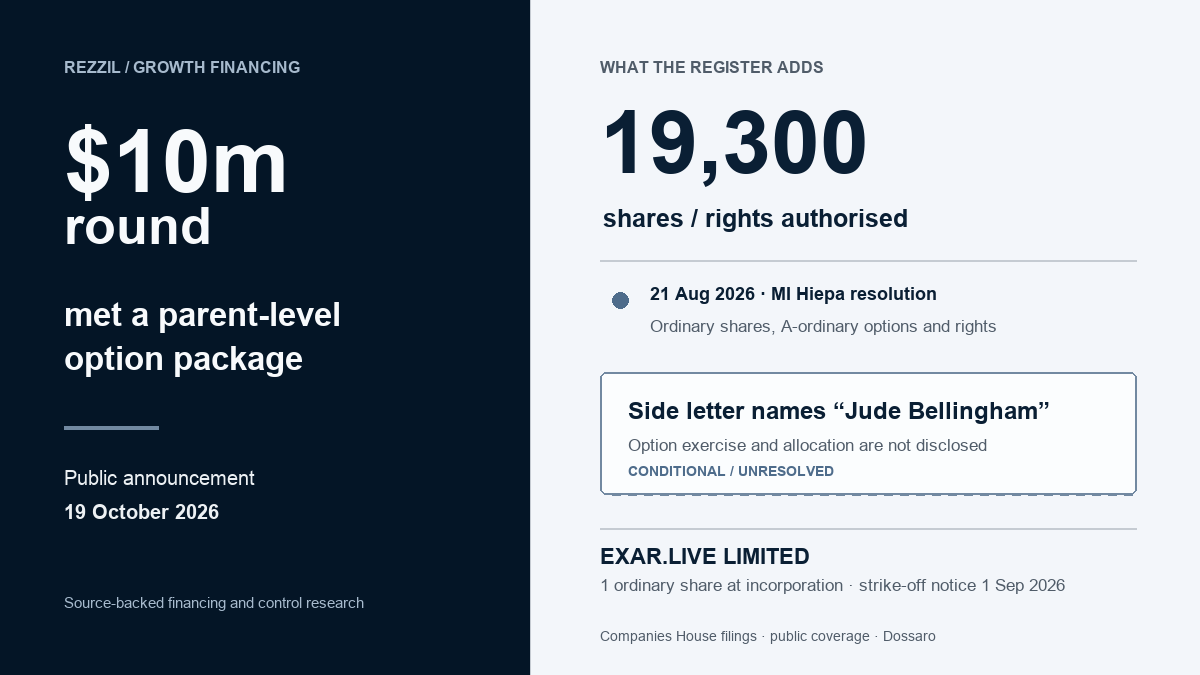
Rezzil’s announced $10 million strategic growth financing looks like a celebrity-backed sports-tech round. The UK register shows a more layered picture: the visible 2026 equity and option work sits at parent company MI Hiepa Scout Limited, while the Exar.Live legal vehicle starts with one ordinary share and has received a first strike-off notice.
That does not prove who paid what, whether an option was exercised or where every dollar of the financing landed. It does show that the control and future-upside package was being assembled above the product brand. A written resolution authorised up to 19,300 shares or subscription rights and approved a side-letter option naming “Jude Bellingham”. Public coverage, however, describes Jobe Bellingham as the investor. The documents do not make those names interchangeable.
The legal structure sits above the product name
Rezzil describes Exar.Live as its post-match analysis tool. Its business site says the product ingests feeds from optical tracking providers and delivers them to analysts and developers. Rezzil’s current site also identifies the company as “Rezzil and MiHiepa Scout Ltd”. Those statements establish a public product and parent relationship, not a complete group chart or proof that Exar.Live holds all of Rezzil’s contracts and intellectual property.
Companies House provides a narrow but useful baseline. EXAR.LIVE LIMITED, company number 15957750, was incorporated on 16 September 2024. The incorporation filing records one ordinary £1 share, held by MI Hiepa Scout Limited, company number 10676157. It also records MI Hiepa as the relevant legal entity with 75% or more of the shares and voting rights and the right to appoint or remove a majority of the board.
The available Exar.Live filing set contains no later allotment filing. Its current Companies House profile is marked “active-proposal-to-strike-off”, and a first Gazette notice was published on 1 September 2026. The notice says the company may be struck off and dissolved unless cause is shown. It does not establish that dissolution occurred, that the Rezzil product is being wound down or that any contract or asset sits in that company.
The register therefore separates two facts that a financing headline compresses. Exar.Live is a one-share vehicle at incorporation with an unresolved legal-continuity notice. MI Hiepa is the company carrying the 2026 share-allotment and option-authority activity. The difference matters if investors, customers or employees assume the product name identifies the entity receiving the new capital.
MI Hiepa’s 2026 filings show a staged equity package
MI Hiepa’s Companies House returns show several allotments in 2026. The safest comparison uses the statement-of-capital totals printed on the filings, not a simple sum of every return. Several July returns are replacements or corrections, and their stated totals do not move in a clean arithmetic sequence.
| Allotment date | Filing date | Stated capital total | What the filing records |
|---|---|---|---|
| 3 July 2026 | 10 July 2026 | 209,524 shares | 12,744 ordinary and 8,416 B ordinary shares |
| 16 July 2026 | 20 July 2026 | 214,094 shares | 4,570 B ordinary shares |
| 25 August 2026 | 10 September 2026 | 229,425 shares | 4,801 ordinary shares |
The July 28 and July 31 returns add further ordinary allotments, and another filing records 300 ordinary shares dated 14 August. Because the returns contain replacement and correction notices, they should not be treated as independent subscriptions that can be added together. What the statements do support is a stated-share comparison from 209,524 to 229,425, an increase of 19,901 shares across the period.
The share classes also matter. The B ordinary particulars give one vote per share, pre-emption rights on transfer and allotment, dividend and capital-distribution rights and co-sale rights. A ordinary shares are non-voting but carry full dividend and capital-distribution rights. The ordinary class carries full voting, dividend and capital-distribution rights. An allotment can therefore change more than a headline count: the class determines who votes, who can participate in future issues and who shares in a sale or winding up.
The returns do not identify every subscriber, the premium paid or the percentage held by any named investor. A higher stated total is evidence of issued-capital movement, not a complete ownership map.
The 19,300-share authority names an option, not an investor cheque
The most revealing document is a written resolution dated 21 August 2026 and filed on 14 September. It authorises the directors to allot up to 19,300 shares or grant rights to subscribe for up to 19,300 shares. The authority covers ordinary shares and A ordinary employee options and replaces earlier unexercised authorities.
Resolution 3 has a separate purpose. It approves the option contained in a side letter between MI Hiepa and “Jude Bellingham”. The text does not state the option price, the number of shares that would be issued on exercise, the vesting conditions or whether the option was ever exercised.
The same resolution carries signatures for or on behalf of several institutional parties, including Simba Investments DMCC, The Football Association Premier League Limited, Velocity Sports Partners LLC and Conyers Family Investment Company (SG) Pte. Ltd. That is evidence that those parties agreed to the corporate resolutions. It is not evidence that each signed party subscribed for a particular allotment or owns a particular percentage.
MI Hiepa also filed the appointment of Sion Peter Colley as a director, effective 2 September 2026. The filing was made on 6 October. Inside Sport and Rezzil coverage identify Colley as Rezzil’s chief executive, while the public financing reports say Jobe Bellingham and Phil Kenyon joined the investor group. City A.M. quotes Rezzil describing Jobe’s investment as part of a broader strategic partnership with the Bellingham family.
That creates an important identity boundary. The parent resolution names Jude. The public coverage names Jobe. Nothing in the filings reviewed proves that Jude invested, that Jobe received a specific number of shares, that the side letter was exercised or that the two references describe the same economic participant.
The control implication is real even without a cap table
The filing trail changes the economic reading of the round without providing a final ownership percentage. Rezzil’s announcement is about $10 million of growth funding and a plan to expand internationally and develop consumer gaming products. The parent-level filings show a moving share base, class-specific rights and a future option authority that can create additional equity exposure.
For existing holders, the risk is not simply dilution from a known cash round. A 19,300-share authority can be used for an investor or employee option, while the earlier allotments may already have changed voting and co-sale positions. For incoming parties, the unresolved question is whether the public financing price and the option terms were negotiated together or describe separate steps in a broader package. The register cannot answer that question because it does not publish a subscriber schedule or the side letter.
This is the same diligence problem seen in other private-company financings. In Salience Labs’ staged-control round, a financing story only becomes legible when the legal sequence and governance consequences are separated. OMass’ Series C preference layer shows the related point for a biotech issuer: a new class can change the downside order without revealing the full investor waterfall. Rezzil’s register adds a parent-level option and an unresolved operating-vehicle notice to the public growth narrative.
What the filings still cannot prove
The evidence supports five bounded conclusions:
- The public event is a $10 million strategic growth financing announced on 19 October 2026, with Jobe Bellingham, Phil Kenyon, existing sports investors and Simba Investments named in coverage.
- MI Hiepa’s 2026 filings show staged allotment activity and a stated-share increase of 19,901 shares between the 3 July and 25 August statement totals.
- A written resolution authorises up to 19,300 shares or subscription rights and approves a side-letter option naming Jude Bellingham.
- Sion Colley became a director of MI Hiepa with an appointment date of 2 September 2026.
- Exar.Live was incorporated with one ordinary share held by MI Hiepa and later received a first Gazette strike-off notice; the available documents do not establish dissolution.
The evidence does not establish the allotment recipient, the amount invested by Jobe or Jude, the exercise of the option, a fully diluted cap table, a transfer of control or the amount of cash that reached any particular Rezzil entity. The benign reading remains plausible: the parent filings may be routine capitalization and employee-option administration around a wider group, and the strike-off notice may be withdrawn or resolved administratively.
The next document that would materially change the story is a post-round confirmation statement or allotment return that identifies subscribers or records the option exercise. An updated Exar.Live filing would also show whether the strike-off proposal was discontinued or whether the vehicle actually left the register. Until then, the defensible conclusion is narrower and more useful than the celebrity-round headline: Rezzil’s financing arrived alongside a parent-level share-and-option package, while the product vehicle’s legal continuity remained unresolved.
Sources
Continue reading
Related Research
Salience Labs’ $125m Series B Was Split Across 23 Allotment Lines
Salience Labs’ $125m Series B spans 23 UK allotment lines worth about £125m, while Oxford Science Enterprises left the PSC record before the issue.
OMass’ $310m Series C Added a £40m C-1 Preference Layer
OMass’s $310m Series C included a £1 deferred-share cancellation and a £40m Series C-1 issue with priority rights, exposing a new downside layer.
Noah’s $16m Extension Leaves the UK Capital Stack Nearly Unchanged
Noah’s $16m seed extension added only 3,150 visible UK shares, while two corporate ordinary blocks still anchor its UK capital stack and control records.
NexGen Cloud's $106m GPU Loan Followed a Founder-Control Reset
NexGen Cloud's $106m GPU loan followed a founder-linked control reset, a new charge over Finnish capacity and a filed €121m promissory-note schedule.