
Ponda's £1.422m Crowd Round Added Preference Capital, Not a Governance Bloc
Ponda's £1.422m Republic round added 249 investors to SALTYCO's Series Seed class, but filings and custodian terms do not document a retail governance bloc.
On this page
Conduct your own private market research
Add dossaro to Claude or ChatGPT and run source-backed register research from your own workspace.
 Add to Claude
 Add to ChatGPT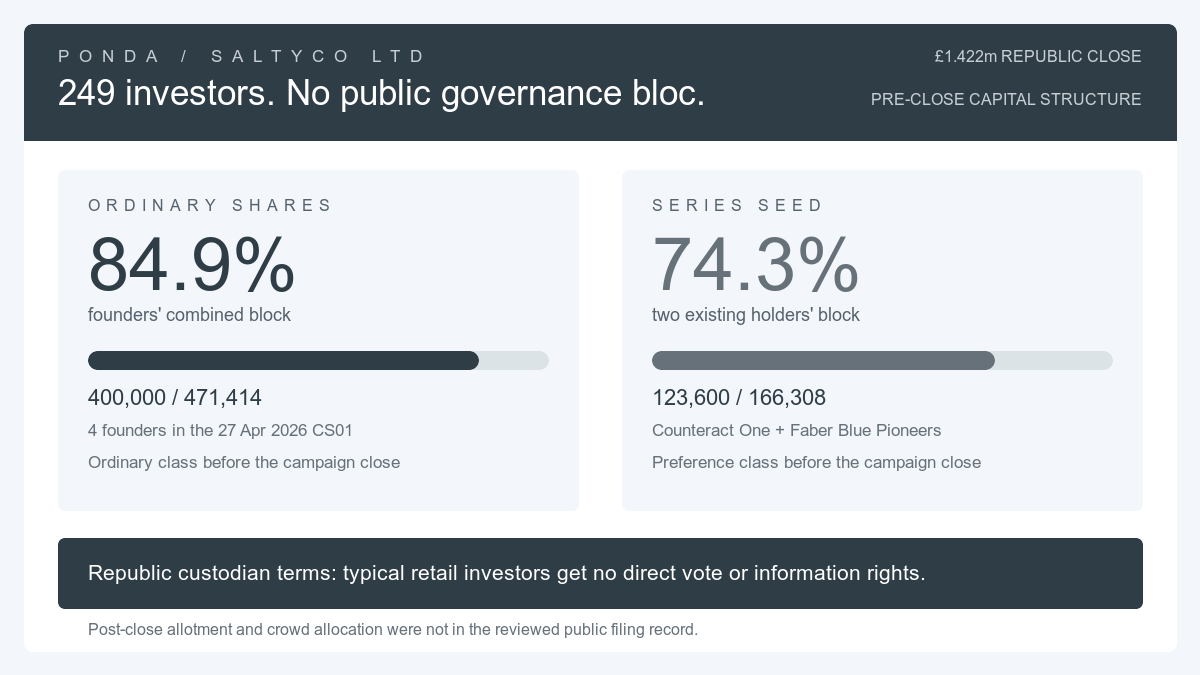
Ponda's Republic campaign closed with £1,422,538 from 249 investors. The important detail is not only how many people joined, but what the published terms say they received. The campaign puts new investors into SALTYCO LTD's Series Seed class through a custodian arrangement that gives typical retail investors no direct information or voting rights, no company updates and no pre-emption on a future fundraise.
That makes the round a preference-capital event rather than a documented governance bloc. The last pre-close Companies House snapshot shows four founders holding 400,000 of 471,414 ordinary shares, or 84.9% of the ordinary class. It also shows Counteract One LP and Faber Blue Pioneers I Fundo C holding 123,600 of 166,308 Series Seed shares, or 74.3% of that preference class. The post-close allotment, crowd allocation and register holder for the custodied shares are not yet public.
The headline round and the rights underneath it
Republic's closed campaign page records a £1,400,003 target and £1,422,538 raised, which is 101.6% of target even though the platform displays 101% after rounding. It values the company at £7.5 million pre-money, rounded from £7,502,669, and says the equity offered is 15.93%. Republic describes Ponda as a Bristol biomaterials company developing BioPuff, a plant-based textile insulation made from wetland crops.
The campaign page also says all investors in the round receive Series Seed shares. That class has full voting rights on the company's share terms and receives a preference amount plus arrears before the surplus on a liquidation, return of capital or exit. A broad-based weighted-average anti-dilution provision applies unless waived by a majority of Series Seed holders. Those are meaningful economic rights, but they are not the same as direct access to the company.
Republic says it is acting as custodian rather than using its standard nominee service because the business is not directly involved in the share sale. It will handle administrative tasks, but investors in that arrangement will not have information or voting rights, updates from the business, pre-emption on future fundraising or ongoing support about trading activity. The platform says direct investment is available only above a threshold set by the company. It does not publish that threshold or a retail allocation in the public view.
| Pre-close block | Shares in the 27 April 2026 filing | Share of relevant class | What it establishes |
|---|---|---|---|
| Four founders' Ordinary shares | 400,000 of 471,414 | 84.9% of Ordinary | A founder-heavy ordinary class before the crowd close |
| Counteract One plus Faber Blue Pioneers Series Seed | 123,600 of 166,308 | 74.3% of Series Seed | A concentrated professional-investor preference block |
| All issued shares | 637,722 | 100% of issued capital | The pre-close denominator only, not a post-close or fully diluted cap table |
The distinction is central. A campaign can have hundreds of investors while their legal rights are aggregated, administered and communicated through a custodian. Investor count is therefore not a proxy for voting power, information access or liquidation priority.
What the Companies House filings show before close
SALTYCO LTD, company number 12614828, is the UK private company named in the Republic terms. Companies House lists it as active, incorporated on 20 May 2020 and registered in Bristol under SIC 13990, manufacture of other textiles not elsewhere classified. Republic identifies Greenhelp Unipessoal Lda in Portugal as the group's wholly owned research and development subsidiary.
The 17 June 2025 allotment, filed on 19 June, added 103,666 Series Seed shares at £12.54 and 59,805 at £10.03. The filing left 471,414 ordinary shares and recorded 163,471 Series Seed shares, 634,885 shares in total. Its prescribed particulars give ordinary shares full voting, dividend and capital-distribution rights subject to satisfying the Series Seed preference amount. Series Seed shares also have full voting rights and a non-participating preference or as-converted pro-rata distribution formulation.
The next SH01, for 23 October 2025 and filed on 16 December, added 2,837 Series Seed shares at £12.54. The resulting statement of capital was 471,414 ordinary and 166,308 Series Seed shares, 637,722 in total. That filing repeats the class rights. Neither allotment is the Republic close: both pre-date the August campaign and neither shows the crowd's allocation.
The 27 April 2026 confirmation statement is the latest pre-close holder view in the research record. It lists 42 shareholders. Neloufar Taheri, Antonia Contreras, Finlay Duncan and Julian Ellis-Brown each held 100,000 ordinary shares. Together they held 400,000 shares, or 84.9% of the ordinary class. Those shares were 62.7% of all issued shares at the time, but that is not a fully diluted ownership percentage and does not establish that the founders held every vote.
The same statement records Counteract One LP with 67,779 Series Seed shares and Faber Blue Pioneers I Fundo C with 55,821. Their combined 123,600 shares represent 74.3% of the existing Series Seed class. Smaller Series Seed positions were held by Evenlode Impact Limited, PDS Ventures, Catherine Hova, RCA (WCS Nominees Limited), AgImpacts Ventures and three founders with 877 Series Seed shares each.
That structure makes the crowd's eventual position a live question. The existing Series Seed class already had a concentrated block and a stated preference. A new issue to retail investors could add economic exposure without giving that dispersed group a practical way to coordinate, especially when the public terms remove direct communication and voting channels.
Why the 249-investor number cannot be turned into a percentage
The platform's 249-investor figure is a campaign statistic, not a share register. It does not say how many shares each investor bought, whether the custodian holds one aggregate position, or whether any investors crossed the threshold for direct ownership. Without a post-close SH01 or confirmation statement, dividing 15.93% by 249 would be an invented allocation, not a calculation supported by the record.
The public count is also inconsistent. EU-Startups reported on 28 August that Ponda closed at approximately €1.6 million or £1.4 million with 256 new investors. Its report confirms the round and describes Ponda's BioPuff product and wetland-farming model, but it does not provide a share allotment or explain the difference from Republic's 249. The reason could be timing, a platform definition or a reporting error; the sources do not establish which.
The economic rights are asymmetric even before that discrepancy is resolved. Series Seed holders receive their preference amount and arrears before ordinary holders receive the surplus. That gives preference investors a priority claim on downside proceeds. The custodian language then limits how typical retail investors can exercise the class's formal rights. The result is not that crowd investors have no economic exposure. It is that the public record does not support treating their number as a coordinated control position.
Ponda's campaign also says the company will use funds for manufacturing scale-up, go-to-market activity, a large demonstrator and research and development. Those plans explain why the financing matters commercially. They do not answer how the new money is priced against the older Series Seed allotments, whether the founders were diluted, or how any future exit proceeds would be divided among the custodian's beneficiaries.
The next filing is the decision-changing evidence
The next document to watch is a post-close SH01 or CS01 for SALTYCO LTD. It should show the exact allotment date, number and class, and may identify a custodian, nominee or another corporate holder. A later confirmation statement could reveal whether the crowd is represented as one registered position or whether any investors hold directly. Neither outcome alone would prove a voting coalition, but either would make the ownership arithmetic less speculative.
An accessible Republic completion document could answer a different question: why its 249 figure differs from the 256 reported by EU-Startups, and what administrative path applies to investors below the direct-investment threshold. Until those records appear, the defensible conclusion is narrower.
Ponda has raised £1.422 million in a campaign that adds preference exposure to SALTYCO's existing Series Seed stack. Before the close, founders dominated the ordinary class and two professional investors dominated the preference class. Republic's custodian terms give typical retail investors no direct information or voting channel. The crowd may become economically important as the company scales BioPuff, but investor count alone is not control, and the post-close filings will decide how much of the capital structure the crowd actually occupies.
For a related example of why the filed share structure matters more than a financing headline, see Callosum's seed-round analysis. The same discipline applies here: follow the class, the holder and the right, then stop where the evidence stops.
Continue reading
Related Research
Callosum's $100m Seed Put 24.1% of the Holdco Into a New Preferred Class
Callosum's $100m seed maps to a filed £57.20m Series Seed 2 issue for 24.1% of its holdco, while Atomico and Plural-linked directors joined the board.
Wexler's Founders Held 54%, But £4.66m Ranked First
Legora bought a Wexler that was 54% founder-owned on its last visible share count, but £4.66m of seed preference ranked ahead of ordinary shares.
ZuriQ's $25.5m Seed Created A 28.6% Preferred Block
ZuriQ's $25.5m seed closed legally in May, creating a 28.6% preferred block and adding a Quantonation-linked director before its July reveal.
INLEAP’s €20m Funding Headline Was Cumulative; Founders Held 80% in the 2025 List
INLEAP says it has raised about €20m since founding, while its latest filed shareholder list shows founder holding companies with 80% and outside holders with 20%.