
Plend's £50m Headline Is A Secured Refinancing, Not £50m In Cash
Plend has £20m committed, not £50m in cash. Filings show a first charge over the whole business, a surviving Fair4All lien and junior capital.
On this page
Conduct your own private market research
Add dossaro to Claude or ChatGPT and run source-backed register research from your own workspace.
 Add to Claude
 Add to ChatGPT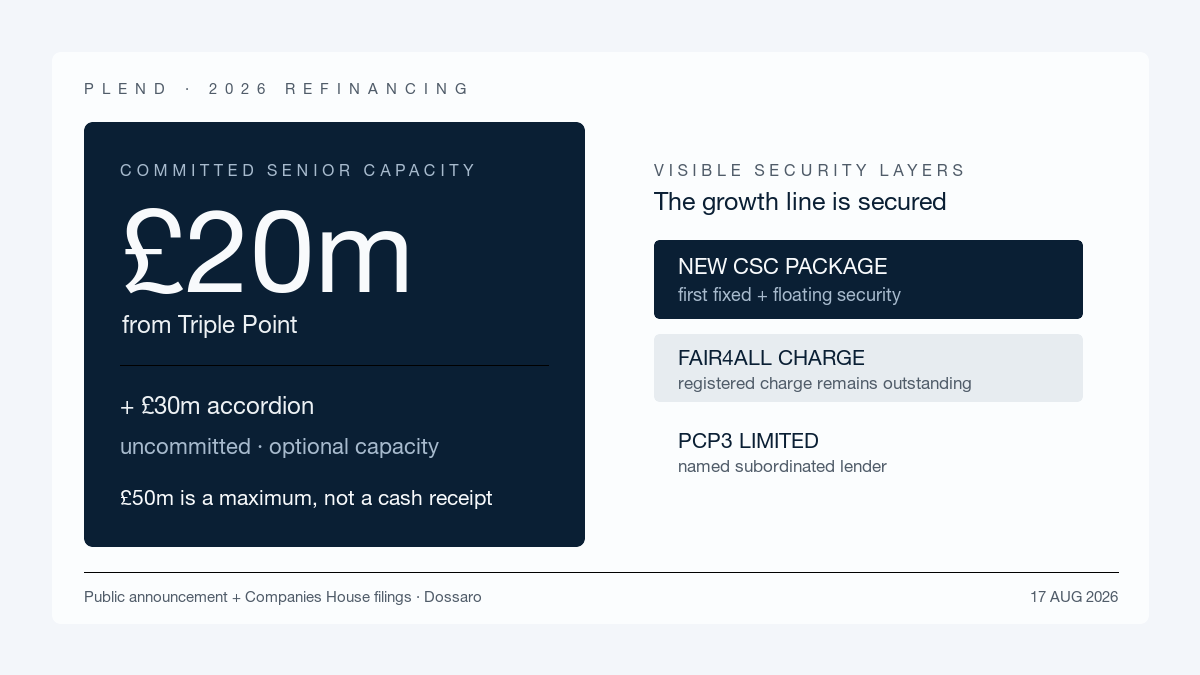
Plend's new financing is being marketed as up to £50 million of growth capacity. The filed security documents show a narrower and more consequential transaction: £20 million is committed, the extra £30 million is an uncommitted accordion, and the senior line is secured against almost the whole operating business.
The Companies House sequence also shows what the headline leaves out. Two Varengold security packages were satisfied on 24 July 2026. A new debenture, created three days earlier and filed on 29 July, gives CSC Trustees first-ranking fixed and floating security over Plend's undertaking, key trademarks, accounts, contracts and future assets. A separate Fair4All Finance charge remains outstanding. The same debenture names PCP3 Limited as a subordinated lender, creating a visible junior layer that was not mentioned in the funding announcement.
This is not evidence that Plend is in distress, nor does it reveal how much of the committed line has been drawn. It does show that the transaction is a secured refinancing and a re-papering of the capital stack, not £50 million of immediately available cash.
The Public Facility Has Two Different Funding States
Fintech Global's 29 July announcement describes a £20 million senior revolving credit facility from Triple Point and an uncommitted accordion that could add another £30 million. It says the line will refinance current debt and finance new loan originations.
The distinction between committed and uncommitted matters commercially. The senior facility is the amount the lender has agreed to make available subject to its conditions. The accordion is optional capacity. Its availability can depend on lender consent, borrowing-base tests, covenants or other conditions that are not disclosed in the public announcement. The headline therefore describes a maximum financing envelope, not a cash receipt.
Plend's own company profile identifies Plend Limited as the FCA-authorised lender behind the trading name, company number 12581855, and describes its open-banking affordability model. That operating model explains why additional loan-origination capacity matters. It does not change the funding distinction: the public source names £20 million as committed and £30 million as uncommitted.
| Funding leg | Public status | What the evidence supports |
|---|---|---|
| Triple Point senior revolving facility | £20m committed | Contracted senior capacity, subject to facility conditions |
| Accordion | Up to £30m, uncommitted | Optional additional capacity, not a disclosed cash draw |
| Announced maximum | Up to £50m | A ceiling combining both legs, not immediate proceeds |
The table is intentionally conservative. The announcement does not say that Plend had drawn all £20 million, and the register does not disclose the facility's pricing, borrowing base or undrawn fee.
The Register Shows A Replacement Security Package
The Companies House filing history records a new MR01 registration for charge 125818550007, created on 23 July and filed on 29 July 2026. The 75-page registration names CSC Trustees Limited as security agent. The same history records two MR04 satisfactions on 24 July for Varengold charges 125818550004 and 125818550006.
The charges register confirms the two Varengold charges were satisfied in full. Charge 125818550004 was created in July 2023 and charge 125818550006 in May 2024. Their release, immediately before the new debenture was filed, is the sequence expected in a refinancing where a new security agent replaces an earlier package.
The new instrument does not merely secure a narrow pool of receivables. Its first fixed charges cover the PLEND, PLEND SCORE, PLENDIES, PLENDERS and PLEND SCORE ENGINE trademarks. It also takes fixed security over present and future property, insurance proceeds, accounts and specified contracts. A first floating charge covers the other present and future assets and the undertaking. The debenture includes a negative pledge and provisions for crystallising the floating charge in specified circumstances.
That breadth changes the economic reading of the facility. Plend's brand, scoring technology and operating contracts are part of the collateral perimeter. If the business performs normally, the security may never be enforced. If performance deteriorates, the senior finance parties have a claim that reaches beyond a segregated loan book and into the franchise that generates future originations.
Fair4All Remains In The Stack
The same Companies House charges page shows charge 125818550005, created on 22 March 2024 in favour of FAIR4ALL Finance Limited, as outstanding. The page describes fixed security and a negative pledge. The new CSC debenture therefore sits alongside an earlier registered security interest rather than replacing every prior charge.
The filings do not establish the intercreditor priority between Fair4All and the Triple Point finance parties. A separate intercreditor agreement or deed could set the order of payment, standstill rights and enforcement controls. Those documents are not public in the source trail reviewed for this article. The accurate conclusion is narrower: Fair4All remains visible as an outstanding secured creditor while the new senior package is registered.
This is a familiar private-credit pattern. A refinancing can release one lender's security while leaving a programme lender, grant-backed lender or other stakeholder protected under a separate instrument. Dossaro's analysis of Modo Energy's secured debt shows why the existence of a charge is not enough to infer the entire waterfall. The legal documents and their priority arrangements determine who is paid first.
The Debenture Names A Junior Lender That Was Not In The Headline
The new debenture's definition of “Secured Parties” includes the security agent, arranger, agent, lenders, other finance parties, a corporate-services provider and a subordinated lender. It identifies PCP3 Limited as that subordinated lender under a subordinated loan agreement dated on or about the debenture date.
PCP3 is not a historical operating subsidiary. The Companies House record for PCP3 Limited shows it was incorporated on 1 August 2025 at Plend's Aldgate Tower address, with SIC code 64205 for financial-services holding companies. The public PSC record identifies Simon Thompson as holding 75% to 100% of the shares or voting rights. The documents reviewed do not disclose PCP3's loan amount or the commercial reason for its position.
The formal role is still useful. It shows that the senior facility was documented alongside junior capital rather than in a two-party lender-borrower arrangement. PCP3 may be aligned capital, a shareholder-linked vehicle or a conventional subordinated funder. The register does not prove which. It does prove that the financing stack is more layered than the Triple Point announcement suggests.
The Economic Consequence Is Risk Transfer, Not A New Ownership Story
Plend's public mission is to expand affordable credit through open-banking data. The new facility can support that mission by refinancing older debt and funding more originations. But the security package means the benefit of growth is paired with a wider lender claim over the assets that make growth possible.
That is the commercial trade-off. Plend receives senior capacity that can be recycled into loans; Triple Point and the other senior finance parties receive a first-ranking security perimeter; Fair4All retains a separate registered charge; and PCP3 occupies a junior contractual position whose economics are not disclosed. The parties have different downside protections even though the public story is one funding headline.
The sequence is also a reminder not to equate a debt announcement with an equity or ownership event. The Companies House PSC material does not show a new controlling shareholder in Plend from this transaction. The disclosed changes are lender security and capital-stack ordering, not a transfer of the operating company.
This is the same analytical separation used in Quantios's Vista transaction: the public event may be described as expansion or acquisition, while filings reveal who has claims against the assets and when those claims were installed. In Plend's case, the strongest evidence is the timing of the releases and the new all-assets debenture.
What The Public Record Still Cannot Answer
Several questions remain open and should not be filled with assumptions:
- How much of the £20 million committed facility has been drawn?
- What conditions govern the uncommitted £30 million accordion?
- What amount does PCP3 have outstanding under its subordinated loan agreement?
- Does an intercreditor deed place Fair4All behind, alongside or ahead of any part of the CSC package?
- Which assets, if any, are excluded from the new fixed charges?
The facilities agreement, subordination deed, intercreditor agreement, Fair4All deed and any later MR04 or MR05 filings would answer those questions. Until those documents are public, the evidence supports a precise but bounded finding: Plend's £50 million headline is a maximum financing envelope wrapped around a £20 million committed senior line, a new first-ranking claim over the operating franchise and a capital stack with visible junior and legacy layers.
Continue reading
Related Research
Freqcon's €1.7m Rescue Left The PE-Backed Company Behind
Amper paid €1.7m for Freqcon's operating assets, moving jobs into a €25,000 vehicle while the former PE-backed company stayed in insolvency.
Vista's Quantios Deal Crosses £92m Of On-Demand Group Liabilities
Vista's Quantios deal crosses £92m of on-demand group payables and registered Jersey-share security created 69 days before the sale announcement.
Modo Energy Put Its Brands Behind $17m Of Venture Debt
Modo Energy called CIBC's $17m package growth funding. UK charges show fixed and floating security over its business and two core trademarks.
Saputo’s £988m UK Dairy Sale Followed A £21.1m Cash Extraction
Before Lactalis agreed to buy Saputo’s UK dairy business for £988m, filings show a £21.1m parent repayment, £42.7m restructuring and a cleared charge.