
Saputo’s £988m UK Dairy Sale Followed A £21.1m Cash Extraction
Before Lactalis agreed to buy Saputo’s UK dairy business for £988m, filings show a £21.1m parent repayment, £42.7m restructuring and a cleared charge.
On this page
Conduct your own private market research
Add dossaro to Claude or ChatGPT and run source-backed register research from your own workspace.
 Add to Claude
 Add to ChatGPT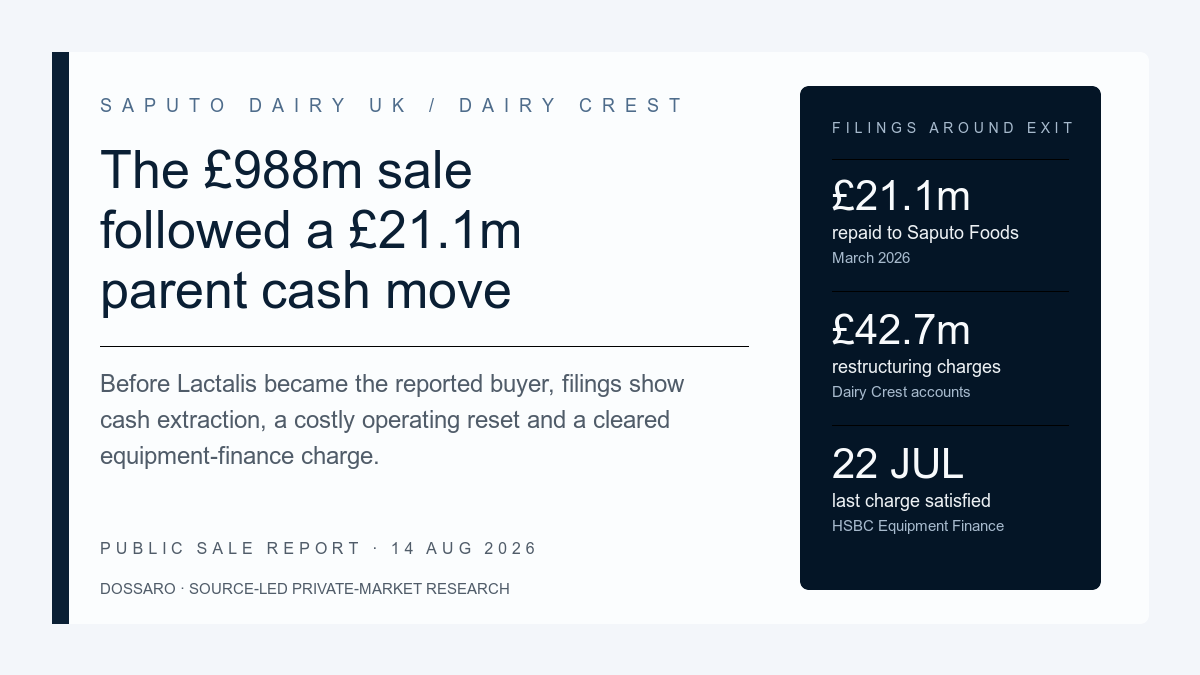
Saputo’s reported £988 million sale of its UK dairy business to family-owned Lactalis was preceded by a sequence that changed the economic reading of the exit. Companies House filings show a £21.107684 million cash repayment to Saputo’s parent in March, while operating company Dairy Crest Limited reported EBITDA of £47.2 million alongside £42.7 million of restructuring charges. On 22 July, Dairy Crest also filed to satisfy its last registered equipment-finance charge.
The sequence is documented. The stronger interpretation, that Saputo was preparing the perimeter for a sale, remains an inference. No public transaction agreement ties the cash repayment, site consolidation or charge release to Lactalis. The useful finding is therefore narrower: the £988 million headline came after cash had moved up to the parent, operations had been reset at a substantial cost and the operating company’s filed collateral position had been cleaned up.
| Preparation step | Date or amount | Filing fact | What it changes in the deal reading |
|---|---|---|---|
| Share-premium repayment | 9–10 Mar 2026; £21.107684m | Saputo Dairy UK Ltd resolved to repay cash to sole shareholder Saputo Foods Limited | Value moved to the parent before the sale was reported |
| Operating reset | Latest filed accounts; £47.2m EBITDA and £42.7m restructuring | Dairy Crest reported higher EBITDA but a £32.6m loss and site-consolidation costs | The business was improving operationally while absorbing a costly reset |
| Charge satisfaction | 22 Jul 2026 | MR04 satisfied HSBC Equipment Finance’s charge created 30 Jul 2021 | The last registered operating-company charge disappeared shortly before sale coverage |
The public sale and the private-company perimeter
FoodBev Media reported on 14 August that Saputo had agreed to sell its UK dairy division to Lactalis for approximately £988 million, with completion expected by the end of the first quarter of 2027, subject to customary closing and regulatory approvals. The report described five manufacturing facilities and brands including Cathedral City, Wensleydale, Davidstow, Clover and Country Life. It also put the UK division’s revenue at about $1.2 billion over the last four quarters, roughly 7% of Saputo’s group revenue.
The exact legal perimeter is not published in the public sources available for this run. Saputo’s corporate contact page identifies Dairy Crest Limited, company number 02085882, as trading as Saputo Dairy UK. Saputo Dairy UK Ltd, company number 11834952, is the relevant holding-company record for the March capital filing. The two entities should not be collapsed into one company or treated as proof that the public £988 million maps exactly to Dairy Crest Limited.
That distinction matters to transaction analysis. A division sale can include several subsidiaries, contracts and assets, while the seller may also move cash or settle financing outside the exact sale perimeter. Dossaro’s Hometrack analysis likewise separated a pre-sale cash distribution from the later transaction, although Dairy Crest’s sequence adds an operating and collateral reset. The public sale number is a headline enterprise fact. The filings below show the balance-sheet and operating events around it, not a completion statement.
Saputo moved £21.1 million to its parent
On 9 March 2026, Saputo Dairy UK Ltd resolved to reduce its share-premium account by £21,107,684 and repay that amount in cash to its sole shareholder, Saputo Foods Limited. The corresponding SH19 filing was filed at Companies House on 10 March. It records 774,824 ordinary shares with aggregate nominal value of £774.824 million after the reduction.
This is a direct, dated movement of cash out of the UK holding company to its parent. It is not evidence of a dividend from Dairy Crest Limited, and it does not show whether the cash was inside or outside the assets transferred to Lactalis. It does establish that part of the group’s value was distributed before the public sale report.
The benign explanation is ordinary group treasury management. A share-premium reduction can return capital without being connected to a sale. The filing does not mention Lactalis, a transaction agreement or a price adjustment. The responsible claim is therefore about timing and cash movement, not about reducing the buyer’s consideration.
Dairy Crest improved EBITDA inside a costly reset
Dairy Crest Limited’s latest filed accounts show an operating business moving in two directions at once. Revenue rose to £668.6 million from £639.3 million, and EBITDA increased to £47.2 million from £23.0 million. Yet the company reported a £32.6 million loss, compared with a £12.8 million loss in the preceding period, and recorded £42.7 million of restructuring charges. Equity stood at £451.2 million, and the accounts reported no dividend.
The accounts describe the decision to stop functional dairy ingredients, close packing operations at Frome and consolidate activity into Nuneaton. Additional packaging activity moved from Kirkby Malzeard. The programme brought impairment and restructuring effects into the reported result. In other words, the business had a stronger EBITDA line while management was still paying to change the footprint.
That combination matters for a buyer. Higher EBITDA can support a stronger operating narrative, but a loss and large restructuring charge show that the earnings base was not a frictionless, fully settled asset. The filings do not say that the consolidation was undertaken for Lactalis, nor do they disclose a sale-adjusted EBITDA or the treatment of the restructuring in the £988 million price. They show a business being operationally reconfigured before ownership changes.
The last registered equipment charge disappeared in July
On 22 July 2026, Dairy Crest Limited filed an MR04 fully satisfying an HSBC Equipment Finance charge created on 30 July 2021. The company’s charges register shows two registered charges in total, both satisfied. The July filing therefore removed the operating company’s last registered charge 26 days before FoodBev’s sale report.
Charge satisfaction is not the same as proving a transaction condition. An equipment-finance facility can be repaid in the ordinary course, and the Companies House record does not disclose the source of repayment. But the timing is economically relevant: the public record moved from a live registered security interest to a clear charge register immediately before the reported disposal.
For a buyer and its lenders, a clear register simplifies diligence and the description of the assets being transferred. It can also be entirely routine. What the filing supports is a collateral clean-up in the documented sequence, not a claim that Lactalis required HSBC’s release.
A prepared perimeter, not a blank slate
The three events fit together as a sequence: cash moved from Saputo Dairy UK Ltd to Saputo Foods Limited in March; Dairy Crest’s accounts captured a footprint reset with £42.7 million of restructuring charges; and the last registered operating-company charge was satisfied in July. Lactalis then became the reported buyer of the UK dairy division for approximately £988 million.
The commercial consequence is a more precise starting point for valuing the disposal. Analysts should ask which entities, cash balances, leases, financing obligations and restructuring liabilities were included in the sale perimeter. A headline price can describe a prepared package after cash extraction and collateral clean-up, while the operating company’s accounts still carry the cost of getting there.
This is not a claim that Saputo engineered every step for sale preparation. The share-premium repayment and MR04 may be ordinary treasury and financing events, and the site changes may reflect a standalone ingredients strategy. There is no public agreement connecting them to Lactalis. The evidence is strong on the dates, amounts and sequence, but only medium on the motive.
That boundary is also why the £988 million cannot be translated into a precise value for Dairy Crest Limited. The sale may cover more than the legal operating company, and the public sources do not publish debt-and-cash adjustments, completion accounts or proceeds allocation. The next decisive documents are the sale agreement, completion statement, the latest accounts for each entity in the perimeter and any repayment or release papers connected to the transaction.
Before Saputo’s UK dairy sale became a £988 million headline, its filings showed a parent repayment of £21.1 million, an operating reset that absorbed £42.7 million while EBITDA doubled to £47.2 million, and a final registered charge disappearing from Dairy Crest’s record. That is not proof of a hidden condition. It is evidence that Lactalis was buying a business after a documented cash, operating and collateral reset.
Continue reading
Related Research
Hometrack Paid A £29.3m Dividend Before The Providence Sale
Hometrack paid a £29.3m group dividend before Providence's deal, equal to 4.94 times annual profit as reported earnings fell 43% and net assets fell £20.9m.
Vista's Quantios Deal Crosses £92m Of On-Demand Group Liabilities
Vista's Quantios deal crosses £92m of on-demand group payables and registered Jersey-share security created 69 days before the sale announcement.
Plend's £50m Headline Is A Secured Refinancing, Not £50m In Cash
Plend has £20m committed, not £50m in cash. Filings show a first charge over the whole business, a surviving Fair4All lien and junior capital.
The Reported $5.4bn ebm-papst Sale Still Runs Through Three Equal Family Legs
Before Madison Air agreed to buy ebm-papst for a reported $5.4bn, the German register still showed three equal family vehicles after a 2025 legal-form reset.