
Hometrack Paid A £29.3m Dividend Before The Providence Sale
Hometrack paid a £29.3m group dividend before Providence's deal, equal to 4.94 times annual profit as reported earnings fell 43% and net assets fell £20.9m.
On this page
Conduct your own private market research
Add dossaro to Claude or ChatGPT and run source-backed register research from your own workspace.
 Add to Claude
 Add to ChatGPT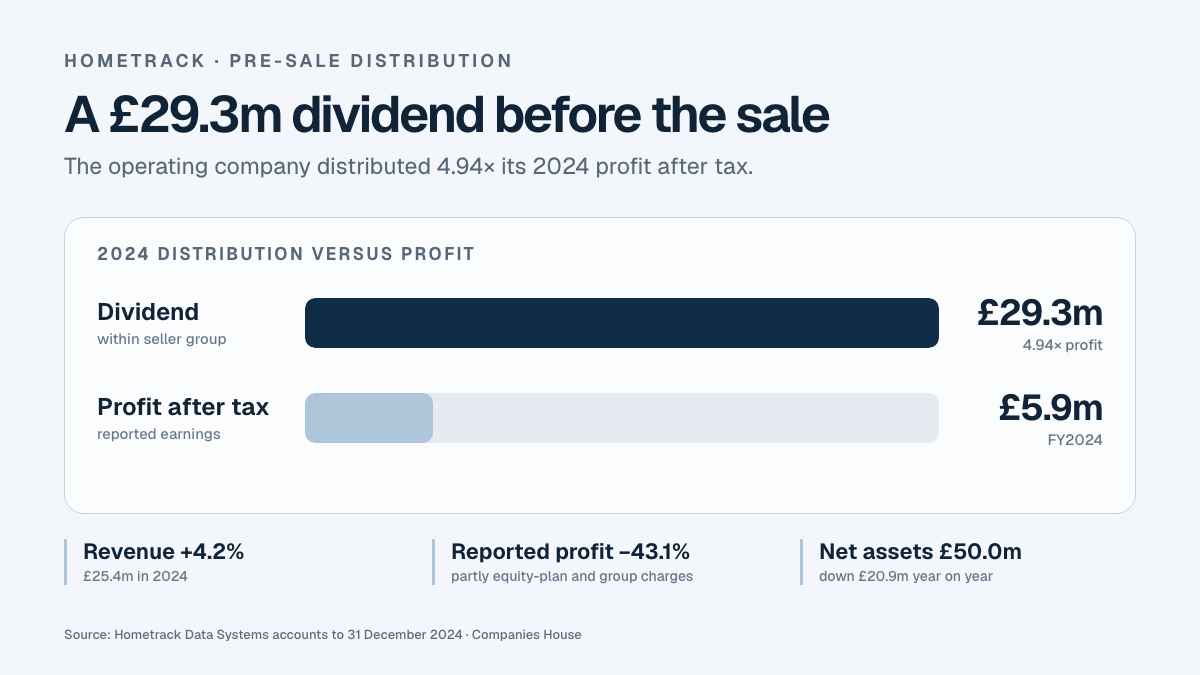
Hometrack Data Systems paid a £29.277 million dividend within the Silver Lake-owned Houseful group before Providence Equity agreed to acquire the property-data business.
The distribution was almost five times Hometrack Data Systems' £5.928 million profit after tax for 2024. It was also larger than the £20.921 million fall in the operating company's net assets, which ended the year at £49.961 million.
The dividend changes the economic reading of the sponsor-to-sponsor transaction. Providence is not simply buying a profitable data asset from another private-equity owner. It is buying the business after the seller's group had already crystallised material cash value from the operating company.
That does not mean Silver Lake received £29.277 million directly. The filing identifies a dividend and the control chain, not its ultimate destination inside the wider group. It also does not show that debt funded the distribution or reveal whether it affected Providence's purchase price.
The Dividend Was 4.94 Times Annual Profit
Hometrack Data Systems' accounts for the year ended 31 December 2024 record the dividend in both the directors' report and the statement of changes in equity.
| Hometrack Data Systems measure | 2024 | 2023 | Change |
|---|---|---|---|
| Revenue | £25.426m | £24.404m | +4.2% |
| Operating profit | £5.761m | £10.566m | -45.5% |
| Profit after tax | £5.928m | £10.425m | -43.1% |
| Dividend | £29.277m | Nil | £29.277m increase |
| Net assets | £49.961m | £70.882m | -£20.921m |
Dividing the £29.277 million distribution by £5.928 million of profit gives 4.94. The comparison does not make the dividend improper or turn it into a return multiple. It shows the scale of cash distributed relative to the earnings retained in the operating company that year.
The equity movement can be reconciled directly. Hometrack began 2024 with £70.882 million of net assets, generated £5.928 million of profit and recorded £2.428 million of share-based-payment reserves. The £29.277 million dividend then brought year-end net assets to £49.961 million.
Revenue Grew While Reported Profit Nearly Halved
The accounts do not describe a contracting top line. Revenue increased 4.2%, driven by new contracts, more automation within existing contracts, new products and higher revenue negotiated on key renewals.
Reported earnings moved in the opposite direction. Operating profit fell 45.5% and profit after tax fell 43.1%.
The filing gives a more nuanced explanation than simple trading deterioration. It attributes the profit decline mainly to increased share-based payments following new joiners to a management equity plan, a changed allocation of the ZPG Property Services Holdings charge, and investment in staff to develop products and win new business.
The share-based-payment charge alone rose from £152,000 to £2.428 million. That is a non-cash accounting cost tied to employee equity awards from a parent company. It explains part of the earnings decline, but not all of it.
This distinction matters for Providence. Hometrack's reported profit fell sharply, yet the accounts still show a profitable company with growing revenue and an important position in mortgage decisioning. Hometrack says its valuation models, property-risk data and decisioning software contribute to nearly all of the United Kingdom's 1.4 million annual mortgage approvals.
Cash Was Swept Into The Wider Group Every Day
Hometrack Data Systems reported no cash at either the 2024 or 2023 year-end. The reason was not that customers stopped paying or the company had no access to funds.
Under Houseful's treasury arrangement, cash was swept daily to an intermediate holding company. Hometrack recorded the transfers through intercompany balances and said it could call on the pooled funds on demand. It also used the pool as short-term finance for operations and future development.
That structure centralised liquidity outside the operating company. It does not prove distress or debt-funded extraction. Hometrack described its financial position as strong and reported £4.960 million of net current assets.
The arrangement does make the operating company's stand-alone cash balance a poor guide to group liquidity. A purchaser must understand both the legal company it is buying and the treasury system around it. That is the same distinction visible in Dossaro's analysis of the operating base behind WestBridge's Beckett deal: a sponsor transaction becomes more useful when the entity, earnings and internal funding structure are separated.
The Seller Had Already Crystallised Cash Value
Providence's acquisition agreement was reported by PE Hub on 14 August and independently included in Axios Pro Rata's deal roundup. No transaction price has been disclosed in the approved evidence pack.
The last public benchmark is historical. ZPG agreed to buy Hometrack for £120 million in 2017, on a cash-free and debt-free basis. Silver Lake then acquired ZPG in 2018, placing Hometrack inside the current seller group.
Those figures cannot be combined into a sponsor return. The 2017 price predates Silver Lake's acquisition of the wider ZPG group, while the 2026 Providence consideration, debt allocation and completion accounts are private. The £29.277 million dividend is a verified operating-company distribution, not a complete measure of seller proceeds.
Still, its commercial significance is clear. By the time Providence agreed the purchase, the seller's group had already moved cash out of Hometrack Data Systems on a scale far above one year's profit. The operating company remained viable and profitable, but it entered the transaction with £20.921 million less net assets than a year earlier.
Ordinary Capital Management Is A Credible Counter-Reading
Companies with accumulated distributable reserves can return surplus capital to their parent. Hometrack had more than £70 million of opening net assets, remained profitable after the dividend and retained nearly £50 million of equity. A large distribution can therefore be ordinary group capital management rather than evidence of financial engineering that weakened the business.
The profit comparison also needs care. Management-equity charges and group cost allocation made the 2024 income statement less directly comparable with 2023. Product and staff investment may support future growth even when it reduces current profit.
Providence may therefore be buying a business whose underlying commercial performance is stronger than the reported profit decline suggests. The filing supports that benign reading alongside the cash-distribution finding.
What it does not support is ignoring the sequence. The £29.277 million distribution occurred before the sale agreement and reduced the retained equity inside the operating company. Whether Providence priced that movement into the deal remains unknown.
The 2025 Accounts Will Test The Earnings Recovery
The next decision-changing evidence comes from three places.
First, completion and post-close control filings should show Providence's final acquisition perimeter and when legal control changes. Second, Houseful's wider accounts could show how the dividend moved through the group and whether it sat beside other distributions or debt movements. Third, Hometrack Data Systems' accounts for 2025, due by 30 September 2026, should show whether reported profit recovered after the equity-plan and cost-allocation effects.
The 2024 accounts also reveal valuation sensitivity inside Hometrack. A 0.5 percentage-point increase in the pre-tax discount rate would have triggered a £2.024 million impairment of its subsidiary investment. A 10% reduction in forecast earnings would have triggered a £4.812 million impairment. Those are accounting sensitivities, not forecasts, but they show how quickly valuation headroom could narrow.
Until the missing documents arrive, the defensible conclusion is precise. Hometrack Data Systems paid a £29.277 million dividend within the Silver Lake-owned group before Providence's acquisition agreement. The distribution equalled 4.94 times annual profit, while revenue grew and reported profit fell sharply for reasons that included equity-plan charges, group allocations and investment. It is verified pre-sale cash extraction, but not yet a verified sponsor return.
Continue reading
Related Research
WestBridge Is Buying Beckett After Pre-Tax Profit Roughly Doubled
WestBridge is buying Beckett after filings showed £13.1m of turnover and pre-tax profit roughly doubled across Foresight's acquisition-led build-up.
Resurgens Took Majority Control Of Qarma As Founders Kept 25–40%
Resurgens took majority control of Qarma through two new vehicles while three continuing shareholder vehicles retained a combined registered band of 25–40%.
Vista's Quantios Deal Crosses £92m Of On-Demand Group Liabilities
Vista's Quantios deal crosses £92m of on-demand group payables and registered Jersey-share security created 69 days before the sale announcement.
iwoca Funded £14.5m Of Shareholder Liquidity Before A Possible Sale
Before a possible £1 billion sale, iwoca funded about £14.5 million of shareholder purchases while Series D ranked first in the visible exit waterfall.