
Phantasma’s €2.6m Round Makes Factory Access Visible Before Control
Phantasma Labs says Jet supplied €2.1m of a €2.6m round, while its last shareholder list shows founder transfers and a 37.72% outside block.
On this page
Conduct your own private market research
Add dossaro to Claude or ChatGPT and run source-backed register research from your own workspace.
 Add to Claude
 Add to ChatGPT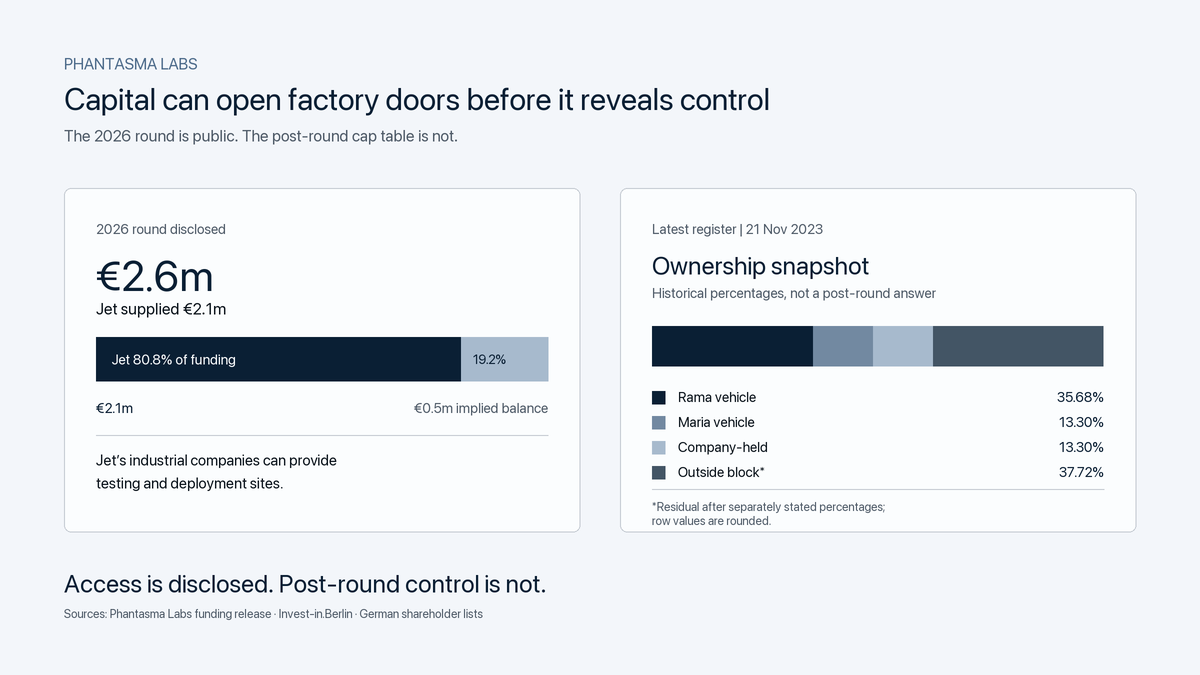
Phantasma Labs says Jet Investment supplied €2.1 million of its €2.6 million funding round and will put the software into factories owned by its industrial portfolio. The cheque is therefore also an access route to production environments. What the announcement does not show is how much ownership or control Jet received.
The distinction matters because the last available German shareholder list already showed a financing history that was more complicated than a founder-only company. The 21 November 2023 filing recorded Rama Nanjundaiah Ventures UG at 35.68%, Maria Meier Ventures UG at 13.30%, Phantasma Labs itself at 13.30% and the remaining investors at a residual 37.72%. A 6 October 2022 list had shown the two founder-linked vehicles at 31.14% each, with the same residual outside block after rounding.
Those filings predate the 2026 round, so they cannot answer Jet’s post-round percentage. They do establish the starting line: Phantasma enters the new financing with a transfer-shaped, externally financed register. Jet’s manufacturing network may be as important to the company’s next phase as the €2.1 million itself.
Jet’s cheque is also a factory-access agreement
Phantasma’s 1 September announcement names Jet Venture 1 SICAV as the source of €2.1 million. Lighthouse Seed Fund II joined the round and existing investor Momenta Ventures continued its backing. The company says Jet became the largest single investor, but it does not publish an issue price, valuation, instrument type or resulting share count.
| Disclosed round fact | Amount or status | What it supports |
|---|---|---|
| Total new funding | €2.6m | The size of the announced round |
| Jet Venture 1 investment | €2.1m | Jet supplied about 80.8% of the disclosed cash amount |
| Other disclosed participants | €0.5m implied balance | Lighthouse Seed Fund II and continued Momenta backing are named; the split is not disclosed |
The €0.5 million balance is a simple subtraction from the company’s €2.6 million total. It is not an allocation between Lighthouse and Momenta, because the announcement gives no such split. Likewise, €2.1 million divided by €2.6 million is about 80.8%. That is Jet’s share of the announced financing amount, not its share of Phantasma’s equity.
An independent Invest-in.Berlin report confirms the same amounts, investor group and Jet’s status as the largest single investor. It also repeats the operational detail that Jet’s own manufacturing companies can provide testing and deployment sites. The independent account does not add terms for the financing or a post-money cap table.
That deployment channel changes the commercial meaning of the round. Phantasma’s AiPS platform is designed to replan factory schedules as machine capacity, labour, changeovers, priorities or supply conditions change. A system that can be tested on a real shop floor can generate evidence that is difficult to produce in a sales demo. It can also expose integration costs, implementation risk and the limits of the model before a wider enterprise rollout.
The last register was already investor-shaped
The exact legal entity is Phantasma Labs GmbH, Berlin, registered with the local court of Charlottenburg as HRB 205639 B. The German register portal lists the shareholder materials used for the historical comparison. The 6 October 2022 list states total nominal capital of €35,681 and identifies the two founder vehicles at 31.14% each. The 21 November 2023 list also ends with €35,681 of nominal capital and records the changes as acquisitions or transfers.
| Holder or block | 6 October 2022 list | 21 November 2023 list | Reading |
|---|---|---|---|
| Rama Nanjundaiah Ventures UG | 31.14% | 35.68% | Largest single named holder in the latest list |
| Maria Meier Ventures UG | 31.14% | 13.30% | Founder-linked vehicle with a lower stated position |
| Phantasma Labs GmbH | Not shown | 13.30% | Company-held entry marked “Anteilserwerb” |
| Other named investors, residual | 37.72%* | 37.72%* | Existing external block, derived as the remainder |
*The residual is 100% less the separately stated holder and company-held percentages. The individual rows in the lists are rounded, so adding every displayed percentage can produce a one-hundredth difference.
The 2022 outside block was made up of Entrepreneur First vehicles, APEX Ventures, VC Fonds Technologie Berlin, Signals Venture Capital, wi venture EAF, Make, Janoodle and Fund VII Corporation. In the 2023 list, the same broad investor set remained visible while the founder and company-held entries changed. The filing does not say that the 2023 changes were a new external financing round. It labels the changed entries as transfers or acquisitions.
This is why the register evidence is useful even though it is not current. It shows that Jet is not entering an empty cap table. The company had already taken outside capital and had already moved shares between founder-linked and company-held positions. The 2026 financing may add new shares, convert an earlier instrument, or combine equity with another form of capital. The public sources do not select among those possibilities.
The 80.8% figure is a funding share, not an ownership share
Funding headlines often invite a quick but invalid conversion from cheque size to control. Here the temptation is particularly strong: Jet supplied about four-fifths of the announced cash and became the largest single investor. But an investor’s share of a round depends on the issue price and the other participants’ subscriptions. Its share of the company depends on the pre-money valuation, the instrument’s conversion terms and any existing rights.
The 2023 list illustrates the gap. Rama’s vehicle was the largest individual holder at 35.68%, but its percentage was not the same thing as its share of all historic funding. The outside block held 37.72% in aggregate, but it was spread across several funds and vehicles that may have invested at different times and prices. Nominal share percentages do not reveal liquidation preferences, voting agreements, board appointment rights or the economic value of any preferred instrument.
The same separation is important for the Jet round. A €2.1 million subscription could represent a large or small ownership percentage depending on Phantasma’s valuation and whether Lighthouse and Momenta invested on the same terms. A convertible note could leave the post-round ordinary-share list unchanged until conversion. A strategic investment could include commercial rights that matter more than the nominal stake. None of those terms is public in the announcement or the independent coverage.
The INLEAP funding and cap-table analysis shows a similar diligence trap from another angle: a cumulative financing headline can sit above a precise but historical shareholder snapshot. Phantasma adds a strategic-access dimension. The investor that can open production sites may create evidence of product-market fit before a later filing makes its ownership legible.
Founder transfers changed the starting line
The movement between the two lists is not a footnote. In 2022, Rama Nanjundaiah Ventures UG and Maria Meier Ventures UG each held 31.14%. In 2023, Rama’s vehicle was at 35.68%, Maria’s at 13.30% and the company appeared at 13.30%, each change marked as an acquisition or transfer in the list.
That sequence means the founder picture was already changing before Jet’s announcement. It is not possible to infer from the list why the transfers occurred, whether the company-held shares carried voting rights in the same way as the other entries or whether any shareholder agreement governed them. The safe conclusion is narrower: the latest historical register records a larger Rama Nanjundaiah Ventures UG block, a smaller Maria Meier Ventures UG block and a company-held entry alongside the existing outside investors.
The structure matters for negotiations. If the 2026 round is primary equity, dilution will be allocated across that 2023 base. If it is a conversion, the relevant price and discount may have been set before Jet arrived. If it includes secondary transfers, the cash may not all have gone into the company. The release’s €2.6 million headline alone cannot distinguish those cases.
Industrial validation arrives before a control answer
Jet’s most concrete contribution is not a board seat or a disclosed voting right. It is the promise that its industrial companies will serve as testing and deployment sites. Kamil Levinský, managing director of Jet Ventures, said the investor can evaluate the technology on its own shop floors rather than taking it on trust. Phantasma founder and CEO Ramakrishna Nanjundaiah described real factories as the proof point an industrial software company needs.
That arrangement can reduce a major commercial risk. Production scheduling software has to connect with existing enterprise resource planning and manufacturing execution systems, absorb incomplete data and respond to disruptions that were not present in a training set. A portfolio-factory deployment can produce reference customers, implementation playbooks and measurable performance evidence. It can also reveal whether the software’s seconds-level replanning claim survives the messy conditions of a live operation.
The strategic benefit does not prove control. Jet’s portfolio access can be available under a commercial partnership rather than an ownership right. Conversely, a minority investment can carry strong consent or information rights even when its percentage is modest. The public record does not disclose either side of that bargain.
This is the central economic reading of the round. Jet has concentrated exposure to the financing amount and a credible route to operational validation. Phantasma’s last filed register shows a company already shaped by outside investors and founder-linked transfers. Together, those facts make access visible and control unresolved.
The next filing is the economic test
The decision-changing document is a post-round shareholder list or capital filing for Phantasma Labs GmbH. It should show whether Jet Venture 1, Lighthouse or another vehicle entered the register, whether the company-held position changed and how the founder vehicles were diluted. A deed or subscription document could also distinguish a new issue from a conversion or secondary transfer.
Until that filing appears, the evidence supports a narrower conclusion. Phantasma says it raised €2.6 million, with Jet supplying €2.1 million and offering access to industrial factories. The latest available shareholder list shows a 35.68% Rama Nanjundaiah Ventures UG block, a 13.30% Maria Meier Ventures UG block, a 13.30% company-held entry and a 37.72% residual outside block after earlier transfers. Jet’s 80.8% share of the announced financing amount is not an 80.8% ownership claim. The next register update will show whether the industrial bet also changed who can decide Phantasma’s future.
Sources
This analysis uses Phantasma Labs’ official funding announcement, Invest-in.Berlin’s independent coverage and the German Handelsregister portal. The historical shareholder percentages come from the 6 October 2022 and 21 November 2023 shareholder lists for Phantasma Labs GmbH, Berlin HRB 205639 B. No post-round ownership, valuation, instrument terms, voting rights or beneficial ownership is inferred.
Continue reading
Related Research
INLEAP’s €20m Funding Headline Was Cumulative; Founders Held 80% in the 2025 List
INLEAP says it has raised about €20m since founding, while its latest filed shareholder list shows founder holding companies with 80% and outside holders with 20%.
Advanced Electric Machines’ £16m Funding Is a Parent-Level Equity and Debt Stack
AEM's £16m funding headline combines parent-level preferred equity with government-backed debt secured over the operating company's IP, receivables and assets.
Uplift Ventures’ €100m Fund Is A Layered Jungheinrich Platform
Uplift Ventures’ €100m fund sits inside a Jungheinrich-backed platform with separate GP, management and partner vehicles, not one undifferentiated pool.
HyImpulse's €50m Round Lands on a 76.43% Holding Block
HyImpulse's €50m financing meets a register where HylImpulse Holding and Schwarz Holding held 76.43% before the round, leaving post-round control unresolved.