
Nouscom’s €120m Series D Was a Two-Step Capital Stack
Nouscom’s €120m Series D followed a 245,428-share conditional-capital block and a smaller D-preferred issue, changing how dilution is read in practice.
On this page
Conduct your own private market research
Add dossaro to Claude or ChatGPT and run source-backed register research from your own workspace.
 Add to Claude
 Add to ChatGPT
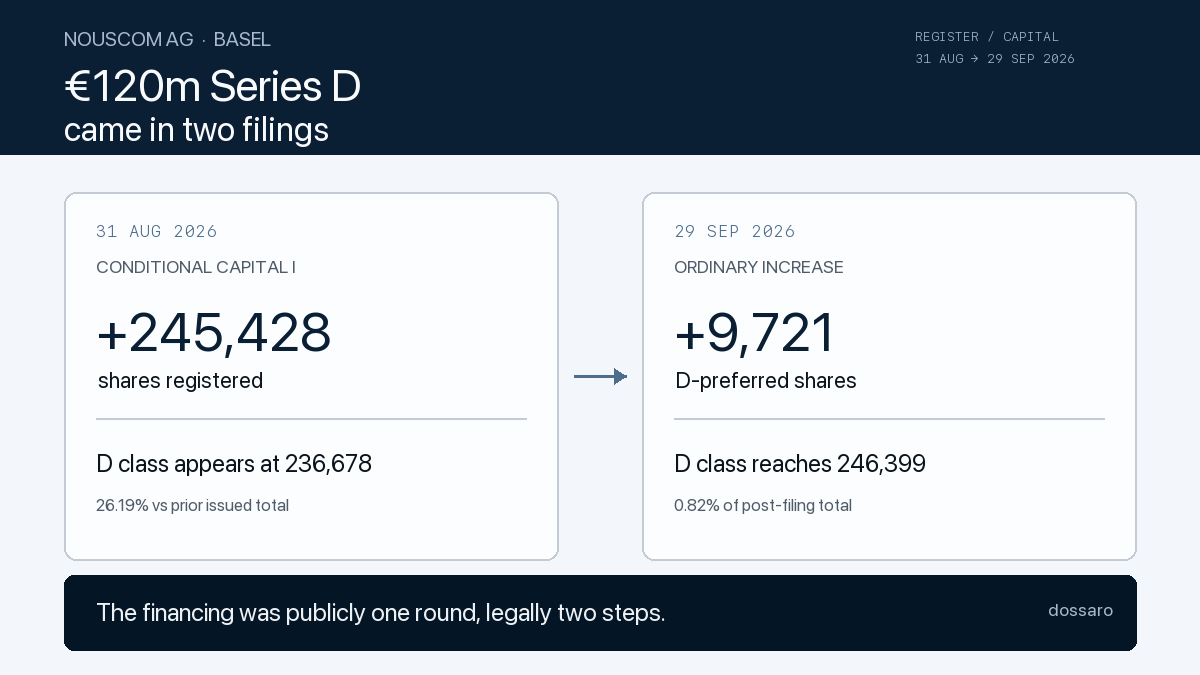
Nouscom’s announced €120 million Series D was publicly one financing round, but the Swiss register records it as a two-step capital-stack event. On 31 August 2026, the Basel biotech registered a 245,428-share increase that created a 236,678-share D-preferred class and expanded its conditional-capital framework. On 29 September, it added another 9,721 D-preferred shares through an ordinary increase.
That sequence matters more than the headline amount. It changes the denominator used to read dilution, adds a preference class with stated rights around new subscriptions and liquidation proceeds, and arrives alongside a board refresh. The filings still do not identify investor-by-investor allocations, issue price, premium, cash paid or fully diluted ownership. What they do show is that the legal mechanics were assembled before the financing announcement, not recorded as one clean visible issuance.
The financing headline and the register are answering different questions
Nouscom announced the closing on 19 October 2026. The company said M Ventures and Revelation Partners co-led an oversubscribed €120 million round, with Angelini Industries, the European Investment Bank through Aurea, Neva SGR and existing life-sciences investors participating. The stated use is advancement of NOUS-209, an investigational off-the-shelf neoantigen immunotherapy, into a global registration-enabling trial for cancer interception in Lynch Syndrome carriers.
The announcement is the right source for the commercial event and its stated purpose. It does not purport to publish a Swiss statement of capital, a subscription schedule or a post-money ownership table. That is why a register check adds a different layer of information. It can show when a class was created, how many shares were registered and what preference language entered the articles, even when the financing announcement uses one round name.
The independent coverage is consistent on the amount and purpose. Fierce Biotech’s fundraising tracker lists Nouscom’s Series D at $135 million and names the lead investors. VISCHER’s transaction note confirms that the law firm advised Nouscom AG on the €120 million financing and repeats the investor group. Neither source supplies the Swiss share-by-share mechanics.
A 245,428-share block arrived before the public announcement
The key filing is Swiss Official Gazette of Commerce publication 1006748373, tied to a 31 August 2026 articles and capital decision and published on 4 September. It moves nominal share capital from CHF 796,539.25 to CHF 1,005,153.05. The statement of capital lists 204,217 common shares, 120,000 A-preference shares, 251,496 B-preference shares, 370,142 C-preference shares and 236,678 D-preference shares.
The preceding statement of capital listed 195,467 common shares and no D class. The total issued share count therefore rises from 937,105 to 1,182,533, an increase of 245,428 shares, or 26.19%. That is a registered-share comparison, not a cash calculation and not a fully diluted ownership percentage. The filing describes the increase as coming from conditional capital I, records a new conditional capital IV decision and restores a capital-band framework.
The same filing says the preference shares carry rights concerning dividends, subscription to new shares and liquidation proceeds. The prior wording referred to subscription and liquidation rights but not dividends. That change is commercially important: the class architecture can affect both future participation and the order in which value is distributed, even though the public sources do not disclose the detailed waterfall.
The filing also removes two directors, Jean-Paul Prieels and Joachim Rothe. Those departures appear in the same capital publication, so the equity change and governance change should be read together. The register does not say that the departures were caused by the financing or identify a negotiated board bargain.
The second step was much smaller, but it completed the visible D class
Publication 1006777883 records a 29 September 2026 ordinary increase, published on 8 October. It raises nominal capital from CHF 1,005,153.05 to CHF 1,013,415.90 and increases D-preferred shares from 236,678 to 246,399. The incremental issue is 9,721 shares, just 0.82% of the 1,192,254 shares outstanding after that filing.
The chronology is therefore clear:
| Register date | Legal move | Share effect | Why it matters |
|---|---|---|---|
| 2 Nov 2023 | Ordinary increase within the capital band | Total to 811,133 shares | Establishes the earlier A, B and C preference structure |
| 27 Feb 2024 | Ordinary increase | Total to 854,546 shares | C-preferred class expands |
| 24 Oct 2024 | Conditional-capital increase | Total to 926,149 shares | Common share count rises to 184,511 |
| 26 Sep 2025 | Conditional-capital increase | Total to 937,105 shares | Common share count rises to 195,467 |
| 31 Aug 2026 | Conditional capital I, conditional capital IV and ordinary increase | +245,428; total 1,182,533 | D class appears at 236,678; preference rights expand |
| 29 Sep 2026 | Ordinary increase within the capital band | +9,721; total 1,192,254 | D class reaches 246,399 |
The earlier filings are not filler. They show that Nouscom has used several legal routes to build its capital structure. Publication 1005881004 moves the 2023 total from 635,955 to 811,133 shares and sets out A, B and C classes. Publication 1005986754 raises the total to 854,546 and expands C. Publications 1006168592 and 1006448944 document further conditional-capital increases before the D class appears. Those steps make the 2026 increase legible as a continuation of an existing architecture rather than an isolated number.
The board was refreshed immediately after the capital sequence
Publication 1006775199, based on a 1 October 2026 board decision and published on 6 October, records Paolo Di Giorgio, Doug Fisher, Paolo Fundarò, Neil Gallagher and Andreas Wallnöfer as directors with collective signing authority. It follows the 31 August departures and precedes the 19 October financing announcement.
The timing is a useful diligence signal, not proof of a board-control transfer. A board refresh can accompany a new investor group, a clinical-development phase or routine governance work. The filing identifies the people and signature rule. It does not identify who nominated them, whether any investor received a board seat as part of Series D or whether the new directors represent a particular ownership block.
The same caution applies to the share classes. A D-preferred class is evidence of a legal priority layer. It is not a statement that one named investor owns all D shares, that every D share was issued for cash or that the class has a particular liquidation multiple. Those terms would sit in the articles, subscription agreements or shareholder resolutions beyond the published statement of capital.
What the two-step sequence changes for diligence
For existing shareholders, the first-order issue is denominator risk. The 31 August filing adds 245,428 issued shares before the market sees the €120 million headline. A holder comparing an old percentage with the post-round total can be diluted even before any later option, warrant or conversion is considered. The 29 September issue is smaller, but it confirms that the D class was still being built after the large conditional-capital block.
For new investors, the key question is priority rather than the press-release amount. The 31 August filing says preference shares now carry dividend, subscription and liquidation rights. That means a cash investor, a converting holder or a future buyer may sit in a different economic position from common shareholders. The public record supports the existence of that layer, but not its detailed payout order.
For employees and counterparties, the board sequence matters because legal authority and operational accountability can change at the same time as the share base. The refreshed board has collective signing authority. The register does not connect that authority to clinical milestones, investor covenants or management changes, so those would be separate questions for diligence.
This is the same reason a financing cannot be read from a headline alone. OMass’s Series C preference reset shows how a new class can change downside order even when the round amount is public. Salience Labs’ staged-control filings show the related governance problem: the legal sequence can reveal influence without publishing a complete cap table. Nouscom adds a biotech case where a conditional-capital block and a later ordinary issue sit around one announced Series D.
The evidence boundary is the point, not a footnote
The register supports five bounded findings. Nouscom’s 19 October announcement describes an oversubscribed €120 million Series D for NOUS-209. The 31 August Swiss filing registers 245,428 additional shares and introduces 236,678 D-preferred shares within a larger conditional-capital and capital-band decision. The 29 September filing adds 9,721 further D-preferred shares. The articles now state preference rights around dividends, new subscriptions and liquidation proceeds. A 1 October board filing refreshes the directors and collective signing authority.
The documents do not establish the issue price, premium, investor allocations, cash paid, post-money valuation, fully diluted ownership, liquidation multiple or board nomination rights. They also do not prove that the 31 August registered block and the 29 September issue map one-for-one onto the €120 million cash proceeds. The commercial announcement and the legal record are compatible, but they answer different questions.
The next document that would materially change the analysis is a filed statement of capital or shareholder resolution that identifies subscribers and the terms attached to the D class. Updated articles or an investor notice setting out the preference waterfall would clarify economic priority. Until then, the defensible conclusion is precise: Nouscom’s Series D was announced as one €120 million financing, while the Swiss register shows a large conditional-capital block followed by a smaller D-preferred issue and a board refresh.
Sources
Continue reading
Related Research
OMass’ $310m Series C Added a £40m C-1 Preference Layer
OMass’s $310m Series C included a £1 deferred-share cancellation and a £40m Series C-1 issue with priority rights, exposing a new downside layer.
Salience Labs’ $125m Series B Was Split Across 23 Allotment Lines
Salience Labs’ $125m Series B spans 23 UK allotment lines worth about £125m, while Oxford Science Enterprises left the PSC record before the issue.
Noah’s $16m Extension Leaves the UK Capital Stack Nearly Unchanged
Noah’s $16m seed extension added only 3,150 visible UK shares, while two corporate ordinary blocks still anchor its UK capital stack and control records.
HyLight’s €13m Series A followed a 36,000-share debt-to-equity reset
French filings show HyLight converted creditor claims into 50,000 shares before its €13m Series A, changing the financing risk visible to new investors.