
HyLight’s €13m Series A followed a 36,000-share debt-to-equity reset
French filings show HyLight converted creditor claims into 50,000 shares before its €13m Series A, changing the financing risk visible to new investors.
On this page
Conduct your own private market research
Add dossaro to Claude or ChatGPT and run source-backed register research from your own workspace.
 Add to Claude
 Add to ChatGPT
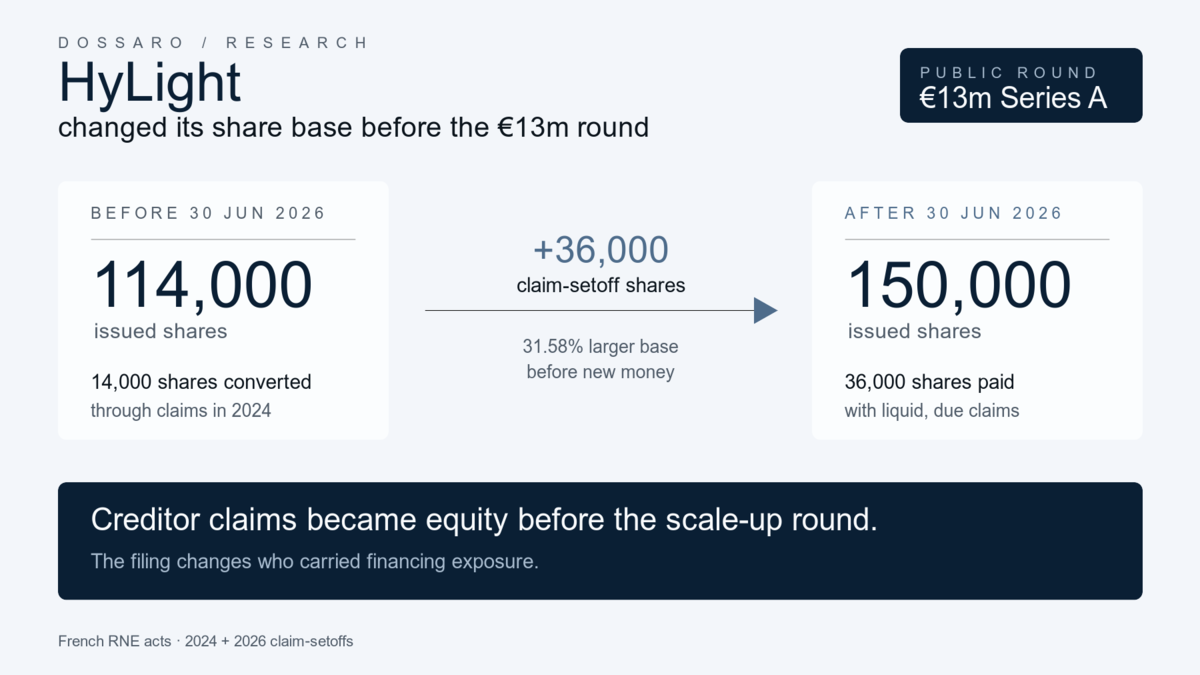
HyLight’s €13 million Series A arrived after the French company had already turned creditor claims into equity. A 30 June 2026 capital increase added 36,000 ordinary shares, lifting issued shares from 114,000 to 150,000, a 31.58 percent increase before the round was announced.
That sequence changes the financing story. HyLight is raising to industrialise autonomous hydrogen airships for infrastructure inspection, but the filings show that an earlier creditor or insider claim had already been converted into ownership. The public record does not identify the claimant, the claim amount or the issue premium. It does show who carried financing exposure before new Series A investors entered the next phase.
The round was announced as an industrial scale-up
HyLight announced a €13 million financing in October to expand production and the operation of its HyLighter airships. The company says the hydrogen-powered aircraft inspect energy, gas and rail infrastructure, carrying sensors such as cameras, LiDAR and methane detectors. The company’s profile of the HyLighter describes a 12-metre aircraft that can fly for up to 10 hours and carry up to 10 kilograms of sensors.
Leonard, Vinci’s start-up programme, reported on 14 October, names Rubio Impact Ventures, DRW and Teampact Ventures alongside returning investors Y Combinator and Ring Capital. Leonard says HyLight has logged more than 750 flight hours, worked with five major infrastructure customers and plans to increase its simultaneously operated fleet from four aircraft to 15 in 2027. Independent coverage by Foundra also confirms the €13 million round and distinguishes the current four-aircraft fleet from the company’s future target.
Those sources describe a capital-funded operating plan. They do not describe the capital state that preceded the plan. The French filings do.
A 36,000-share increase changed the denominator
HyLight, registered as HYLIGHT under SIREN 915019947, was originally built around 100,000 ordinary shares with €1,000 of nominal capital. The company then used two separate capital increases paid by compensation with claims against the company.
The first increase added 14,000 ordinary shares. The second, approved on 30 June 2026 and confirmed in July, added 36,000. Together they put 50,000 new shares into the legal capital through claim-setoff mechanics.
| Register state | Ordinary shares | Nominal capital | Economic reading |
|---|---|---|---|
| Formation | 100,000 | €1,000 | Original share base |
| June 2024 increase | 114,000 | €1,140 | 14,000 shares paid through creditor-claim compensation |
| 30 June 2026 increase | 150,000 | €1,500 | 36,000 shares paid through liquid, due claims |
The 30 June issue therefore increased the pre-issue share count by 36,000 divided by 114,000, or 31.58 percent. That is a share-count calculation, not a valuation. The filings do not state the claim value, the subscription price above nominal value, the identity of the claimant or the rights attached to any side agreement.
The relevant 2026 French register act records the associates’ decision to increase capital from €1,140 to €1,500. The updated statutes confirm the new 150,000-share total. The earlier 2024 decision and 2024 accompanying act show the first 14,000-share conversion.
The order of events is the point. HyLight’s largest disclosed pre-Series A capital increase did not arrive as a cash subscription described in the funding announcement. It arrived as a conversion of claims that the company already owed.
The financing risk moved before the new money
A creditor claim can arise from several commercial situations: a bridge advance, founder or shareholder funding, an unpaid supplier balance, or another claim that the company has accepted as due. HyLight’s filings do not identify which of those applies here. They do establish that the subscription was paid by compensation with liquid, due claims on the company.
That means the claim holder became an equity holder before the public Series A. The legal record does not say whether the claimant was an existing shareholder, an insider, a lender or another creditor. It does not show whether the conversion was negotiated as part of the Series A process. The timing creates a narrower and more useful question for investors: which earlier financing risk was being settled, and on what economic terms, before the new round set its own price and preferences?
The 2024 conversion matters for the same reason. It added 14,000 shares through the same broad mechanism, taking the share base from 100,000 to 114,000. By the time of the June 2026 issue, the company had already used claim-setoff equity once. The 36,000-share increase was not an isolated clerical event in an otherwise untouched cap table.
The filings do not prove financial distress. Claim-setoff can be a routine way to capitalise a company when a creditor agrees to exchange a receivable for long-term upside. It can also settle bridge financing ahead of a priced round. Either explanation is compatible with the public expansion plan. Neither explains the claimant, the price or the allocation without additional subscription material.
New Series A investors entered after the reset
The named Series A investors are Rubio Impact Ventures, DRW, Teampact Ventures, Y Combinator and Ring Capital. They are publicly associated with the €13 million financing and HyLight’s expansion into larger production and European markets. The filings do not allocate any post-round shares to those investors, and the post-Series A share state is not exposed in the material used for this article.
For a new investor, the pre-round reset matters because percentages are measured from a changed denominator. The 36,000 converted shares represent 31.58 percent of the share base that existed immediately before the issue. A new-money investor can still negotiate a strong position after that reset, but the baseline is no longer the 100,000-share company created at formation or even the 114,000-share state recorded after the 2024 conversion.
This is the same distinction visible in other private-company financings. Reverion’s Series B filings show a larger denominator and founder percentages moving lower before a factory expansion. Nouscom’s Series D sequence shows how a large conditional-capital block can sit beside a later preferred-share issue. HyLight adds a different mechanism: the earlier equity was paid for with claims on the company rather than a disclosed new-money subscription.
The commercial consequence is not that the Series A is smaller or less real. It is that the round follows a capital repair or bridge-settlement step that changes the people exposed to the company before the expansion capital is priced. That distinction matters to diligence on runway, related-party funding and the priority given to earlier claims.
What the filings establish, and what comes next
The public record supports four firm conclusions. HYLIGHT is the French SAS behind the HyLight brand, with SIREN 915019947. Its nominal capital began at €1,000 divided into 100,000 ordinary shares. A June 2024 increase added 14,000 shares through compensation with claims. A 30 June 2026 increase added 36,000 more shares through compensation with liquid, due claims, bringing the total to 150,000 before the October financing coverage.
The same record stops short of the economics that would complete the picture. It does not name the claimant, disclose the amount of the claims, state an issue premium, show the post-Series A cap table or connect the June issue contractually to the €13 million announcement. The boundary is important because a nominal share issue cannot be divided into the round headline to produce a price.
HyLight plans to increase its operating fleet from four aircraft to 15 in 2027 and to hire across engineering, data, operations, regulatory work and sales. Those are company plans reported by Leonard, not outcomes established by the filings. The next decision-changing source would be a post-Series A statement of capital, updated statutes or shareholder resolution that names subscribers and shows how the converted claims sit beside the new investors.
Until that filing appears, the cleanest reading is also the most useful one: HyLight’s €13 million scale-up round followed a documented 36,000-share debt-to-equity reset. The airships are the visible growth story. The converted claims are the financing risk that new investors had to inherit, settle or price around.
Continue reading
Related Research
Reverion's $175m Round Rebuilt the Ownership Map Before the Factory
Reverion's $175m Series B added 20,597 nominal shares, introduced new investment vehicles and diluted founder holdings to roughly 8-10% each.
OMass’ $310m Series C Added a £40m C-1 Preference Layer
OMass’s $310m Series C included a £1 deferred-share cancellation and a £40m Series C-1 issue with priority rights, exposing a new downside layer.
Nouscom’s €120m Series D Was a Two-Step Capital Stack
Nouscom’s €120m Series D followed a 245,428-share conditional-capital block and a smaller D-preferred issue, changing how dilution is read in practice.
LO:TECH’s $12m Series A Sits on a Founder-Holding Company Reset
LO:TECH’s $12m Series A follows a holding-company reorganization, preferred seed classes and a Companies House control record that went blank.