
Körber’s NAiSE Stake Puts Vendor-Neutral Robot Control Under Strategic Pressure
Körber’s NAiSE stake adds industrial reach to a vendor-neutral robot control layer, while filings leave the ownership and neutrality terms open.
On this page
Conduct your own private market research
Add dossaro to Claude or ChatGPT and run source-backed register research from your own workspace.
 Add to Claude
 Add to ChatGPT
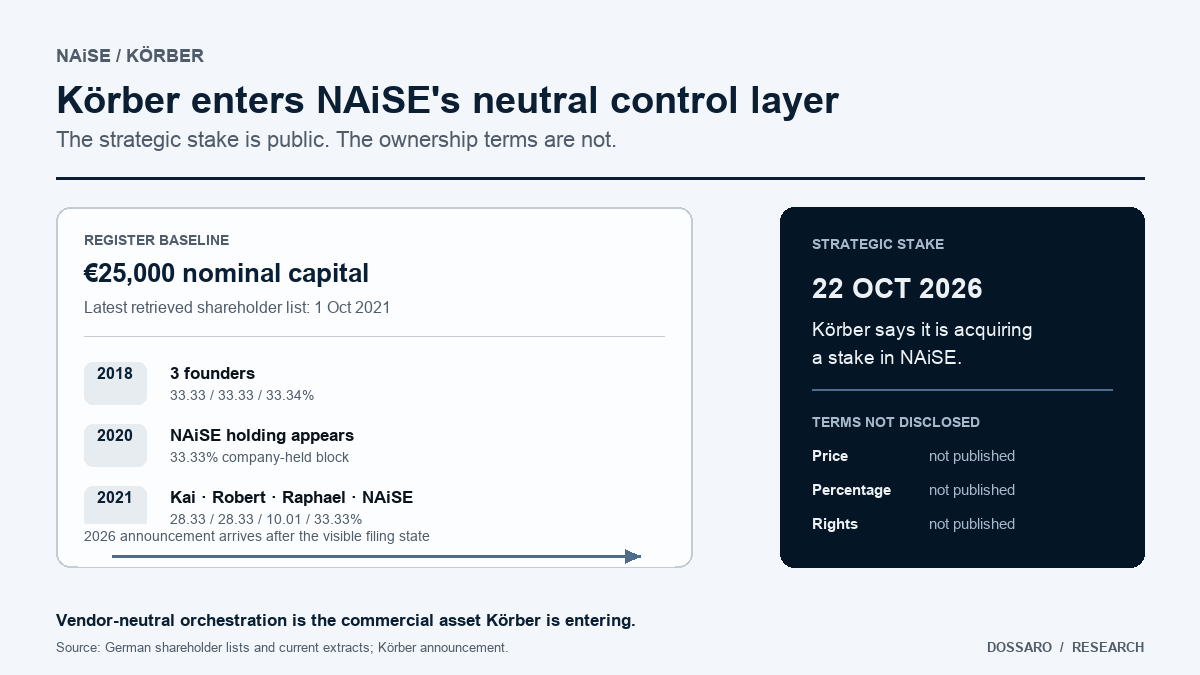
Körber’s investment in NAiSE gives a vendor-neutral robot-control platform a major industrial channel at the moment when fleet orchestration is becoming a strategic layer in warehouse automation. The 22 October announcement says Körber is acquiring a stake, but it does not publish a price or percentage. The latest register evidence reviewed for NAiSE still ends with a 1 October 2021 shareholder list and a €25,000 nominal capital state.
That gap is not a contradiction. It is the commercial question. Körber can add distribution, integration and warehouse expertise without the public record yet showing the legal instrument or the size of the stake. For NAiSE, neutrality is the asset that makes the partnership valuable. The terms of that neutrality will matter more than a headline percentage.
The deal adds industrial reach to a control layer above individual robots
Körber’s announcement describes NAiSE as a Germany-based software company founded in 2017. Its fleet-management software connects automated guided vehicles, autonomous mobile robots and manual trucks from different manufacturers. Körber says the partnership will deepen integrations with its warehouse products and extend use cases to areas including humanoid robotics. The announcement also says NAiSE will remain open to additional system integrators and vehicle manufacturers, while operational management remains with the founding team.
The business logic is straightforward. A warehouse operator does not want every vehicle fleet to become a separate software island. A vendor-agnostic orchestration layer can coordinate mixed fleets and connect them to warehouse-management and execution systems. That makes the control layer a potential source of switching costs and deployment data even when the underlying vehicles come from many suppliers.
Independent coverage keeps the financial terms bounded. MEKAWIRE reports that the price and stake were undisclosed, while describing NAiSE as self-funded and connected to more than 28 AGV and AMR brands. EUVC’s account likewise calls the transaction an undisclosed strategic investment and identifies interoperability as the commercial mechanism.
The announcement therefore establishes a strategic relationship, not a public cap-table outcome. Körber brings a warehouse platform and customer network. NAiSE brings a control layer whose value depends on being trusted by more than one equipment ecosystem.
The register shows a 2021 ownership state, not the 2026 deal terms
The German shareholder lists provide a useful baseline. They show how the nominal €25,000 capital was allocated before the Körber announcement, but they do not price the new investment or establish its post-closing ownership percentage.
| Register state | Shareholder evidence | What it establishes |
|---|---|---|
| 5 Dec 2018 | Jens Heinrich 33.33%, Kai Przybysz-Herz 33.33%, Robert Libert 33.34% | Three founder-level holders after the move from Darmstadt to Stuttgart |
| 17 Sep 2020 | Jens’s 8,333 shares were cancelled; NAiSE held 8,333 shares, with Kai at 33.33% and Robert at 33.34% | A treasury-like company holding appeared without changing the €25,000 capital |
| 1 Oct 2021 | Kai 7,083 shares (28.33%), Robert 7,083 (28.33%), Raphael Kusumoto Barbosa de Almeida 2,501 (10.01%), NAiSE 8,333 (33.33%) | The last retrieved shareholder list and the visible 2021 ownership reset |
| Current extract retrieved 24 Oct 2026 | €25,000 capital; Kai and Robert listed as managing directors; last entry dated 1 Oct 2021 | The current extract does not itself show a post-2021 shareholder filing |
The 2020 list describes NAiSE’s 8,333 shares as newly formed after Jens’s shares were withdrawn. The 2021 list records transfers that reduced Kai and Robert to 28.33% each and allocated 10.01% to Raphael. It also continues to show NAiSE as holder of 8,333 shares. Those are legal-register facts, not a complete account of economic control or the rights attached to any later instrument.
The most precise current statement is therefore: no post-announcement ownership document was retrieved in the register evidence reviewed. That is narrower than saying Körber owns no shares, that the founders retain a majority, or that the company’s 2021 state remains its economic ownership today.
Why neutrality is the asset at stake
NAiSE’s commercial proposition depends on being useful above the vehicle layer. If the software can coordinate different brands, a system integrator can deploy it without conceding the whole control stack to one vehicle maker. Körber’s announcement reinforces that positioning by saying the company remains open to other integrators and manufacturers.
But a strategic investor can influence a business without needing an outright majority. It can add channel access, integration priorities, reference customers, hiring capacity or a path into a broader warehouse suite. Those benefits can be positive for every customer while still creating a governance question: which roadmap decisions remain open when the investor is also a major platform partner?
This is why the missing price and percentage matter less than the missing rights. A minority stake with board or consent rights can shape a product differently from a passive secondary purchase. A primary subscription can fund expansion differently from a purchase of existing shares. A convertible or another instrument may defer the ownership change. None of those possibilities should be selected from the announcement alone.
The issue is commercially familiar in private-company research. Reflex Aerospace’s NVIDIA-linked financing story shows why a named strategic relationship does not automatically reveal a post-event cap table. The relevant diligence question is the mechanism connecting the public partnership to legal ownership and governance.
The current extract narrows the filing question, but not the transaction
The current extract retrieved on 24 October 2026 shows four historical register entries and retains the €25,000 nominal capital. It lists Kai Przybysz-Herz and Robert Libert as managing directors. The chronological extract records the 2018 seat move to Stuttgart, the 2019 constitutional changes, the 2021 address update and the 1 October 2021 personal-data update. Neither extract supplies a price or a Körber stake percentage.
The result should be read as a filing boundary, not a negative finding. A strategic stake can close after the latest shareholder list, sit in a document that has not yet been retrieved, or use a structure that does not immediately alter the nominal capital. A secondary purchase can also leave the company’s capital amount unchanged. The public evidence does not distinguish these cases.
The management language is similarly layered. Körber says operational management remains with the founding team of Kai, Robert and Raphael. The current register extract names Kai and Robert as managing directors. The two statements can coexist because “founding team” is a broader operational description than the statutory director line, but they should not be collapsed into a claim that all three hold the same legal office.
The next document should connect the stake to rights and economics
For customers, integrators and future investors, the next useful evidence is not another generic announcement. It is the first post-22 October shareholder list, capital statement or transaction document that identifies the investor, the issuer and the rights attached to the investment. A board appointment, reserved-matters schedule or commercial exclusivity clause could be equally important even if the ownership percentage is small.
The near-term economic test is whether Körber’s reach expands NAiSE’s neutral control layer without narrowing the set of equipment and integration partners it can serve. If the company can add Körber’s warehouse channel while preserving the openness stated in the announcement, the stake may strengthen the platform’s network effect. If the partnership makes the roadmap effectively dependent on one ecosystem, the same stake could change what vendor-neutral means in practice.
The public record supports the positive finding that NAiSE has gained an industrial partner with a route into warehouse customers and product integrations. It does not yet support a valuation, a control claim or a precise post-deal cap table. The commercial value of the transaction will be visible in the rights and follow-on filings that connect the Körber announcement to the register state.
Continue reading
Related Research
Reflex Aerospace's Planned NVIDIA Investment Has Not Yet Reset Its Filed Cap Table
Reflex Aerospace announced a planned NVIDIA minority investment, yet its latest filed list still shows Alpine at 47.43% and Ballheimer at 30.75%.
Cognitive Credit’s $40m Growth Investment Sits Beside a New HSBC Security Layer
Cognitive Credit announced a $40m Summit-led investment, while filings show 876 new shares and an outstanding HSBC security over its IP and business.
Matter Machine's £4m Round Changed Founder Control At Launch
Matter Machine's £4m pre-Series A took a one-share founder company to 808,300 shares, cut the founder's PSC band and installed institutional governance.
StrollMe’s €22m Raise Finances a Fleet, Not Just a Valuation
StrollMe raised €22m in equity and debt. Its filings and customer terms put the key question on fleet, receivables and risk allocation, not valuation.