
Fractile’s £577m Series C Arrived After Its Oxford-Linked PSC Ceased
Fractile’s £577m Series C created 19.2% of its shares after Oxford Science Enterprises left the PSC record, leaving the new control position undisclosed.
On this page
Conduct your own private market research
Add dossaro to Claude or ChatGPT and run source-backed register research from your own workspace.
 Add to Claude
 Add to ChatGPT
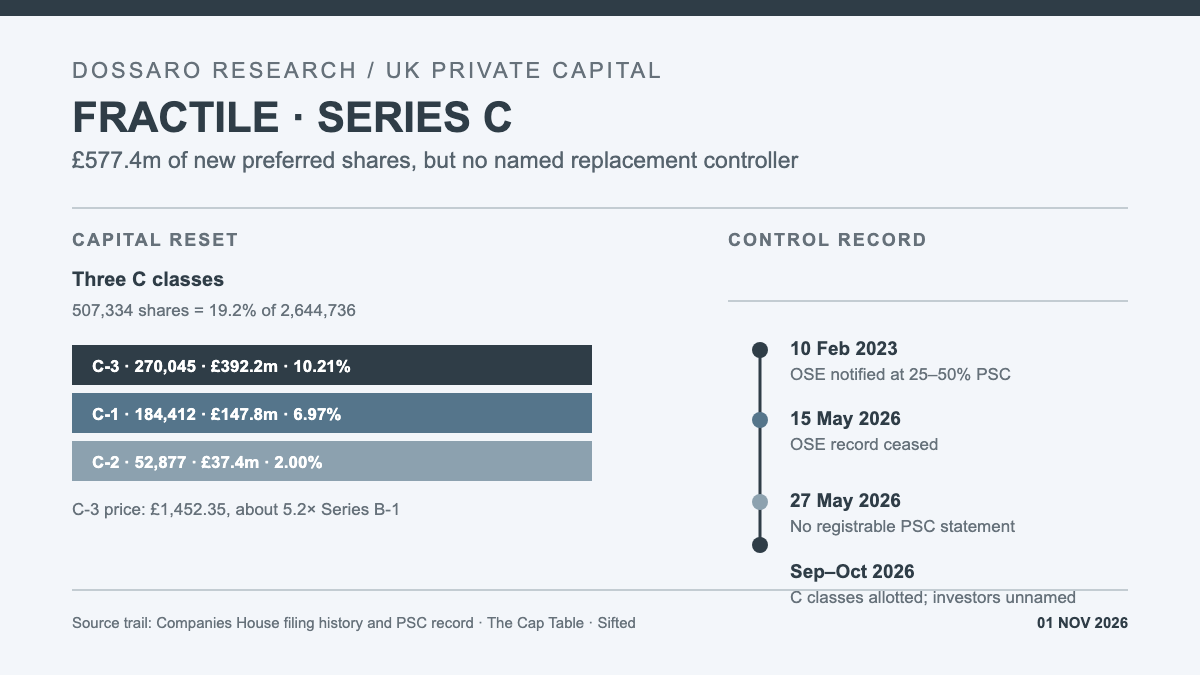
Fractile’s Series C is public as a £577.4m financing, but the more consequential change in the register came before the new preferred shares were allotted. Oxford Science Enterprises’ former 25–50% control record ended in May 2026, and Fractile then filed that it knew of no registrable person or entity with significant control. The nine Series C allotments that followed created 507,334 shares, or 19.2% of the final issued total, without naming the investors who now sit behind those rights.
That leaves a financing in which price, capital and control visibility move on different tracks. The public filings show three new preferred classes, three materially different issue prices and a large dilution event for the existing share base. They do not show who replaced the old visible control position, whether any investor crossed a reporting threshold, or whether the new classes carry negotiated rights that are not reflected in a PSC notice.
The Companies House filing history records the allotments and the 12 October resolutions that created Series C-1, C-2 and C-3. Independent coverage from The Cap Table and Sifted supplies the public funding context. The control conclusion comes from the separate PSC record, not from an assumption that an unnamed Series C investor is now the controller.
The round created three price tiers
The allotment statements describe new shares issued between 9 September and 23 October 2026. They state that no shares were allotted otherwise than for cash and that no amount remained unpaid. That is the legal treatment in the forms. It does not, on its own, prove that every pound in the aggregate was fresh cash rather than a conversion or other transaction reflected through the filing language.
| Series C class | Shares allotted | Filed price per share | Filed amount | Share of final issued shares |
|---|---|---|---|---|
| C-1 preferred | 184,412 | £801.54 | £147.8m | 6.97% |
| C-2 preferred | 52,877 | £707.25 | £37.4m | 2.00% |
| C-3 preferred | 270,045 | £1,452.35 | £392.2m | 10.21% |
| Series C total | 507,334 | n/a | £577.4m | 19.18% |
The arithmetic matters because the C-3 price is not merely a rounded version of the other two. At £1,452.35, it is about 5.2 times the £278.37 price reported for the Series B-1 allotment five months earlier. C-1 was priced at roughly 55% of C-3, and C-2 at roughly 49%. Those differences may reflect class rights, investor timing, conversions or staged closings. The filings do not identify the allottees or explain the commercial reason for the tiers, so the article cannot turn the price ladder into a ranking of investor conviction.
The final issued share count in the latest reviewed allotment state was 2,644,736. The three Series C classes therefore account for 19.18% of the simple issued-share count. That is a dilution calculation, not a fully diluted ownership percentage. Options and any further allotments could change the denominator, while the preferred rights may change the economic value of each share.
This is the same distinction visible in Epoch Blue’s preferred-share stack, where the legal classes and filed amounts add precision to a public funding announcement without revealing every investor’s final economic position. In Fractile’s case, the scale of the issue makes the distinction harder to ignore: more than one in five issued shares in the final state belongs to the new C classes.
The old visible control record ended first
Fractile Ltd, company number 14143636, is an active UK private company incorporated on 31 May 2022. Its PSC history shows Dr Yuhang Song notified on 31 May 2022 with more than 25% but not more than 50% of shares and votes, plus the right to appoint or remove directors. Song ceased to be recorded on 3 June 2024.
Oxford Science Enterprises Plc was then notified on 10 February 2023 with more than 25% but not more than 50% of shares and votes. Companies House records OSE as ceased on 15 May 2026. On 27 May 2026, Fractile filed an active statement saying it knew or had reasonable cause to believe that there was no registrable person or registrable relevant legal entity in relation to the company.
The sequence is more important than any single line. The former corporate PSC ended before the Series C classes were created, and the no-significant-control statement was already active before the nine allotment statements were filed. The public register therefore moves from a named Oxford-linked control record to no registrable controller, then to a much larger preferred-share base whose investors remain unnamed in the reviewed state.
The statement does not prove that Fractile has no controller. A person or entity can sit below the relevant reporting threshold, hold rights through arrangements that do not trigger a PSC filing, or become reportable only after a later filing. The correct conclusion is narrower: the register no longer identifies a named controller at the time the Series C financing was being built.
A larger capital base does not answer the control question
The Cap Table counted £577.4m of Series C allotments and reported a 5.2x step-up from Series B. Sifted reported a roughly £540m round from an earlier filing count. The difference is a useful reminder that the total depends on which allotment statements and tranches are included. The reviewed Companies House sequence supports the higher £577.4m arithmetic across C-1, C-2 and C-3.
The filings also show ordinary shares rising from 439,427 to 447,427 and B-1 shares rising from 644,432 to 645,104 between the June pre-C state and the final reviewed state. The total share increase is therefore not identical to the Series C count. That does not change the core dilution calculation, but it prevents a false claim that every new share in the company was a C share.
The new financing arrives as Fractile moves from chip design toward volume supply. The company’s hardware programme needs engineering, testing, manufacturing partners and working capital before commercial shipments can generate operating returns. A large preferred round can fund that transition while giving investors downside protection or consent rights. The public register cannot tell us which rights were negotiated, how the investors are allocated across the three classes, or whether any one of them can direct the board.
That gap matters commercially. Existing ordinary and earlier preferred holders can see the issued-share denominator expand by 19.2%, but they cannot see the identity of the parties receiving the new capital or the governance position those parties negotiated. The company’s control surface is therefore less legible precisely when the financing scale is becoming more consequential.
The control gap is not proof of a hidden owner
There is a benign reading of the sequence. OSE may have fallen below the PSC threshold, transferred an interest without becoming a registrable controller, or retained contractual rights outside the PSC form. The three Series C prices may reflect different rights or closing dates rather than a hidden bargain between favoured and unfavoured investors. The absence of a current PSC is not evidence that no person or entity exercises practical influence.
That counter-reading is why the claim stops at control visibility. It is supportable to say that OSE’s PSC record ceased, that the company filed a no-significant-control statement, and that 507,334 Series C shares were allotted across three classes. It is not supportable to say that OSE sold its shares, that a particular fund now controls Fractile, or that the new investors are all fresh-money subscribers.
The pattern is also different from a planned strategic investment that has not yet closed. In Reflex Aerospace’s NVIDIA story, the announced investment remained prospective in the latest filed state. Fractile is the opposite problem: the capital issuance is visible, but the identity and control consequences behind it are not.
The next filing should identify the economic winners
The next decision-changing record is a confirmation statement or shareholder list that names the Series C holders. It should show whether the three price tiers map to different funds, whether any investor holds a reportable block, and whether OSE or another former holder remains economically present through a different vehicle. Updated articles or resolutions could clarify voting, liquidation and consent rights, while future SH01 filings may add further C tranches.
Until then, Fractile’s Series C is best understood as a price-tiered capital reset with an unresolved control outcome. The public record proves a £577.4m aggregate across three preferred classes and a 19.2% increase in the simple issued-share base. It also proves that the last named 25–50% corporate PSC disappeared before the financing was filed. What it does not yet prove is who now has the power to decide how that capital is deployed.
Sources
Continue reading
Related Research
Epoch's $4.25m Seed Came With 670,087 Preferred Shares
Epoch's $4.25m seed sits beside 670,087 preferred shares, $6.26m of filed paid-in amounts, a Burnt Island board appointment and a June issue window.
XRlabs Added Seed-2 Preference Rights While Its Founder Kept Statutory Control
XRlabs raised an $8.4m Playground-led seed while filings show 621,130 Seed-2 shares and a founder still above 50% with majority board rights.
Reflex Aerospace's Planned NVIDIA Investment Has Not Yet Reset Its Filed Cap Table
Reflex Aerospace announced a planned NVIDIA minority investment, yet its latest filed list still shows Alpine at 47.43% and Ballheimer at 30.75%.
Wexler's Founders Held 54%, But £4.66m Ranked First
Legora bought a Wexler that was 54% founder-owned on its last visible share count, but £4.66m of seed preference ranked ahead of ordinary shares.