
CVC DIF Takes firstcolo Majority as Frankfurt Power Becomes the Asset
CVC DIF agreed to buy a significant firstcolo majority from CUBE, keeping founders in place while a 24 MW FRA7 build anchors the next growth phase.
On this page
Conduct your own private market research
Add dossaro to Claude or ChatGPT and run source-backed register research from your own workspace.
 Add to Claude
 Add to ChatGPT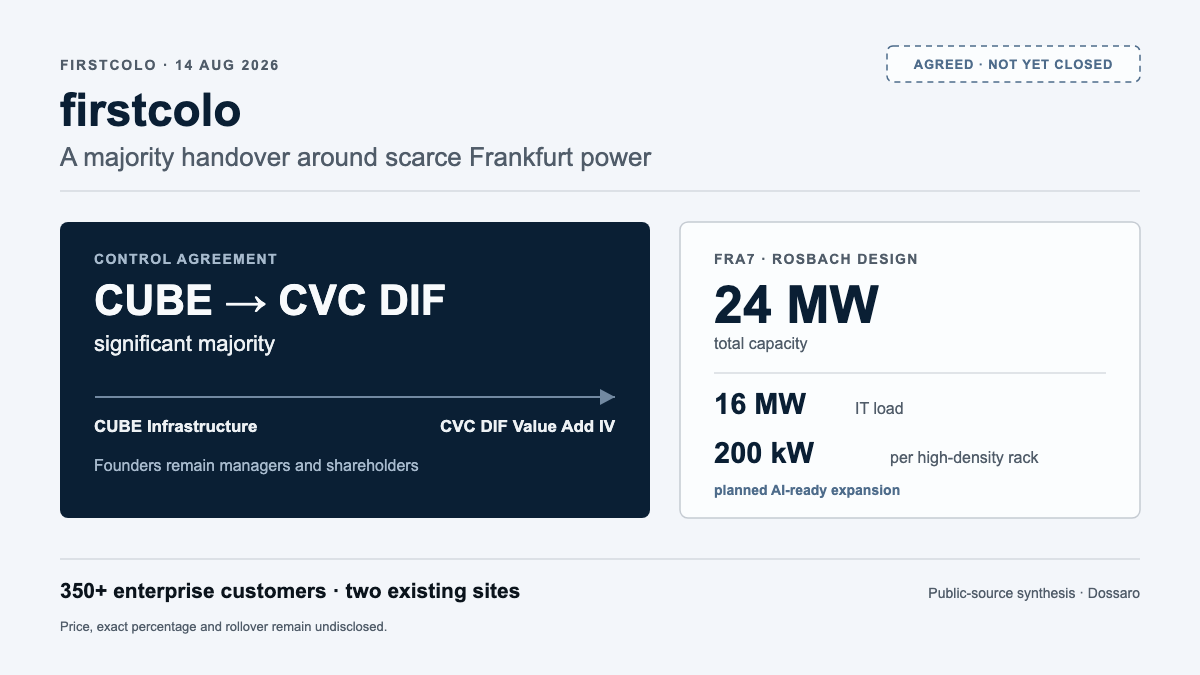
firstcolo's 14 August agreement is a control handover around scarce Frankfurt power, not a disclosed-price exit. CVC DIF Value Add IV has agreed to acquire a significant majority of the data-centre operator from CUBE Infrastructure. The founders remain in management and retain an equity interest, while the project that makes the platform strategically valuable is still being built.
The public record is unusually clear about the industrial asset and unusually quiet about the transaction economics. firstcolo and CUBE name the buyer, seller, fund vehicle and expected closing window. They do not state consideration, the exact percentage sold, any shareholder rollover or the rights that will govern the post-close company. Latham's 17 August deal notice independently confirms the significant-majority agreement and the expected end-September closing, subject to customary conditions.
| Publicly established | What it means | Still unresolved |
|---|---|---|
| CVC DIF Value Add IV agreed to acquire a significant majority from CUBE | CVC DIF is the announced incoming controlling investor | Exact percentage, consideration and closing status |
| Jerome Evans and Nicolaj Kamensek remain managers and retain equity | Founder continuity is part of the announced operating plan | Rollover size, voting rights and dilution |
| FRA7 is designed for up to 24 MW total capacity and 16 MW IT load | The deal is tied to a permitted, power-intensive expansion platform | Construction spend, financing terms and utilisation |
| CUBE reports nearly doubled adjusted EBITDA and 24 MW of secured power | The seller describes an operating and power-position value-creation case | Audited results, exit proceeds and investor return |
FRA7 turns a majority sale into a power-and-permits bet
firstcolo's announcement describes FRA7 in Rosbach vor der Höhe as the first step in a scalable German high-performance data-centre platform. The facility is designed for up to 24 MW of total capacity, equivalent to up to 16 MW of IT load. Liquid-cooled high-density racks are specified at up to 200 kW per rack, with a target power-usage effectiveness ratio below 1.2.
Those are design parameters, not a forecast of revenue. They do, however, explain the commercial consequence of the ownership change. A data-centre buyer is not only buying today's colocation contracts. It is buying a path through the hardest constraints in the market: site, power, permits, construction delivery and the ability to fill the resulting capacity with credible customers.
firstcolo says the site, power supply, permits and turnkey delivery model have already been secured. It also names a partnership with regional energy provider OVAG, which is intended to secure supply and enable data-centre waste heat to be used in district-heating networks. The company says the platform serves more than 350 customers across two existing regional facilities, alongside cloud, connectivity and managed services.
CUBE's own sale announcement supplies the seller's version of that value-creation story. It says CUBE secured 24 MW of power in a highly constrained Frankfurt market, established a regional-utility partnership and prepared FRA7 for construction and commercialisation. It also says adjusted EBITDA nearly doubled during CUBE's ownership. That is an important source-attributed result, but it is not a substitute for audited accounts or a disclosed exit multiple.
CUBE's four-year hold explains the handover, not the return
CUBE agreed to acquire firstcolo in October 2022 from funds advised by EMERAM Capital Partners and its portfolio company diva-e. The 2022 announcement said financial details were not disclosed. It described firstcolo as a Frankfurt business founded in 2007, with two Tier III+ data centres and services spanning colocation, dedicated servers, managed services and private cloud.
The same announcement recorded a founder continuity arrangement. Jerome Evans and Nicolaj Kamensek would remain shareholders and continue to lead the company. The 2026 announcement repeats the operational pattern: both founders remain active managers and retain an equity interest, with CFO Dennis Bergfeld and the existing management team staying on.
That continuity is economically meaningful but not numerically complete. It says the founders are not being presented as fully cashed out. It does not reveal whether their percentage is unchanged, whether they rolled part of a prior holding, or whether CVC DIF has rights that make the majority materially stronger than the headline suggests. The phrase “significant majority” establishes control at a high level, not the cap table.
The timeline also matters for the seller. CUBE calls the transaction its first data-centre exit and the first exit for Cube Infrastructure Fund III. Its account of nearly doubled adjusted EBITDA and newly secured power suggests an investment period focused on operational scale and development readiness. The public releases still give no exit price, proceeds allocation or fund-level return. A successful platform build can be inferred as the seller's stated objective; a successful financial outcome cannot.
The missing percentage is the central evidence gap
The announcements answer who is expected to control firstcolo after closing, but leave four decision-relevant questions open.
First, what does “significant majority” mean in issued shares and votes? A majority can range from a narrow control position to an overwhelming one, with very different minority protections and future funding consequences. Second, what consideration did CVC DIF agree to pay? Without price, no one can calculate an enterprise-value-to-EBITDA multiple or compare the sale with other European colocation exits.
Third, what did the founders retain? The phrase “retain an equity interest” could describe a meaningful rollover or a small continuing stake. The sources do not say. Fourth, when will the legal transfer be visible? firstcolo, CUBE and Latham all say closing is expected by the end of September 2026 subject to customary conditions. Until a post-close shareholder filing or equivalent confirmation appears, the agreement remains a pending transaction.
This is why the deal should not be described as a completed sale or as proof that CUBE fully exited. CUBE says it agreed to sell its stake, while firstcolo says CUBE is the seller of the significant majority. Neither source gives a post-close register state. The next filing for Frankfurt HRB 113867 is therefore more valuable than another repetition of the press release: it could show the ownership percentage, founder rollover and any new security or capital change around FRA7.
What the buyer is actually underwriting
The disclosed facts point to an infrastructure underwriting case with three layers. The first is a recurring operating base of more than 350 enterprise customers across two near-fully-utilised sites. The second is a development option in a power-constrained Frankfurt market, where site, permits and 24 MW of planned capacity are already described as secured. The third is execution risk: construction, customer ramp, liquid cooling, grid performance and the commercial use of waste heat still have to work in practice.
CVC DIF's stated role is to support delivery of FRA7 and further expansion in Germany. That makes the transaction's commercial consequence visible even without a price. Control is being placed with a fund that can finance and govern a build-out, while the founders keep the technical and customer relationships that the releases present as part of firstcolo's edge. The arrangement aligns capital and operating continuity, but the financial split remains private.
For readers tracking private infrastructure, that distinction is the useful result. The public evidence supports a pending majority transfer around a scarce, AI-ready data-centre platform. It does not support an exit multiple, a founder payout, a dilution number or a claim that FRA7 is already producing cash flow. Those conclusions must wait for the transaction documents and the next shareholder record.
The same perimeter question appears in Deutsche Telekom's planned purchase of both halves of Poland's Fiberhost split: an infrastructure headline becomes useful only after the legal owner, operating asset and transaction boundary are separated.
Continue reading
Related Research
Deutsche Telekom Agreed to Buy Both Halves of Poland's Fiberhost Split
Deutsche Telekom agreed to buy Fiberhost's open-access network and INEA's retail business, reunited after a 2021 split under one Polish holding chain.
Athora's German Strategy Reversed From A €19bn Expansion To A €3.5bn Sale
Athora agreed to sell its €3.5bn German platform after abandoning a €19bn AXA expansion, reversing a strategy that would have added 900,000 policies.
EQT Bought Coller's Manager and Carry Rights, Not Its Fund Assets
EQT's $3.2bn Coller deal buys management and GP entities plus carry rights, while Companies House shows the UK operating manager rather than fund assets.
Campagnolo Opens Its First Outside Stake While the Family Keeps Control
Campagnolo announced that SPAC SA will acquire a minority stake while the family keeps control; price, size and primary funding effect remain undisclosed.