
Campagnolo Opens Its First Outside Stake While the Family Keeps Control
Campagnolo announced that SPAC SA will acquire a minority stake while the family keeps control; price, size and primary funding effect remain undisclosed.
On this page
Conduct your own private market research
Add dossaro to Claude or ChatGPT and run source-backed register research from your own workspace.
 Add to Claude
 Add to ChatGPT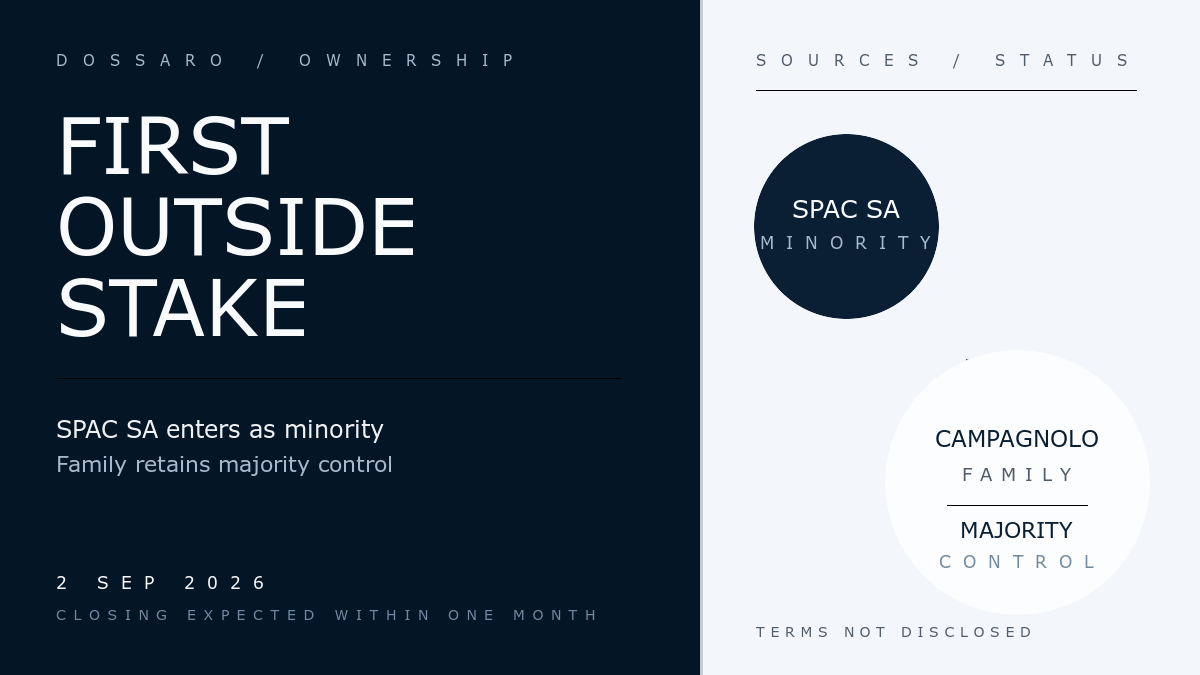
Campagnolo has announced an agreement for SPAC SA to acquire a minority stake from an existing quotaholder while the Campagnolo family remains the majority shareholder and keeps control. The statement makes the ownership opening clear. It does not make the economics clear: the stake size, price, rights and destination of any new money are not disclosed.
That distinction matters because the wording describes an agreement with an existing shareholder rather than a plainly stated capital increase. SPAC could be buying an existing interest, subscribing for new shares, or combining a transfer with primary capital. Each structure allocates cash and dilution differently. Until closing documents appear, the defensible reading is a pending, control-preserving entry by an outside investor, not a measured valuation or financing result.
A minority acquisition, still awaiting closing
Campagnolo's 2 September 2026 statement says SPAC SA will acquire a minority stake “through a strategic investment” after signing an investment agreement with the company's existing quotaholder. Completion is expected within the following month and remains subject to customary conditions precedent. The sources reviewed for this article do not show a closing confirmation as of 15 September.
The transaction is therefore an announced agreement, not a completed sale. That status is more than a legal footnote. A closing condition can cover approvals, documentation or other requirements, and the share transfer may not yet be visible in the Italian register. The announcement tells commercial partners that a new investor is expected. It does not yet show the post-closing cap table.
The public statement also calls the partnership an important step in Campagnolo's evolution and says it will bring additional resources and strategic expertise. Those are the company's stated benefits. They do not identify the instrument, the cash recipient or whether the purchase price is paid to the company, the existing shareholder or both.
A buyer with a cycling portfolio, not a proven ownership chain
SPAC SA is described as a Swiss private investment holding company based in Zurich. Campagnolo and the independent reports say it has other investments in cycling, including Pinarello. Cyclingnews and Cycling Weekly discuss links to Ivan Glasenberg, who is reported to have interests in Pinarello and the Q36.5 apparel brand and team.
Those links are useful context for why a cycling investor might see strategic value in a component maker. They are not a substitute for an ownership document. Cyclingnews reports that Campagnolo's group head of product and marketing, Federico Gardin, would not comment on the individual shareholders behind SPAC. This article therefore names the reported connection but does not present Glasenberg as a proven beneficial owner of SPAC SA or as Campagnolo's controller.
The company also says it will continue to operate entirely independently from SPAC's other cycling investments, including Pinarello. It says relationships with bicycle manufacturers and commercial partners will remain independent. That qualifier is central to the announcement: a common investor does not, on the disclosed facts, turn Campagnolo into a Pinarello subsidiary or make the two brands a single operating business.
Family control survives, but the economic split is invisible
The statement says the Campagnolo family will remain the majority shareholder and retain control. It describes a family-owned entrepreneurial legacy that began when Tullio Campagnolo founded the business in Vicenza in 1933. Independent coverage confirms that the minority position is the first outside stakeholder described in the public account.
The control message is clear, but “minority” covers a wide range of outcomes. A 1% holding, a 49% holding and a holding with strong veto rights can all be described that way while producing very different economics. The sources disclose none of the percentage, share class, voting arrangement, board rights, liquidation preference or future funding obligation.
Campagnolo's company data page identifies Campagnolo S.r.l. in Vicenza, with public number 01270200247, REA VI156588 and €15.6 million of nominal paid-in capital. It currently labels the entity as a single-shareholder company. That is useful legal-identity and capital context, but it should not be read as the post-closing shareholder list while the announced transaction is still within its expected closing window. Nominal capital is not a valuation, and it does not reveal what SPAC has agreed to pay.
This is the opposite of a measured register event such as SOWITEC's disclosed minority split, where named holders and percentages could be stated. For Campagnolo, the public evidence supports the direction of the ownership change but not its size or priority.
Why the transaction wording matters
An agreement with an existing quotaholder leaves three commercial structures open.
| What is established | What the wording could mean | What remains unproven |
|---|---|---|
| SPAC SA is expected to acquire a minority position | A transfer from an existing holder, a subscription for new shares, or a blended deal | The percentage, price and identity of the selling or issuing entity |
| The family remains the majority and keeps control | The family may sell part of its holding while retaining a controlling block | Whether the family receives proceeds, contributes capital or both |
| Campagnolo cites additional resources and expertise | The company may receive primary funding or strategic support alongside a transfer | The amount of cash reaching Campagnolo and its use in the operating business |
| Closing is expected within a month and is conditional | The announced position may not yet be legally effective | Closing date, share class, governance rights and any new filing |
A secondary purchase would change who owns part of Campagnolo without sending the purchase price to the operating company. A primary issue would send cash into the company and dilute existing holders. A blended structure could fund the business and pay a seller. The announcement's language is compatible with all three, so it would be inaccurate to call the event a €15.6 million recapitalisation, a cash injection of a specified amount or a family exit.
Resources aimed at a product and channel reset
Campagnolo's stated use of the partnership is operational rather than purely financial. The company says technology, electronics and connectivity are reshaping the component market. It points to the wireless Super Record 12V launched in 2023, the redesigned Super Record 13V in 2025 and the new Record in 2026 as steps in that transition.
The next priorities named in the statement are stronger technology and product capabilities, a more agile organisation, closer relationships with bicycle manufacturers and commercial partners, modernised operations and continued development of the Campagnolo and Fulcrum brands. The company also wants a stronger connection with elite and professional racing.
Cycling Weekly describes the strategic context as a brand trying to regain ground against Shimano and SRAM after years of declining visibility in the groupset market. That reporting supplies a commercial reason for seeking an outside partner, but it does not turn the announcement into a quantified turnaround plan. Campagnolo has not disclosed an investment budget, sales target or timetable for any racing return.
The strategic rationale can therefore be stated at the level the sources support: SPAC is expected to add resources and expertise while the family retains control, and Campagnolo intends to direct that support toward products, operations, commercial relationships and professional racing. The financial split behind those plans remains unknown.
What a closing filing would settle
The next document that could change this analysis is a post-closing Italian shareholder filing or deed. It should show whether SPAC's position came from a transfer, a new issue or both, and it could establish the percentage, consideration, share class and governance rights. A closing notice would settle timing but might still leave the capital flow private. Updated accounts could show whether Campagnolo's cash, share capital or liabilities changed.
Until that evidence appears, Campagnolo's announcement is best read as a controlled opening of a family-held company to outside capital. SPAC SA is the announced minority partner. The family is the announced continuing controller. The public record does not show who receives the purchase price, how much cash reaches the business or what rights accompany the new position.
That boundary is commercially useful. Suppliers, OEM customers and prospective investors can treat the partnership as a signal of strategic investment in Campagnolo's next product cycle, while recognising that the transaction has not yet supplied a price, a dilution calculation or a verified beneficial-owner chain. The next Italian filing, not another repetition of the press release, will determine whether the opening was mainly a transfer of ownership, a financing for the operating company or both.
Continue reading
Related Research
Frank Hummel and Vestas Were SOWITEC's Last Visible Owners
The latest visible SOWITEC owner list showed Frank Hummel at 74.91% and Vestas' vehicle at 25.09% when four core group companies entered insolvency.
Ground A's €9.1m pre-seed leaves each founder at 22.75%
Ground A's €9.1m pre-seed created 31.75% of new shares, leaving each founder vehicle at 22.75% and Vsquared Ventures III at 14.17% in the latest register.
Enpulsion's Lift Me Off Deal Exposes A Funding-Dependent Handover
Enpulsion's Lift Me Off deal coincided with a founder exit, buyer-side appointment and accounts warning that funding and sale completion still mattered.
CVC DIF Takes firstcolo Majority as Frankfurt Power Becomes the Asset
CVC DIF agreed to buy a significant firstcolo majority from CUBE, keeping founders in place while a 24 MW FRA7 build anchors the next growth phase.